
UNITED STATES SECURITIES AND EXCHANGE COMMISSION
Washington, D.C. 20549
Form
ANNUAL REPORT PURSUANT TO SECTION 13 OR 15(d) OF THE SECURITIES EXCHANGE ACT OF 1934 |
For the fiscal year ended
or
TRANSITION REPORT PURSUANT TO SECTION 13 OR 15(d) OF THE SECURITIES EXCHANGE ACT OF 1934 |
For the transition period from to
Commission file number
(Exact name of registrant as specified in its charter)
(State or other jurisdiction of incorporation or organization) | | (I.R.S. Employer Identification No.) |
(Address of principal executive offices) | (Zip Code) |
Registrant’s telephone number, including area code (
Securities registered pursuant to Section 12(b) of the Act:
Title of Each Class |
| Trading Symbol |
| Name of Each Exchange on Which registered: |
|
|
Securities registered pursuant to Section 12(g) of the Act:
None
Indicate by check mark if the registrant is a well-known seasoned issuer, as defined in Rule 405 of the Securities Act.
Indicate by check mark if the registrant is not required to file reports pursuant to Section 13 or Section 15(d) of the Act. Yes ◻
Indicate by check mark whether the registrant (1) has filed all reports required to be filed by Section 13 or 15(d) of the Securities Exchange Act of 1934 during the preceding 12 months (or for such shorter period that the registrant was required to file such reports), and (2) has been subject to such filing requirements for the past 90 days.
Indicate by check mark whether the registrant has submitted electronically every Interactive Data File required to be submitted pursuant to Rule 405 of Regulation S-T during the preceding 12 months (or for such shorter period that the registrant was required to submit such files).
Indicate by check mark whether the registrant is a large accelerated filer, an accelerated filer, a non-accelerated filer, a smaller reporting company, or an emerging growth company. See the definitions of “large accelerated filer,” “accelerated filer”, “smaller reporting company” and “emerging growth company” in Rule 12b-2 of the Exchange Act.
| Accelerated Filer ◻ | | Non-accelerated Filer ◻ | | Smaller Reporting Company | Emerging Growth Company |
If an emerging growth company, indicate by check mark if the registrant has elected not to use the extended transition period for complying with any new or revised financial accounting standards provided pursuant to Section 13(a) of the Exchange Act. ◻
Indicate by check mark whether the registrant has filed a report on and attestation to its management’s assessment of the effectiveness of its internal control over financial reporting under Section 404(b) of the Sarbanes-Oxley Act (15 U.S.C. 7262(b)) by the registered public accounting firm that prepared or issued its audit report.
If securities are registered pursuant to Section 12(b) of the Act, indicate by check mark whether the financial statements of the registrant included in the filing reflect the correction of an error to previously issued financial statements
Indicate by check mark whether any of those error corrections are restatements that require a recovery analysis of incentive-based compensation received by any of the registrant’s executive officers during the relevant recovery period pursuant to Section 240.10D-1(b). ◻
Indicate by check mark whether the registrant is a shell company (as defined in Rule 12b-2 of the Exchange Act). Yes
The aggregate market value (approximate) of the registrant’s common equity held by non-affiliates based on the closing price of a share of the registrant’s common stock for Nasdaq Global Select Market composite transactions on December 26, 2025 (the last business day of the registrant’s most recently completed second fiscal quarter) was $
As of August 7, 2026, the total number of shares outstanding of the registrant’s Common Stock was
DOCUMENTS INCORPORATED BY REFERENCE
Portions of the registrant’s definitive proxy statement (to be filed pursuant to Reg. 14A) relating to the Annual Meeting of Shareholders anticipated to be held on November 20, 2026, are incorporated herein by reference in Part III of this Report.
TABLE OF CONTENTS
2
PART I
Item 1. Business
Avnet, Inc. and its consolidated subsidiaries (collectively, the “Company” or “Avnet”), is a leading global electronic component technology distributor and solutions provider that has served customers’ evolving needs for more than a century. Founded in 1921, the Company works with electronic component manufacturers (suppliers) in every major electronic component segment to serve customers in more than 140 countries.
Avnet serves a wide range of customers: from startups and mid-sized businesses to enterprise-level original equipment manufacturers (“OEMs”), electronic manufacturing services (“EMS”) providers, and original design manufacturers (“ODMs”).
Organizational Structure
Avnet has two primary operating groups — Electronic Components (“EC”) and Farnell (“Farnell”). Both operating groups have operations in each of the three major economic regions of the world: (i) the Americas, (ii) Europe, Middle East, and Africa (“EMEA”) and (iii) Asia/Pacific (“Asia”). Each operating group has its own management team, who manage various functions within each operating group. Each operating group also has distinct financial reporting to the executive level, which informs operating decisions, strategic planning, and resource allocation for the Company as a whole. Regional divisions (“business units”) within each operating group serve primarily as sales and marketing units to streamline sales efforts and enhance each operating group’s ability to work with its customers and suppliers, generally along more specific geographies or product lines. However, each business unit relies heavily on support services from the operating groups, as well as centralized support at the corporate level.
A description of each operating group is presented below. Further financial information by operating group is provided in Note 16 “Segment information” to the consolidated financial statements appearing in Item 8 of this Annual Report on Form 10-K.
Electronic Components
Avnet’s EC operating group primarily supports high and medium-volume customers. It markets, sells, and distributes electronic components from many of the world’s leading electronic component manufacturers, including semiconductors, IP&E components (interconnect, passive and electromechanical components), and other integrated and embedded components.
EC serves a variety of markets ranging from industrial to automotive to defense and aerospace. It offers an array of customer support options throughout the entire product lifecycle, including both turnkey and customized design, supply chain, programming, logistics, and post-sales services.
Within the EC operating group for 2026, net sales of approximately 83% consist of semiconductor products, approximately 15% consist of interconnect, passive, and electromechanical components, and 2% consist of computers and others.
Avnet Design Solutions
EC offers design support that provides engineers with a host of technical design solutions, which helps EC support a broad range of customers seeking to create complex products that incorporate electronic components. With access to a suite of design tools and engineering support, customers can get product specifications along with evaluation kits and
3
reference designs that enable a broad range of applications from any point in the design cycle. EC also offers engineering and technical resources deployed globally to support product design, bill of materials development, and technical education and training. By utilizing EC’s design chain support, customers can optimize their electronic component selection and accelerate their time to market. EC’s extensive electronic component offerings provide customers access to a diverse range of products from a complete spectrum of suppliers.
Avnet Supply Chain Solutions
EC’s supply chain solutions provide procurement support and warehousing and logistics services to OEMs, EMS providers, and electronic component manufacturers, enabling them to optimize supply chains on a local, regional, or global basis. EC’s internal competencies in supply chain, global warehousing and logistics, information technology, and inventory and asset management, combined with its global footprint and extensive supplier relationships, allows EC to develop supply chain solutions that provide for a deeper level of engagement with its customers. These customers can manage their supply chains to meet the demands of a competitive global environment without a commensurate investment in physical assets, systems, and personnel. With supply chain planning tools and a variety of electronic component management solutions, EC provides various solutions that meet a customer’s requirements and minimize supply chain risk in a variety of scenarios.
Avnet Embedded and Avnet Integrated Solutions
EC provides embedded solutions, including technical design and integration and assembly of embedded products, systems, and solutions for a variety of end markets, including industrial and healthcare. EC also provides embedded display solutions, including touch and passive displays. In addition, EC develops and produces standard board and industrial subsystems and application-specific devices that enable it to produce specialized systems tailored to specific customer requirements. EC serves OEMs that require embedded systems and solutions, including engineering, product prototyping, integration, and other value-added services in the medical, telecommunications, industrial, and digital editing markets.
EC also provides integrated solutions and services for software companies that bring their intellectual property to market via hardware solutions, including custom-built servers.
Farnell
Avnet’s Farnell operating group primarily supports lower-volume customers that need electronic components quickly to develop, prototype, and test their products. It distributes a comprehensive portfolio of kits, tools, electronic components, industrial automation components, and test and measurement products to both engineers and entrepreneurs, primarily through an e-commerce channel. Farnell also distributes new product introductions for its suppliers across their various product categories.
Within the Farnell operating group for 2026, net sales of approximately 19% consists of semiconductor products, approximately 36% consists of IP&E components, approximately 13% consists of single-board computers, and approximately 32% consists of other products and services, including test and measurement and maintenance, repair, and operations products.
Major Products
One of Avnet’s competitive strengths is the breadth and quality of the suppliers whose products it distributes. Products from one supplier were over 10% of consolidated sales during fiscal year 2026 and approximately 10% of
4
consolidated sales during fiscal years 2025 and 2024. Listed in the table below are the major product categories and the Company’s approximate sales of each during the past three fiscal years. “Other” consists primarily of test and measurement and maintenance, repair, and operations (MRO) products.
Years Ended | ||||||||||
| June 27, | | June 28, | | June 29, |
| ||||
2026 | 2025 | 2024 | ||||||||
(Millions) | ||||||||||
Semiconductors | $ | 21,711.0 | $ | 17,207.9 | $ | 19,030.3 | ||||
Interconnect, passive & electromechanical (IP&E) |
| 4,605.2 |
| 3,976.9 |
| 3,745.9 | ||||
Computers | 601.6 | 528.9 | 382.8 | |||||||
Other |
| 714.9 |
| 487.1 |
| 598.1 | ||||
Sales | $ | 27,632.7 | $ | 22,200.8 | $ | 23,757.1 | ||||
Competition & Markets
The electronic components industry is competitive. The Company’s major competitors include: Arrow Electronics, Future Electronics, World Peace Group, and WT Microelectronics for EC; Mouser Electronics, Digi-Key Electronics, and RS Components for Farnell. There are also certain smaller, specialized competitors who generally focus on particular sectors or on narrower geographic locations, markets, or products. As a result of these factors, Avnet’s pricing and product selection and availability must remain competitive.
A key competitive factor in the electronic component distribution industry is the need to carry a sufficient amount and selection of inventory to meet customers’ demand and various delivery requirements. To minimize its exposure related to inventory on hand, the Company purchases most of its products pursuant to franchised distribution agreements, which typically provide certain protections for product obsolescence and price erosion. These agreements are generally cancelable upon 30 to 180 days’ notice and, in most cases, provide for or require inventory return privileges upon cancellation. In addition, the Company enhances its competitive position by offering a variety of value-added services, which are tailored to individual customer specifications and business needs, such as design support, point of use replenishment, labelling, testing, assembly, programming, supply chain management, and materials management.
A competitive advantage is the breadth of the Company’s supplier product line card. Because of the number of Avnet’s suppliers, many customers can simplify their procurement process and can make all or substantially all of their required electronic component purchases from Avnet, rather than purchasing from several different parties.
Seasonality
Historically, Avnet’s business has not been materially impacted by seasonality, except for differences in regional sales mixes at different times during the year. Typically, the Americas and EMEA have less sales than Asia in the first half of the fiscal year due to holidays in the December quarter and to a lesser extent vacation periods in the September quarter. Asia typically has lower sales in the second half of the fiscal year, primarily in the March quarter where the region is impacted by lunar new year holidays across the region.
Human Capital
The Company values its employees and recognizes their significant contributions to the Company’s success. Its core values of integrity, customer focus, ownership, teamwork, and inclusiveness provide a foundation for its culture and are key expectations of employees. The Company’s culture and commitment to its employees are vital to attracting, motivating, and retaining exceptional talent. Consequently, the Company invests in its global workforce to drive
5
inclusiveness; provide fair and competitive pay and benefits; foster employee development; promote employees health and safety; and understand employees’ experiences and identify opportunities to improve.
Additional information regarding the Company’s Human Capital programs, initiatives, and metrics can be found on its website, including in its Sustainability Reports accessible on its website. The Sustainability Reports and other information contained on the Company’s website are not incorporated by reference into this Annual Report.
Number of Employees
As of June 27, 2026, the Company had a global workforce of approximately 15,040 employees across 48 countries. This included approximately 4,125 employees in the Americas, 6,108 employees in EMEA, and 4,807 employees in Asia.
Compensation, Benefits and Wellness
The Company strives to pay all its employees competitively and fairly, without regard to gender, race, or other personal characteristics. The Company sets pay ranges based on market data and considers an employee’s role, experience, tenure, job location, and job performance. The Company periodically reviews its compensation practices, both in terms of its overall workforce and individual employees, to help ensure that pay remains competitive and fair.
The Company offers an array of benefits that support employees’ well-being. Through its THRIVE program, the Company offers resources covering (1) physical and mental health, fitness, and well-being; (2) professional growth, skills, and development; (3) total rewards, retirement planning and money management; and (4) community connections, networks, and social interests.
Learning and Development
The Company supports career growth and provides an array of resources and opportunities to help employees reach their potential. There is a structured learning framework as employees progress from individual contributor roles to senior management. Learning and development resources include self-paced courses, books, listen and learn events, mentoring programs and internal and external trainings, which cover a variety of technical, business, interpersonal, and leadership topics. The performance management process provides for goal-setting, ongoing conversations and check-ins between employees and their leaders, and includes coaching and training for people managers. Talent and succession planning activities are conducted for the Company’s executive officers and senior leaders at least annually and periodically for other levels of management.
Health and Safety
The Company aims to create workspaces and practices that foster a safe and secure work environment. In fiscal 2026, continued progress was made with implementing a multi-year plan to improve alignment and consistency of management systems, policies, and procedures; provide comprehensive health and safety training to employees relevant to their specific work functions; drive continual improvement processes with a focus on identified risks; and increase ISO certifications at operational sites. As of June 27, 2026, the Company has 27 operational sites, of which nine are certified to ISO 45001 and 19 are certified to ISO 14001.
Inclusion
The Company strives for (i) an employee population that reflects the diverse communities in which they live, work, and do business, and (ii) a culture that seeks out varying perspectives, which allows the best ideas to come to light.
6
The Company is committed to making employment decisions based on merit and the needs of the Company’s business, while ensuring equal employment opportunities for all applicants and employees regardless of race, gender, national origin, or other protected characteristic. The Company’s Global Inclusion Council, a global cross-functional team of leaders, oversees inclusion efforts. The council meets regularly and engages with colleagues across the Company to connect inclusion-related initiatives to the Company’s broader business strategy.
The Company’s Equal Employment Opportunity Policy actively promotes inclusion in the Company’s talent management practices. The Company’s commitment to inclusion is evidenced by the makeup of its Board of Directors, which as of June 27, 2026, was 40% women and 50% racially and ethnically diverse (including Middle Eastern origin). In addition, for fiscal years 2021 through 2026, executive’s annual incentive compensation included non-financial performance goals that consist in part on inclusion.
The Company’s employee-led Employee Resource Groups (ERGs) provide a forum for employees to communicate and exchange ideas, build a network of relationships across the Company, and support each other in personal and career development. The Company’s eight ERGs support the following communities: women, Asian and Pacific Islanders, Blacks, Hispanic and Latinos, U.S. veterans, LGBTQ+, later career employees; and environmental and sustainability causes.
Employee Engagement
The Company engages with its employees and encourages open and direct feedback through employee engagement surveys. Through such surveys, the Company regularly collects feedback to better understand its employees’ experiences and identify opportunities to improve the work environment, increase employee satisfaction, and strengthen its culture. In fiscal 2026, the Company conducted its regular global employee engagement survey and achieved a participation rate of 70%.
Available Information
The Company files its annual report on Form 10-K, quarterly reports on Form 10-Q, Current Reports on Form 8-K, proxy statements, and other documents (including registration statements) with the U.S. Securities and Exchange Commission (“SEC”) under the Securities Exchange Act of 1934 or the Securities Act of 1933, as applicable. The Company’s SEC filings are available to the public on the SEC’s website at http://www.sec.gov and through The Nasdaq Global Select Market (“Nasdaq”), 165 Broadway, New York, New York 10006, on which the Company’s common stock is listed.
A copy of any of the Company’s filings with the SEC, or any of the agreements or other documents that constitute exhibits to those filings, can be obtained by request directed to the Company at the following address and telephone number:
Avnet, Inc.
2211 South 47th Street
Phoenix, Arizona 85034
(480) 643-2000
Attention: Corporate Secretary
The Company also makes these filings available, free of charge, through its website (see “Avnet Website” below).
7
Avnet Website
In addition to the information about the Company contained in this Report, extensive information about the Company can be found at http://www.avnet.com, including information about its management team, products and services, and corporate governance practices.
The corporate governance information on the Company’s website includes the current version of the Company’s Corporate Governance Guidelines, the Code of Conduct, and the charters for each of the committees of its Board of Directors. Waivers granted to directors and executive officers under the Code of Conduct, if any, will be posted in this area of the website. These documents can be accessed at ir.avnet.com/documents-charters. Printed versions can be obtained, free of charge, by writing to the Company at the address listed above in “Available Information.”
The Company’s filings with the SEC, as well as Section 16 filings made by any of the Company’s executive officers or directors with respect to the Company’s common stock, are available on the Company’s website (ir.avnet.com/financial-information/sec-filings) as soon as reasonably practicable after the filing is electronically filed with, or furnished to, the SEC.
These details about the Company’s website and its content are only for information. The contents of the Company’s website are not, nor shall they be deemed to be, incorporated by reference in this Report.
Item 1A. Risk Factors
Forward-Looking Statements and Risk Factors
This Report contains forward-looking statements within the meaning of Section 27A of the Securities Act of 1933, as amended (“Securities Act”), and Section 21E of the Securities Exchange Act of 1934, as amended (the “Exchange Act”) with respect to the financial condition, results of operations, and business of Avnet. These statements are generally identified by words like “believes,” “plans,” “projects,” “expects,” “anticipates,” “should,” “will,” “may,” “estimates,” or similar expressions. Forward-looking statements are subject to numerous assumptions, risks, and uncertainties, and actual results and other outcomes could differ materially from those expressed or implied in the forward-looking statements. Any forward-looking statement speaks only as of the date on which that statement is made. Except as required by law, the Company does not undertake any obligation to update any forward-looking statements to reflect events or circumstances that occur after the date on which the statement is made.
Risks and uncertainties that may cause actual results to differ materially from those contained in the forward-looking statements include the risk factors discussed below as well as risks and uncertainties not presently known to the Company or that management does not currently consider material. Such factors make the Company’s operating results for future periods difficult to predict and, therefore, prior results do not necessarily indicate results in future periods. Some of the risks disclosed below may have already occurred, but not to a degree that management considers material unless otherwise noted. Any of the below factors, or any other factors discussed elsewhere in this Report, may have an adverse effect on the Company’s financial condition, operating results, prospects, and liquidity. Similarly, the price of the Company’s common stock is subject to volatility due to fluctuations in general market conditions; actual financial results that do not meet the Company’s or the investment community’s expectations; changes in the Company’s or the investment community’s expectations for the Company’s future results, dividends, or share repurchases; and other factors, many of which are beyond the Company’s control.
8
Changes in customer needs and consumption models
Changes in customer product demands and consumption models may cause a decline in the Company’s billings, which would have a negative impact on the Company’s financial results. Changes in technology (such as artificial intelligence) could reduce the types or quantity of services that customers require from the Company. While the Company attempts to identify changes in market conditions as soon as possible, the dynamics of the industries in which it operates make it difficult to predict and timely react to such changes, including those relating to product shortages or excess supply. Also, future downturns, inflation, or supply chain challenges, including in the semiconductor, embedded solutions, maintenance, and test and measurement industries, could adversely affect the Company’s relationships with its customers, operating results, and profitability.
Specifically, the semiconductor industry experiences periodic fluctuations in product supply and demand (often associated with changes in economic conditions, technology, and manufacturing capacity) and suppliers may not adequately predict or meet customer demand. Geopolitical uncertainty (including from military conflicts, health-related crises, and international trade disputes) has led, and may continue to lead, to shortages, extended lead times, and unpredictability in the supply of certain semiconductors and other electronic components. In reaction, customers may over order to ensure sufficient inventory, which, when the shortage lessens, may result in order cancellations and decreases. In cases where customers have non-cancellable/ non-returnable orders, customers may not be able or willing to carry out the terms of the orders. The Company’s prices to customers depend on many factors, including product availability, supplier costs, and competitive pressures. The Company may be unable to increase prices to customers to offset higher internal costs, which could reduce margins. During fiscal 2026, 2025, and 2024, sales of semiconductors represented approximately 79%, 78%, and 80% of the Company’s consolidated sales, respectively, and the Company’s sales closely follow the strength or weakness of the semiconductor industry. These conditions make it more difficult to manage the Company’s business and predict future performance.
Disruptions to key supplier and customer relationships
One of the Company’s competitive strengths is the breadth and quality of the suppliers whose products the Company distributes. For fiscal 2026, one supplier accounted for over 10% of the Company’s consolidated billings. The Company’s contracts with its suppliers vary in duration and are generally terminable by either party at will and upon notice. The Company’s suppliers may terminate or significantly reduce their volume of business with the Company because of a product shortage, an unwillingness to do business with the Company, changes in strategy, or otherwise.
Shortages of products or loss of a supplier may negatively affect the Company’s business and relationships with its customers, as customers depend on the Company’s timely delivery of technology hardware and software from the industry’s leading suppliers. In addition, shifts in suppliers’ strategies, or performance and delivery issues, may negatively affect the Company’s financial results. These conditions make it more difficult to manage the Company’s business and predict future performance. The competitive landscape has also experienced consolidation among suppliers and capacity constraints, which could negatively impact the Company’s profitability and customer base.
Further, if key suppliers modify the terms of their contracts (including terms regarding price protection, rights of return, order cancellation rights, delivery commitments, rebates, or other terms that protect or enhance the Company’s gross margins), it could negatively affect the Company’s results of operations, financial condition, or liquidity. The Company may attempt to limit associated risks by passing such terms on to its customers, but this may not be possible.
Customers, suppliers, and investors are increasingly requesting information and action regarding the Company’s supply chain due diligence, environmental impacts, cybersecurity, and other social and governance practices. Such increased expectations may increase costs and result in reputational damage and loss of business if the Company is perceived to have not met such expectations.
9
Risks related to international operations
During fiscal 2026, 2025, and 2024 approximately 78%, 77% and 77%, respectively, of the Company’s sales came from its operations outside the United States. The Company’s operations are subject to a variety of risks that are specific to international operations, including, but not limited to, the following:
| ● | potential restrictions on the Company’s ability to repatriate funds from its foreign subsidiaries; |
| ● | foreign currency and interest rate fluctuations; |
| ● | non-compliance with foreign and domestic data privacy regulations, business licensing requirements, environmental regulations, and anti-corruption laws, the failure of which could result in severe penalties, including monetary fines and criminal proceedings; |
| ● | non-compliance with foreign and domestic import and export regulations and adoption or expansion of trade restrictions, including technology transfer restrictions, additional license, permit or authorization requirements for shipments, specific company sanctions, new and higher duties, tariffs or surcharges, or other import/export controls; |
| ● | complex and changing tax laws and regulations; |
| ● | regulatory requirements and prohibitions that differ between jurisdictions; |
| ● | economic and political instability, terrorism, military conflicts, or civil unrest; |
| ● | fluctuations in freight costs (both inbound and outbound), limitations on shipping and receiving capacity, and other disruptions in the transportation and shipping infrastructure; |
| ● | natural disasters (including due to climate change), pandemics, and other public health crises; |
| ● | differing employment practices and labor issues; and |
| ● | non-compliance with local laws. |
In addition to the cost of compliance, the potential penalties for violations of import or export regulations and anti-corruption laws, by the Company or its third-party agents, create heightened risks for the Company’s international operations. If a regulatory body determines that the Company has violated such laws, the Company could be fined significant sums, incur sizable legal defense costs, have its import or export capabilities restricted or denied, or have its inventories seized, which could have a material and adverse effect on the Company’s business. Additionally, allegations that the Company has violated any such regulations may negatively impact the Company’s reputation, which may result in customers or suppliers being unwilling to do business with the Company. While the Company has adopted measures and controls designed to ensure compliance with these laws, these measures may not be adequate, and the Company may be materially and adversely impacted in the event of an actual or alleged violation.
Tariffs, trade restrictions, sanctions, or changes in trade policies may adversely affect the Company’s sales and profitability. For example, the U.S. administration has made, and continues to make, changes in trade policies, including negotiating or terminating trade agreements, imposing higher tariffs on imports into the United States, and other measures affecting trade between the United States and other countries. Additionally, some countries are changing their trade policies relating to goods imported from the United States. These policies and related geopolitical tensions could dampen consumer demand, increase market volatility, and impact currency exchange rates, each of which could adversely affect the Company’s financial performance. Further, evaluating and complying with new and future trade measures diverts management’s attention from existing initiatives, which may negatively impact the Company’s business operations. The recent U.S. Supreme Court decision invalidating certain tariffs has increased complexity.
10
The impact of these trade disruptions is difficult to predict and depends on various factors, including (i) when trade measures are implemented, (ii) the ultimate amount, scope, nature, and duration of tariffs and other trade measures, (iii) and the extent to which price increases, together with mitigation efforts, do not fully offset increased costs. In addition, the impact of trade disruptions on general economic conditions is difficult to predict.
The Company employs and continues to develop systems and other measures to mitigate the impact of tariffs. The Company also has contingency plans to respond to a range of economic scenarios. The Company continues to monitor and evaluate changing trade policies, as well as the overall economic environment in the electronic components industry. However, despite these efforts, the Company may not be able to fully mitigate the impact of changes in trade policies or an economic downturn. These actions have resulted in increased costs, which the Company may not be able to pass on to customers; shortages of materials and electronic components; increased cybersecurity attacks; credit market disruptions; and inflation. In addition, increased operational expenses incurred in minimizing the number of products subject to tariffs could adversely affect the Company’s operating profits. These measures have not yet had a material impact, but future actions or escalations that affect trade relations could materially affect the Company’s sales and results of operations.
The Company transacts sales, pays expenses, owns assets, and incurs liabilities in countries using currencies other than the U.S. Dollar. Because the Company’s consolidated financial statements are presented in U.S. Dollars, the Company must translate such activities and amounts into U.S. Dollars at exchange rates in effect during each reporting period. Therefore, increases or decreases in the exchange rates between the U.S. Dollar and other currencies affect the Company’s reported amounts of sales, operating income, and assets and liabilities denominated in foreign currencies. In addition, unexpected and dramatic changes in foreign currency exchange rates may negatively affect the Company’s earnings from those markets. While the Company may use derivative financial instruments to reduce its net exposure, foreign currency exchange rate fluctuations may materially affect the Company’s financial results. Further, foreign currency instability and disruptions in the credit and capital markets may increase credit risks for some of the Company’s customers and may impair its customers’ ability to repay existing obligations.
Internal information systems failures
The Company depends on its information systems to facilitate its day-to-day operations and to produce timely, accurate, and reliable information on financial and operational results. Currently, the Company’s global operations are tracked with multiple information systems, including systems from acquired businesses, some of which are subject to ongoing IT projects designed to streamline or optimize the Company’s systems. These IT projects are extremely complex, in part because of wide ranging processes, use of on-premise and cloud environments, the Company’s business operations, and changes in information technology. The Company may not always succeed at these efforts. Implementation or integration difficulties may adversely affect the Company’s ability to complete business transactions and ensure accurate recording and reporting of financial data. In addition, IT projects may not achieve the expected efficiencies and cost savings, which could negatively impact the Company’s financial results. A failure of any of these information systems (including due to power losses, computer and telecommunications failures, cybersecurity incidents, or manmade or natural disasters), or material difficulties in upgrading these information systems, could have an adverse effect on the Company’s business, internal controls, and reporting obligations under federal securities laws.
Due to the Company’s increased online sales, system interruptions and delays that make its websites and services unavailable or slow to respond may reduce the attractiveness of its products and services to its customers. If the Company is unable to continually improve the efficiency of its systems, it could cause systems interruptions or delays and adversely affect the Company’s operating results.
11
Logistics disruptions
The Company’s global logistics services are operated through specialized and centralized distribution centers around the globe, some of which are outsourced. The Company also depends almost entirely on third-party transportation service providers to deliver products to its customers. A major interruption or disruption in service at one or more of its distribution centers for any reason, or significant disruptions of services from the Company’s third-party transportation providers, could cause a delay in expected cost savings or an increase in expenses, which may not be possible to pass on to customers. Such disruptions could result from risks related to information technology, data security, or any of the General Risk Factors, as discussed herein. In addition, as the Company continues to increase capacity at various distribution centers, it may experience operational challenges, increased costs, decreased efficiency, and customer delivery delays and failures. Such operational challenges could have an adverse impact on the Company’s business partners, and on the Company’s business, operations, financial performance, and reputation.
Data security and privacy threats
Threats to the Company’s data and information technology systems (including cybersecurity attacks such as phishing and ransomware) are becoming more frequent and sophisticated, including through the use of artificial intelligence and machine learning. Threat actors have successfully breached the Company’s systems and processes in various ways, and such cybersecurity breaches expose the Company to significant potential liability and reputational harm.
The Company seeks to protect and secure its systems and information, prevent and detect evolving threats, and respond to threats as they occur. Measures taken include implementing and enhancing information security controls, such as enterprise-wide firewalls, continuous monitoring, intrusion detection, endpoint protection, email security, disaster recovery, vulnerability management, and cybersecurity training for employees to enhance awareness of general security best practices, financial fraud, and phishing. Despite these efforts, the Company may not always be successful. Threat actors frequently change their techniques and technology (such as implementing artificial intelligence) and, consequently, the Company may not always promptly detect the existence or scope of a security breach. As these types of threats grow and evolve, the Company may make further investments to protect its data and information technology infrastructure, which may impact the Company’s profitability. The Company’s insurance coverage for protecting against cyber attacks may not be sufficient to cover all possible claims, and the Company may suffer losses that could have a material adverse effect on its business. As a global enterprise, the Company may be negatively impacted by existing and proposed laws and regulations, as well as government policies and practices, related to cybersecurity, data privacy, data localization, and data protection. Failure to comply with such requirements could have an adverse effect on the Company’s reputation, business, financial condition, and results of operations, as well as subject the Company to significant fines, litigation losses, third-party damages, and other liabilities.
12
Financial Risks
Inventory value decline
The electronic components and integrated products industries are subject to technological change, new and enhanced products, changes in customer needs, and changes in industry standards and regulatory requirements, which can cause the Company’s inventory to decline in value or become obsolete. Regardless of the general economic environment, prices may decline due to a decrease in demand or an oversupply of products, which may increase the risk of declines in inventory value. Many of the Company’s suppliers offer certain protections from the loss in value of inventory (such as price protection and limited rights of return), but such policies may not fully compensate for the loss. Also, suppliers may not honor such agreements, some of which are subject to supplier discretion. In addition, certain Company sales are made pursuant to individual purchase orders, rather than through long-term sales contracts. Where there are contracts, such contracts are generally terminable at will upon notice. Unforeseen product developments, inventory value declines, or customer cancellations may adversely affect the Company’s business, results of operations, financial condition, or liquidity.
Accounts receivable defaults
Accounts receivable are a significant portion of the Company’s working capital. If entities responsible for a significant amount of accounts receivable cease doing business, direct their business elsewhere, fail to pay, or delay payment, the Company’s business, results of operations, financial condition, or liquidity could be adversely affected. An economic or industry downturn could adversely affect the Company’s ability to collect receivables, which could result in longer payment cycles, increased collection costs, and defaults exceeding management’s expectations. A significant deterioration in the Company’s ability to collect accounts receivable in the United States could impact the cost or availability of financing under various financing programs.
Liquidity and capital resources constraints
The Company’s ability to satisfy its cash needs and implement its capital allocation strategy depends on its ability to generate cash from operations and to access the financial markets, both of which are subject to general economic, financial, competitive, legislative, regulatory, and other factors that are beyond the Company’s control. In addition to cash on hand, the Company relies on external financing to help satisfy its cash needs. However, various factors affect external financing, including general market conditions, interest rate fluctuations, and the Company’s debt ratings and operating results. Consequently, external financing may not be available on acceptable terms or at all. An increase in the Company’s debt or deterioration of its operating results may cause a reduction in its debt ratings. Any such reduction could negatively impact the Company’s ability to obtain additional financing or renew existing financing at acceptable terms, and could result in reduced credit limits, increased financing expenses, and additional restrictions and covenants. A reduction in its current debt rating may also negatively impact the Company’s working capital and impair its relationship with its customers and suppliers.
As of June 27, 2026, the Company had debt outstanding with financial institutions under various notes, secured borrowings, and committed and uncommitted lines of credit. The Company needs cash to pay debt principal and interest, and for general corporate purposes, such as funding its ongoing working capital and capital expenditure needs. Under certain of its credit facilities, the applicable interest rate and costs are based in part on the Company’s current debt rating. If its debt rating is reduced, higher interest rates and increased costs would result. A portion of the Company’s debt is subject to variable interest rates and an increase in such rates would increase debt service obligations. Any material increase in the Company’s financing costs or loss of access to cost-effective financing could have an adverse effect on its profitability, results of operations, and cash flows.
13
General economic or business conditions, both domestic and foreign, may be less favorable than management expects and could adversely impact the Company’s sales or its ability to collect receivables from its customers, which may impact access to the Company’s accounts receivable securitization program.
Financing covenants and restrictions may limit management discretion
The agreements governing the Company’s financing, including its credit facility, accounts receivable securitization program, and the indentures governing the Company’s outstanding notes, contain various covenants and restrictions that, in certain circumstances, limit the Company’s ability, and the ability of certain subsidiaries, to:
| ● | grant liens on assets; |
| ● | make restricted payments (including, under certain circumstances, paying dividends on, redeeming, or repurchasing common stock); |
| ● | make certain investments; |
| ● | merge, consolidate, or transfer all, or substantially all, of the Company’s assets; |
| ● | incur additional debt; or |
| ● | engage in certain transactions with affiliates. |
The Company may be in default under certain of its credit facilities if its leverage ratio exceeds a certain level. In such an event, lenders may accelerate payment, other lenders may declare a cross-default, and the Company may be unable to continue to utilize these facilities, which could cause the Company to have insufficient cash to make interest payments, to repay indebtedness, or for general corporate needs.
As a result of these covenants and restrictions, the Company may be limited in the future in how it conducts its business and may be unable to raise additional debt, repurchase common stock, pay a dividend, compete effectively, or make further investments.
Tax law changes and compliance
As a multinational corporation, the Company is subject to the tax laws and regulations of the United States and many foreign jurisdictions. From time to time, governments enact or revise tax laws and regulations, which are further subject to interpretations, guidance, amendments, and technical corrections from international, federal, and state tax authorities. Such changes to tax law may adversely affect the Company’s cash flow, costs of share buybacks, and effective tax rate, including through decreases in allowable deductions and higher tax rates.
Many countries have adopted provisions to align their international tax rules with the Base Erosion and Profit Shifting Project, led by the Organisation for Economic Co-operation and Development (“OECD”), which applied to the Company as of fiscal year 2026. The project aims to standardize and modernize global corporate tax policy, and levies a 15% global minimum corporate tax rate on a country-by-country basis on companies with revenue over a set threshold. Various jurisdictions are adopting related regulations at different times and in varying forms. Conflicting regulations or interpretations could increase risk of double taxation, compliance complexity, and disputes with taxing authorities. Furthermore, many countries are independently evaluating their corporate tax policy, which could result in tax legislation and enforcement that adversely impacts the Company’s tax provision and value of deferred assets and liabilities.
The tax laws and regulations of the various countries where the Company has operations are extremely complex and subject to varying interpretations. The Company believes that its historical tax positions are sound and consistent with applicable law, and that it has adequately reserved for taxes. However, taxing authorities may challenge such
14
positions and the Company may not be successful in defending against any such challenges. The Company’s future income tax expense could be adversely affected by changes in the mix of earnings in countries with differing statutory tax rates, changes in the valuation of deferred tax assets, and liabilities and changes to its operating structure.
Constraints on internal controls
Effective internal controls are necessary for the Company to provide reliable financial reports, safeguard its assets, and prevent and detect fraud. If the Company cannot do so, its brand and operating results could be harmed. Internal controls over financial reporting are intended to prevent and detect material misstatements in its financial reporting and material fraudulent activity, but are limited by human error, circumventing or overriding controls, and fraud. As a result, the Company may not identify all material activity or all immaterial activity that could aggregate into a material misstatement. Therefore, even effective internal controls cannot guarantee that financial statements are wholly accurate or prevent all fraud and loss of assets. Management continually evaluates the effectiveness of the design and operation of the Company’s internal controls. However, if the Company fails to maintain the adequacy of its internal controls, including any failure to implement required new or improved internal controls, or if the Company experiences difficulties in their implementation, the Company’s business and operating results could be harmed. Additionally, the Company may be subject to sanctions or investigations by regulatory authorities, or the Company could fail to meet its reporting obligations, all of which could have an adverse effect on its business or the market price of the Company’s securities.
Acquisition expected benefits shortfall
The Company has made, and expects to make, strategic acquisitions or investments globally to further its strategic objectives and support key business initiatives. Acquisitions and investments involve risks and uncertainties, some of which may differ from those associated with the Company’s historical operations. Examples include risks relating to expanding into emerging markets and business areas, adding additional product lines and services, impacting existing customer and supplier relationships, incurring costs or liabilities associated with the companies acquired, incurring potential impairment charges on acquired goodwill and other intangible assets, and diverting management’s attention from existing operations and initiatives. As a result, the Company’s profitability may be negatively impacted. In addition, the Company may not successfully integrate the acquired businesses, or the integration may be more difficult, costly, or time-consuming than anticipated. Further, any litigation involving the potential acquisition or acquired entity may increase expenses associated with the acquisition, cause a delay in completing the acquisition, or impact the ability to integrate the acquired entity, all of which may impact the Company’s profitability. The Company may experience disruptions that could, depending on the size of the acquisition, have an adverse effect on its business, especially where an acquisition target may have pre-existing regulatory issues or deficiencies, or material weaknesses in internal controls over financial reporting. Furthermore, the Company may not realize all benefits anticipated from its acquisitions, which could adversely affect the Company’s financial performance.
Legal and Regulatory Risks
Legal proceedings costs and damages
From time to time, the Company may become involved in legal proceedings, including government investigations, that arise out of the ordinary conduct of the Company’s business, including matters involving intellectual property rights, commercial matters, merger-related matters, product liability, and other actions. Legal proceedings could result in substantial costs and diversion of management’s efforts and other resources, and could have an adverse effect on the Company’s operations and business reputation. The Company may be obligated to indemnify and defend its customers if the products or services that the Company sells are alleged to infringe any third party’s intellectual property rights. The
15
Company may not be able to obtain supplier indemnification for itself and its customers against such claims, or such indemnification may not fully protect the Company and its customers against such claims. Also, the Company is exposed to potential liability for technology and products that it develops for which it has no indemnification protections. If an infringement claim against the Company is successful, the Company may be required to pay damages or seek royalty or license arrangements, which may not be available on commercially reasonable terms. The Company may have to stop selling certain products or services, which could affect its ability to compete effectively. In addition, the Company’s expanding business activities may include the assembly or manufacture of electronic component products and systems. Product defects, whether caused by a design, assembly, manufacture or component failure or error, or manufacturing processes not in compliance with applicable statutory and regulatory requirements, may result in product liability claims, product recalls, fines, and penalties. Product liability risks could be particularly significant with respect to aerospace, automotive, and medical applications because of the risk of serious harm to users of such products.
Regulatory non-compliance
The Company is subject to laws and regulations addressing a variety of issues, including import and export regulations, environmental impacts and related disclosures, data privacy, workplace safety, and supply chain regulations. While the Company strives to fully comply with all applicable regulations, certain of these regulations are subject to differing interpretations and conflicts among various jurisdictions or may impose liability without fault. Additionally, the Company may be held responsible for the prior activities of an entity it acquired.
Failure to comply with these regulations could result in substantial costs, fines, and civil or criminal sanctions, as well as third-party claims for property damage or personal injury. Future regulations may become more stringent over time, imposing greater compliance costs, and increasing risks, penalties and reputational harm associated with violations.
General Risk Factors
Negative impacts of economic or geopolitical uncertainty, or a health crisis, on operations and financial results
Economic weakness and geopolitical uncertainty (including from military conflicts and international trade disputes), as well as health-related crises (including pandemics and epidemics), have resulted, and may result in the future, in a variety of adverse impacts on the Company and its customers and suppliers. Such adverse impacts include decreased sales, margins, and earnings; increased logistics costs; demand uncertainty; constrained workforce participation; global supply chain disruptions; and logistics and distribution system disruptions. Such crises and uncertainties could also result in, or heighten the risks of, customer bankruptcies, customer delayed or defaulted payments, delays in product deliveries, financial market disruption and volatility, and other risk factors described in the Company’s Annual Report. As a result, the Company may need to impair assets (including goodwill, intangible assets, and other long-lived assets), implement restructuring actions, and reduce expenses in response to decreased sales or margins.
The Company may not be able to adequately adjust its cost structure in a timely fashion, which may adversely impact its profitability. Uncertainty about economic conditions may increase foreign currency volatility, which may negatively impact the Company’s results. Economic weakness and geopolitical uncertainty also make it more difficult for the Company to manage inventory levels (including when customers decrease orders, cancel existing orders, or are unable to fulfill their obligations under non-cancelable/ non-return orders) and collect customer receivables, which may result in provisions to create reserves, write-offs, reduced access to liquidity, higher financing costs, and increased pressure on cash flows.
An increase in or prolonged period of inflation could affect the Company’s profitability and cash flows, due to higher wages, higher operating expenses, higher financing costs, and higher supplier prices. Inflation may also adversely
16
affect foreign exchange rates. The Company may be unable to pass along such higher costs to its customers, which may result in lower gross profit margins. In addition, inflation may adversely affect customers’ financing costs, cash flows, and profitability, which could adversely impact their operations and the Company’s ability to offer credit and collect receivables.
Competition
The market for the Company’s products and services is very competitive and subject to technological advances (including artificial intelligence), new competitors, non-traditional competitors, and changes in industry standards. The Company competes with other global and regional distributors, as well as some of the Company’s own suppliers that maintain direct sales efforts. In addition, as the Company expands its offerings and geographies, the Company may encounter increased competition from current or new competitors. The Company’s failure to maintain and enhance its competitive position, including by adopting or enhancing digital capabilities, could adversely affect its business and prospects. Furthermore, the Company’s efforts to compete in the marketplace could cause deterioration of gross profit margins and, thus, overall profitability.
The size of the Company’s competitors varies across market sectors, as do the resources the Company has allocated to the sectors and geographic areas in which it does business. Therefore, some competitors may have greater resources or a more extensive customer or supplier base in some market sectors and geographic areas. As a result, the Company may not be able to effectively compete in certain markets, which could impact the Company’s profitability and prospects.
Employee retention and hiring constraints
The Company’s success depends on its ability to attract, engage, develop, and retain qualified employees in a competitive labor market. Key talent acquisition may be impacted by immigration restrictions, shifting workforce demographics, and evolving skill requirements driven by technological change, including artificial intelligence. Restructuring activities and position eliminations may also affect the Company’s brand reputation as an employer, employee morale, and retention, particularly in areas where employees are represented by works councils and unions. Any challenges in maintaining a skilled and engaged workforce could adversely affect the Company’s business, financial condition, and results of operations.
Item 1B. Unresolved Staff Comments
Not applicable.
Item 1C. Cybersecurity
The Company recognizes the importance of assessing, identifying, and managing material risks associated with cybersecurity threats, as defined in Item 106(a) of Regulation S-K. These risks include operational risks; intellectual property theft; fraud; extortion; harm to employees or customers; legal risks, including violations of privacy or data protection laws; and reputational risks. The Company has implemented several cybersecurity processes, technologies, and controls to aid in its efforts.
The Company’s
17
Technology (NIST) Cyber Security Framework (CSF) and seeks to align to the additional cybersecurity measures of NIST 800-171 and ISO27001.
The Company has processes for overseeing and identifying cybersecurity threats, vulnerabilities, and controls associated with
The Company provides quarterly updates to, and receives oversight from, the
The Company regularly tests the effectiveness of its security program through internal audit and external assessments. The Company makes investments for continual improvements in risk and vulnerability mitigation, including ongoing monitoring, network and system updates, and employee cybersecurity awareness training.
The Company’s cybersecurity assessments and auditing include:
•Regular penetration tests conducted by external consultants;
•Regular maturity assessments conducted by external consultants;
•Quarterly self-assessments of internal cybersecurity capabilities; and
•Ongoing internal audits of cybersecurity systems and practices.
The Company’s employee communication and training program includes:
•Annual tabletop exercises performed with its executive team;
•Annual tabletop exercises with its cybersecurity incident response team;
•Annually distributing the Global Information Security Policy (GISP) to all employees;
• | New hire and biennial computer-based training on data privacy and cybersecurity for all employees, with in-person training for high-risk positions; |
•Cybersecurity awareness training videos available to employees and updated quarterly;
•Phishing simulations conducted with employees monthly; and
•Newsletters distributed to all employees on relevant cybersecurity threats.
18
Please refer to Item 1.A, Risk Factors (Data security and privacy threats) for a discussion of whether cybersecurity threats have or will materially affect the Company, as well as the potential impact on the Company’s operations and financial condition.
Item 2. Properties
The Company’s Corporate and EC Americas headquarters are in Phoenix, Arizona. The Company owns and leases approximately 2.1 million and 4.1 million square feet of space, respectively, of which approximately 24% is in the United States. The facilities consist of office, warehousing, integration and value-added operations. The Company believes that the facilities are well maintained and adequate for current and future operating needs. The following table summarizes the square footage of the Company’s facilities by region as of June 27, 2026 (in millions):
| Approximate | ||
Square | |||
Footage | |||
Americas | 1.9 | ||
EMEA | 3.2 | ||
Asia | 1.1 | ||
Total | 6.2 |
See Note 5, “Property, plant and equipment, net” and Note 11, “Leases” to the Company’s consolidated financial statements included in Item 8 of this Annual Report on Form 10-K for additional information on the Company’s properties.
Item 3. Legal Proceedings
Pursuant to SEC regulations, including but not limited to Item 103 of Regulation S-K, the Company regularly assesses the status of and developments in pending environmental and other legal proceedings to determine whether any such proceedings should be identified specifically in this discussion of legal proceedings, and has concluded that no particular pending legal proceeding requires public disclosure. Based on the information known to date, management believes that the Company has appropriately accrued in its consolidated financial statements for its share of the estimable costs of environmental and other legal proceedings.
The Company is also currently subject to various pending and potential legal matters and investigations relating to compliance with governmental laws and regulations, including import/export and environmental matters. The Company currently believes that the resolution of such matters will not have a material adverse effect on the Company’s financial position or liquidity but could possibly be material to its results of operations in any single reporting period.
Item 4. Mine Safety Disclosures
Not applicable.
19
PART II
Item 5. Market for Registrant’s Common Equity, Related Stockholder Matters and Issuer Purchases of Equity Securities
Market Information
The Company’s common stock is listed on the Nasdaq Global Select Market under the symbol AVT.
Dividends
The declaration and payment of future dividends will be at the discretion of the Board of Directors and will be dependent upon the Company’s financial condition, results of operations, capital requirements, and other factors the Board of Directors considers relevant. In addition, certain of the Company’s debt facilities may restrict the declaration and payment of dividends, depending upon the Company’s then current compliance with certain covenants.
Record Holders
As of August 7, 2026, there were 1,160 registered holders of record of Avnet’s common stock.
Stock Performance Graphs and Cumulative Total Returns
The graph below matches the cumulative 5-year total return of holders of Avnet’s common stock with (i) the cumulative total returns of the Nasdaq Composite Index and (ii) a customized peer group of five companies (Agilysys Inc., Arrow Electronics Inc., Insight Enterprises Inc., Scansource Inc., and TD Synnex Corporation). The graph assumes that the value of the investment in Avnet’s common stock, in each index, and in the peer group (including reinvestment of dividends) was $100 on 7/3/2021 and tracks it through 6/27/2026.
20
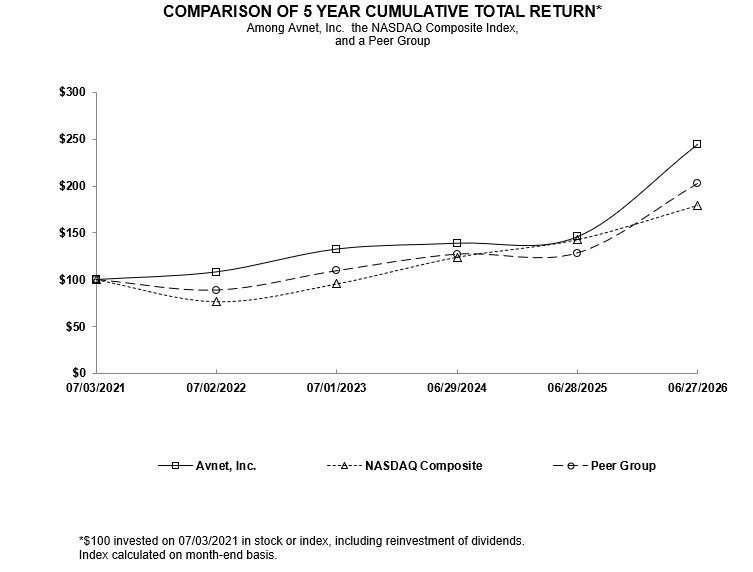
| 7/3/2021 | | 7/2/2022 | | 7/1/2023 | | 6/29/2024 | | 6/28/2025 | | 6/27/2026 |
| |||||||
Avnet, Inc. | $ | 100 | $ | 108.20 | $ | 132.63 | $ | 138.84 | $ | 145.69 | $ | 244.51 | |||||||
Nasdaq Composite | $ | 100 | $ | 76.54 | $ | 95.69 | $ | 124.02 | $ | 142.78 | $ | 179.25 | |||||||
Peer Group | $ | 100 | $ | 88.85 | $ | 109.49 | $ | 127.14 | $ | 128.45 | $ | 202.37 | |||||||
The stock price performance included in this graph is not necessarily indicative of future stock price performance.
Issuer Purchases of Equity Securities
The Company’s Board of Directors has approved the repurchase plan of up to an aggregate of $600 million of common stock. During the fourth quarter of fiscal 2026, the Company did not repurchase any shares under the share repurchase program.
Item 6. [Reserved]
21
Item 7. Management’s Discussion and Analysis of Financial Condition and Results of Operations
For a description of the Company’s critical accounting policies and an understanding of Avnet and the significant factors that influenced the Company’s performance during the past three fiscal years, the following discussion should be read in conjunction with the description of the business appearing in Item 1 of this Report and the consolidated financial statements, including the related notes and schedule, and other information appearing in Item 8 of this Report. Discussions of fiscal 2024 items and year-to-year comparisons between fiscal years 2025 and 2024 are not included in this Form 10-K and can be found in “Management’s Discussion and Analysis of Financial Condition and Results of Operations” in Part II, Item 7 of the Company’s Annual Report on Form 10-K for the fiscal year ended June 28, 2025. The Company operates on a “52/53 week” fiscal year. Fiscal years 2026, 2025 and 2024 each contained 52 weeks.
The discussion of the Company’s results of operations includes references to the impact of foreign currency translation. When the U.S. Dollar strengthens and the stronger exchange rates are used to translate the results of operations of Avnet’s subsidiaries denominated in foreign currencies, the result is a decrease in U.S. Dollars of reported results. Conversely, when the U.S. Dollar weakens, the weaker exchange rates result in an increase in U.S. Dollars of reported results. In the discussion that follows, results excluding this impact, primarily for subsidiaries in EMEA and Asia, are referred to as “constant currency.”
In addition to disclosing financial results that are determined in accordance with generally accepted accounting principles in the U.S. (“GAAP”), the Company also discloses certain non-GAAP financial information, including:
| * | “Adjusted operating income,” which is operating income excluding (i) restructuring, integration and other expenses, and (ii) amortization of acquired intangible assets. |
The following table provides a reconciliation of operating income to adjusted operating income:
Years Ended | |||||||||
| June 27, | | June 28, | | June 29, | ||||
2026 | 2025 | 2024 | |||||||
(Thousands) | |||||||||
Operating income | $ | 724,782 | $ | 514,254 | $ | 844,367 | |||
Restructuring, integration, and other expenses |
| 134,706 |
| 108,316 |
| 52,550 | |||
Amortization of acquired intangible assets |
| 1,457 |
| 1,463 |
| 3,130 | |||
Adjusted operating income | $ | 860,945 | $ | 624,033 | $ | 900,047 | |||
Management believes that providing this additional information is useful to financial statement users to better assess and understand operating performance, especially when comparing results with prior periods or forecasting performance for future periods, primarily because management typically monitors the business with and without these adjustments to GAAP results. Management also uses these non-GAAP measures to establish operational goals and, in many cases, for measuring performance for compensation purposes. However, any analysis of results on a non-GAAP basis should be used in conjunction with results presented in accordance with GAAP.
Industry outlook
The Company’s operations subject it to tariffs and other trade protection measures. The U.S. administration has instituted certain changes, and may make additional changes, in trade policies that include the negotiation or termination of trade agreements, higher tariffs on imports into the U.S., and other measures affecting trade between the U.S. and other countries from which the Company imports. Due in part to these measures, some countries are changing their trade policies relating to goods imported from the U.S. These global trade disruptions and geopolitical tensions, together with
22
any related downturns in the global economy, could dampen customer demand, increase market volatility, and impact currency exchange rates, all of which could materially and adversely affect the Company’s financial performance.
In February 2026, the U.S. Supreme Court issued a ruling striking down tariffs imposed under the International Emergency Economic Powers Act (IEEPA), including, among others, tariffs on imports of certain Canadian, Chinese, and Mexican goods, a universal baseline tariff on imports from most countries, and reciprocal tariffs on select countries. The global tariff landscape continues to shift rapidly, with changes impacting businesses and markets around the world.
The Company continues to monitor the situation, including any potential refunds of such tariffs, and evaluate the impact on its results of operations. No potential refunds have been recorded in the Consolidated Financial Statements as the Company cannot reasonably estimate the financial impact.
Sales related to customer billings for various tariffs were less than one percent of total sales for fiscal 2026, fiscal 2025 and fiscal 2024.
During fiscal 2026, the Company’s financial performance improved as demand for electronic components strengthened resulting in year-over-year sales growth across all regions and improved days of inventory on hand. The Company expects sales in the first quarter of fiscal 2027 will grow approximately 10% compared to fourth quarter of fiscal 2026 sales with expected sales growth across all Electronic Components regions and Farnell.
Results of Operations
Years Ended | |||||||||||||||
2026 | 2025 | Variance | Variance % | ||||||||||||
($ in millions, unless otherwise stated) | |||||||||||||||
Sales | $ | 27,633 | $ | 22,201 | $ | 5,432 | 24.5 | % | |||||||
Gross profit | 2,882 | 2,385 | 497 | 20.8 | |||||||||||
Selling, general and administrative expenses | 2,022 | 1,762 | 260 | 14.8 | |||||||||||
Restructuring, integration, and other expenses | 135 | 108 | 26 | 24.4 | |||||||||||
Operating income | 725 | 514 | 211 | 40.9 | |||||||||||
Adjusted operating income | 861 | 624 | 237 | 38.0 | |||||||||||
Other expense, net | (7) | (17) | 11 | (61.6) | |||||||||||
Interest and other financing expenses, net | (251) | (246) | (4) | 1.8 | |||||||||||
Income tax expense | 133 | 10 | 123 | 1,185.2 | |||||||||||
Net income | 334 | 240 | 94 | 39.2 | |||||||||||
Diluted earnings per share | 4.01 | 2.75 | 1.26 | 45.8 | |||||||||||
Other Metrics | |||||||||||||||
Gross profit margin | 10.4 | % | 10.7 | % | (31) | bps | (0.3) | % | |||||||
Operating income margin | 2.6 | % | 2.3 | % | 30 | bps | 0.3 | % | |||||||
Adjusted operating income margin | 3.1 | % | 2.8 | % | 31 | bps | 0.3 | % | |||||||
Effective tax rate | 28.5 | % | 4.1 | % | 2,433 | bps | 24.3 | % | |||||||
23
Sales
Analysis of Sales: By Operating Group and Geography
The table below provides sales change rates for fiscal 2026 as compared to fiscal 2025 as reported and on a constant currency basis by geographic region and operating group.
Sales | ||||||||||||||||||
Year-Year % | ||||||||||||||||||
Years Ended | Sales | Change in | ||||||||||||||||
| June 27, | | % of | June 28, | | % of | Year-Year % | Constant | ||||||||||
2026 | | Total | | 2025 | Total | | Change | Currency | ||||||||||
($ in millions) | ||||||||||||||||||
Sales by Operating Group: | ||||||||||||||||||
EC | $ | 25,851.9 | 93.6 | % | $ | 20,755.0 | 93.5 | % | 24.6 | % | 22.6 | % | ||||||
Farnell | 1,780.8 | 6.4 | % | 1,445.8 | 6.5 | % | 23.2 | % | 19.8 | % | ||||||||
Total Avnet | $ | 27,632.7 | $ | 22,200.8 | 24.5 | % | 22.4 | % | ||||||||||
Sales by Geographic Region: | ||||||||||||||||||
Americas | $ | 6,480.8 |
| 23.5 | % | $ | 5,300.0 |
| 23.9 | % | 22.3 | % | 22.3 | % | ||||
EMEA |
| 7,725.1 |
| 28.0 | % |
| 6,409.6 |
| 28.9 | % | 20.5 | % | 13.1 | % | ||||
Asia |
| 13,426.8 |
| 48.5 | % |
| 10,491.2 |
| 47.2 | % | 28.0 | % | 28.2 | % | ||||
Total Avnet | $ | 27,632.7 | $ | 22,200.8 | ||||||||||||||
Avnet’s sales for fiscal 2026 were $27.63 billion, an increase of $5.43 billion, or 24.5%, from fiscal 2025 sales of $22.20 billion, with growth across all EC regions and Farnell. Sales in constant currency increased 22.4% year over year, driven by strong performance in both EC and Farnell operating groups across all end markets served.
EC sales in fiscal 2026 were $25.85 billion, representing a $5.10 billion increase, or 24.6% increase over prior year sales of $20.75 billion. EC sales increased 22.6% year over year in constant currency. All three EC regions contributed to this growth led by the Company’s Asia region. The increase in EC sales was mainly attributable to increased sales volumes and the mix of higher-priced components and to a lesser extent from increase in prices for certain memory-related products.
Farnell sales in fiscal 2026 were $1.78 billion, representing an increase of $335.0 million or 23.2%, compared to prior year sales of $1.45 billion. The year-over-year increase in sales in fiscal 2026 is primarily due to improvement in demand for single board computers and on-the-board electronic components. The increase in sales at Farnell was primarily driven by an increase in volume as increases in components pricing including certain memory-related products was a smaller contributor to sales growth during fiscal 2026.
Gross Profit
The Company’s gross profit and gross margin are primarily affected by sales volume, product mix, customer mix and pricing, and geographic sales mix. Gross profit increased $496.9 million, or 20.8% to $2.88 billion in fiscal 2026, compared to $2.38 billion in fiscal 2025. This increase was primarily driven by higher sales in both operating groups, partially offset by year-over-year lower gross profit margin in the EC operating group. Gross profit margin decreased to 10.4% in fiscal 2026 or 31 basis points from fiscal 2025 gross profit margin of 10.7%.
24
EC gross profit margin declined in fiscal 2026 compared with fiscal 2025 primarily due to a higher mix of sales from the lower-margin Asia region and changes in product and customer mix in the Western regions. Asia represented approximately 51% of EC sales in fiscal 2026, compared with 49% in fiscal 2025. EC gross profit margin decreased 44 basis points to 9.24% in fiscal 2026 from 9.68% in fiscal 2025.
Farnell gross profit margin was 27.73% in fiscal 2026, up 168 basis points year over year, primarily due to a higher mix of on-the-board electronic components and, to a lesser extent, an increase in component pricing for certain memory-related products during fiscal 2026.
Selling, General and Administrative Expenses
Selling, general and administrative expenses (“SG&A expenses”) in fiscal 2026 were $2.02 billion, an increase of $260.0 million, or 14.8%, from fiscal 2025. The year-over-year increase in SG&A expenses is primarily due to increases in variable operating expenses associated with higher sales volumes and the impact of changes in foreign currency translation rates.
Metrics that management monitors with respect to its operating expenses are SG&A expenses as a percentage of sales and as a percentage of gross profit. In fiscal 2026, SG&A expenses were 7.3% of sales 70.2% of gross profit, compared with 7.9% and 73.9%, respectively, in fiscal 2025. The year-over-year decrease in SG&A expenses as a percentage of sales and gross profit was primarily due to increased sales without a corresponding increase in SG&A expenses, partially offset by the decline in gross profit margin in EC as discussed above.
See Note 16 “Segment information” to the Company’s consolidated financial statements included in Item 8 of this Annual Report on Form 10-K for the amount of selling, general and administrative expenses by operating group.
Restructuring, Integration and Other Expenses
The Company recorded total restructuring, integration, and other expenses in fiscal 2026 of $134.7 million consisting of $87.7 million of severance and other restructuring related expenses, and $47.0 million of integration and other costs primarily related to start-up costs associated with a new distribution center in EMEA, partially offset by a benefit due to a change in estimate from the settlement of an audit in Mexico. The largest component of the severance expense in fiscal 2026, was due to the announced closure of a distribution center in Germany that impacted approximately 350 employees. The closure is expected to be completed in the third quarter of fiscal 2027.
The after-tax impact of restructuring, integration, and other expenses were $96.1 million and $1.15 per share on a diluted basis.
During fiscal 2025 the Company recorded restructuring, integration, and other expenses of $108.3 million, which consists of restructuring costs of $56.1 million, integration and other costs of $14.5 million, a benefit of $6.0 million for changes in estimates for costs associated with prior year restructuring actions, and $43.7 million of other costs primarily related to the estimated contingent liability associated with the consumption tax audit in Mexico.
See Note 17, “Restructuring expenses” to the Company’s consolidated financial statements included in Item 8 of this Annual Report on Form 10-K for additional information related to restructuring expenses.
Operating Income
Operating income increased $210.5 million, or 40.9%, to $724.8 million in fiscal 2026, compared with $514.3 million in fiscal 2025. Operating income margin increased 30 basis points to 2.6% in fiscal 2026 from 2.3% in fiscal
25
2025. Adjusted operating income for fiscal 2026 was $860.9 million, an increase of $236.9 million or 38.0%, from fiscal 2025 adjusted operating income. Adjusted operating income margin increased 31 basis points to 3.1% in fiscal 2026 compared to 2.8% in fiscal 2025. These increases were primarily driven by operating leverage from higher sales.
EC operating income increased 26.9% to $898.5 million, and EC operating income margin increased 7 basis points to 3.5% in fiscal 2026. Farnell operating income increased 221.7% to $105.7 million in fiscal 2026. Farnell operating income margin increased 366 basis points to 5.9% in fiscal 2026. The increases in operating income and operating income margin in Farnell are due to higher sales and higher gross profit margin.
Interest and Other Financing Expenses, Net and Other Expense, Net
Interest and other financing expenses for fiscal 2026 was $250.7 million, an increase of $4.3 million, or 1.8%, compared with interest and other financing expenses of $246.4 million in fiscal 2025. The increase in interest and other financing expenses in fiscal 2026 compared to fiscal 2025 is primarily a result of higher average borrowings.
The Company had other expenses of $6.6 million in fiscal 2026, compared to other expenses of $17.3 million in fiscal 2025. The decrease in other expenses is primarily due to differences in foreign currency translation losses between the years.
Income Tax
Income tax expenses were $133.0 million in fiscal 2026, reflecting an effective tax rate of 28.5% as compared to income tax expenses of $10.4 million in fiscal 2025, reflecting an effective tax rate of 4.1%. The increase in the effective tax rate in fiscal 2026 as compared to fiscal 2025 was primarily related to the tax attribute carryforwards that were generated in fiscal 2025, but not in fiscal 2026.
See Note 9, “Income taxes” to the Company’s consolidated financial statements included in Item 8 of this Annual Report on Form 10-K for further discussion on the effective tax rate.
Net Income
As a result of the factors described in the preceding sections of this MD&A, the Company’s net income in fiscal 2026 was $334.4 million, or earnings per share on a diluted basis of $4.01, compared with fiscal 2025 net income of $240.2 million, or earnings per share on a diluted basis of $2.75.
Liquidity and Capital Resources
Cash Flows
Operating Activities
Net cash used for operating activities was $280.9 million in fiscal 2026, compared with net cash provided by operating activities of $724.5 million in fiscal 2025. The $1.01 billion year-over-year decrease in operating cash flow was primarily due to cash used for working capital in fiscal 2026 to support sales growth. Cash used for working capital and other was $802.4 million during fiscal 2026, compared with cash generated from working capital of $402.2 million in fiscal 2025, primarily reflecting higher inventory purchases, the timing of payments for inventory purchases and higher accounts receivable due to increased sales and cash collection timing. The Company used $61.4 million of cash from operations to settle the consumption tax audit in Mexico during fiscal 2026. Other, net in fiscal 2025 included a $9.2 million gain recognized on the sale of a building during fiscal 2025.
26
Financing Activities
Net cash provided by debt financing activities was $568.9 million in fiscal 2026, primarily reflecting $633.8 million of net proceeds from the issuance of Convertible Notes, $270.2 million of proceeds from term loans, $157.9 million of net borrowings under the Credit Facility, and $57.0 million of proceeds from other debts. These cash inflows were partially offset by the repayment of the $550.0 million 4.63% Notes in April 2026. In comparison, net debt repayments were $274.9 million in fiscal 2025.
The Company repurchased $138.3 million of common stock under its share repurchase plan during fiscal 2026, compared with $303.5 million during fiscal 2025. The Company paid cash dividends of $1.40 per share, or $114.4 million, during fiscal 2026, compared with $1.32 per share, or $113.3 million, during fiscal 2025.
Investing Activities
Net cash used in investing activities decreased by $65.7 million during fiscal 2026, compared to fiscal 2025, primarily due to lower capital expenditures.
Financing Transactions
The Company maintains a diversified financing structure, including both short-term and long-term arrangements to support its operating requirements and supplement cash generated from operating activities. The Company seeks to reduce reliance on any single source of financing and to lower overall funding costs. These arrangements include public debt (“Notes”), convertible debt, short-term and long-term bank and term loans, a revolving credit facility (the “Credit Facility”), and an accounts receivable securitization program (the “Securitization Program”).
The Company has various lines of credit, financing arrangements, and other forms of bank debt in the U.S. and various foreign locations to fund the working capital, foreign exchange, overdraft, capital expenditure, and letter of credit needs of its wholly owned subsidiaries. Outstanding borrowings under such forms of debt at the end of fiscal 2026 was $162.6 million.
As an alternative form of liquidity outside of the United States, primarily in the Asia region, the Company sells certain of its trade accounts receivable on a non-recourse basis to financial institutions pursuant to factoring agreements. The Company accounts for these transactions as sales of receivables and presents cash proceeds as cash provided by operating activities in the consolidated statements of cash flows. Fees for the sales of trade accounts receivable are classified within “Interest and other financing expenses, net” in the consolidated financial statements.
See Note 7, “Debt” to the Company’s consolidated financial statements included in Item 8 of this Annual Report on Form 10-K for additional information on financing transactions including the Credit Facility, the Securitization Program and the outstanding Notes as of June 27, 2026.
Covenants and Conditions
The Company’s Credit Facility includes covenants that limit, among other items, the Company’s ability to incur debt, repurchase shares, pay dividends, make investments and incur capital expenditures. The Credit Facility also includes a financial covenant requiring the Company to maintain a leverage ratio below a specified threshold. The Company was in compliance with all such covenants as of June 27, 2026.
The Company’s Securitization Program includes covenants related to the quality of the receivables sold. If these covenants are not satisfied, the Company may be unable to borrow additional funds, and the financial institutions may
27
deem the noncompliance an amortization event under the Securitization Program agreements, which would permit the financial institutions to liquidate the accounts receivables to cover any outstanding borrowings. Circumstances that could affect the Company’s ability to satisfy these covenants and related conditions may be affected by the Company’s ongoing profitability, as well as other economic, market, and industry factors. The Company was in compliance with all such covenants as of June 27, 2026.
Management does not believe that the covenants under the Credit Facility or Securitization Program limit the Company’s ability to pursue its intended business strategy or its future financing needs.
See Liquidity below for further discussion of the Company’s availability under these various facilities.
Liquidity
The Company held cash and cash equivalents of $155.4 million as of June 27, 2026, of which $146.4 million was held outside the United States. As of June 28, 2025, the Company held cash and cash equivalents of $192.4 million, of which $181.8 million was held outside of the United States.
During periods of weakening demand in the electronic components industry, the Company typically generates cash from operating activities. Conversely, during periods of higher growth, the Company generally uses cash to fund working capital requirements. For the fiscal year ended June 27, 2026, the Company used $280.9 million of cash in operating activities.
The Company’s liquidity is affected by a variety of factors, including normal business operations and general economic, financial, competitive, legislative and regulatory conditions, many of which are outside the Company’s control. Cash balances held outside the United States that cannot be remitted in a tax-efficient manner are generally used to support local working capital requirements, including inventory purchases, capital expenditures and other foreign business needs. In addition, local government regulations may restrict the Company’s ability to transfer funds among jurisdictions under certain circumstances. Management does not believe these restrictions would limit the Company’s ability to execute its intended business strategy.
In September 2025, the Company issued $650 million aggregate principal amount of convertible senior notes due 2030. The Company used the net proceeds to (i) reduce the Credit Facility by $533.8 million and (ii) repurchase $100 million of the Company’s common stock in privately negotiated transactions entered into in connection with the convertible debt offering.
In July 2026, subsequent to the end of fiscal 2026, the Company amended and extended its trade accounts receivable securitization program for two years. The amendment increased the maximum purchase limit under the Receivables Purchase Agreement from $500.0 million to $700.0 million, extended the facility termination date to July 1, 2028, and excluded certain receivables from the agreement. On August 12, 2026, subsequent to the end of fiscal 2026, the Company entered into a credit agreement (“2026 Term Loan”) for $375 million. The loan is priced at a variable interest rate and matures in July 2028. See Item 9B (other information) of this Annual Report for additional information regarding the 2026 Term Loan.
As of June 27, 2026, there were $557.0 million of borrowings outstanding under the Credit Facility and $0.8 million in letters of credit issued, and $500.0 million outstanding under the Securitization Program. During fiscal 2026, the Company had an average daily balance outstanding under the Credit Facility of approximately $744.8 million and $476.8 million under the Securitization Program. During fiscal 2025, the Company had an average daily balance outstanding under the Credit Facility of approximately $1.00 billion and $490.5 million under the Securitization
28
Program. As of June 27, 2026, the combined availability under the Credit Facility and the Securitization Program was $1.19 billion. Availability under the Securitization Program is subject to the Company having sufficient eligible trade accounts receivable in the United States to support desired borrowings.
The Company has the following contractual obligations outstanding as of June 27, 2026 (in millions):
| | Payments due by period |
| |||||||||||||
Less than | More than | |||||||||||||||
Contractual Obligations | Total | 1 year | 1-3 years | 3-5 years | 5 years |
| ||||||||||
Long-term debt obligations (1) | $ | 3,233.4 | $ | 733.9 | $ | 679.9 | $ | 1,512.9 | $ | 306.7 | ||||||
Interest expense on long-term debt obligations (2) | $ | 381.1 | $ | 123.6 | $ | 161.7 | $ | 79.9 | $ | 15.9 | ||||||
Operating lease obligations (3) | $ | 434.1 | $ | 61.5 | $ | 91.4 | $ | 52.6 | $ | 228.6 | ||||||
| (1) | Includes amounts due within one year and excludes unamortized discount and issuance costs on debt. |
| (2) | Represents interest expense due on debt by using fixed interest rates for fixed rate debt and assuming the same interest rate at the end of fiscal 2026 for variable rate debt. |
| (3) | Excludes imputed interest on operating lease liabilities. |
The Company purchases inventories in the normal course of business throughout the year through the issuance of purchase orders to suppliers. During fiscal 2026, the Company’s cost of sales, substantially all of which related to the underlying purchase of inventories was $24.8 billion and the Company had $6.1 billion of inventories as of June 27, 2026. The Company expects to continue to purchase sufficient inventory to meet its customers’ demands in fiscal year 2027, some of which relates to outstanding purchase orders at the end of fiscal 2026. Outstanding purchase orders with suppliers may be non-cancellable/non-returnable at the point where such orders are issued or may become non-cancellable at some point in the future, typically within 30 days to 90 days from the requested delivery date of inventories.
At June 27, 2026, the Company had an estimated liability for income tax contingencies of $123.9 million, which is not included in the above table. The settlement period for the remaining amount of the unrecognized tax benefits, including related accrued interest and penalties, cannot be determined, and therefore was not included in the table.
As of June 27, 2026, the Company may repurchase up to an aggregate of $225.8 million of shares of the Company’s common stock through the share repurchase program approved by the Board of Directors. The Company may repurchase stock from time to time at the discretion of management, subject to strategic considerations, market conditions including share price and other factors. The Company may terminate or limit the share repurchase program at any time without prior notice. During fiscal 2026, the Company repurchased $138.3 million of common stock.
The Company has historically paid quarterly cash dividends on shares of its common stock, and future dividends are subject to approval by the Board of Directors. During the fourth quarter of fiscal 2026, the Board of Directors approved a dividend of $0.35 per share, which resulted in $28.7 million of dividend payments during the quarter.
The Company continually monitors and reviews its liquidity position and funding needs. Management believes that the Company’s ability to generate operating cash flows through the liquidation of working capital in the future and available borrowing capacity, including capacity for the non-recourse sale of trade accounts receivable, will be sufficient to meet its future liquidity needs. Additionally, the Company believes that it has sufficient access to additional liquidity from the capital markets if necessary.
29
During fiscal 2027 the Company may use cash for investing and financing activities including the payment of cash dividends and capital expenditures for distribution centers and information systems including digital tools and capabilities. The Company may also use cash in fiscal 2027 for share repurchases and for acquisitions.
Critical Accounting Policies
The Company’s consolidated financial statements have been prepared in accordance with GAAP. The preparation of these consolidated financial statements requires the Company to make estimates and assumptions that affect the reported amounts of assets, liabilities, sales and expenses. These estimates and assumptions are based upon the Company’s continual evaluation of available information, including historical results and anticipated future events. Actual results may differ materially from these estimates.
The Securities and Exchange Commission defines critical accounting policies as those that are, in management’s view, most important to the portrayal of the Company’s financial condition and results of operations and that require significant judgments and estimates. Management believes the Company’s most critical accounting policies at the end of fiscal 2026 relate to the valuation of inventories and accounting for income taxes.
Valuation of Inventories
Inventories are recorded at the lower of cost or estimated net realizable value. Inventory cost includes the purchase price of finished goods, and any freight cost incurred to receive the inventory into the Company’s distribution centers. The Company’s inventories include electronic components sold into changing, cyclical, and competitive markets, so inventories may decline in market value or become obsolete.
The Company regularly evaluates inventories for expected customer demand, obsolescence, current market prices, and other factors that may render inventories less marketable. Write-downs are recorded so that inventories reflect the estimated net realizable value and take into account the Company’s contractual provisions with its suppliers, which may provide certain protections to the Company for product obsolescence and price erosion in the form of rights of return, stock rotation rights, obsolescence allowances, industry specific supplier rebate programs and price protections. Because of the large number of products and suppliers and the complexity of managing the process around price protections, supplier rebate programs and stock rotations, estimates are made regarding the net realizable value of inventories. Additionally, assumptions about future demand and market conditions, as well as decisions to discontinue certain product lines, impact the evaluation of whether to write-down inventories. If future demand changes or actual market conditions are less favorable than assumed, then management evaluates whether additional write-downs of inventories are required. In any case, actual net realizable values could be different from those currently estimated.
Accounting for Income Taxes
Management’s judgment is required in determining income tax expense, unrecognized tax benefit liabilities, deferred tax assets and liabilities, and valuation allowances recorded against net deferred tax assets. Recovering net deferred tax assets depends on the Company’s ability to generate sufficient future taxable income in certain jurisdictions. In addition, when assessing the need for valuation allowances, the Company considers historic levels and types of income, expectations and risk associated with estimates of future taxable income, and ongoing prudent and feasible tax planning strategies. If the Company determines that it cannot realize all or part of its deferred tax assets in the future, it may record additional valuation allowances against the deferred tax assets with a corresponding increase to income tax expense in the period such determination is made. Similarly, if the Company determines that it can realize all or part of its deferred tax assets that have an associated valuation allowance established, the Company may release a valuation allowance with a corresponding benefit to income tax expense in the period such determination is made.
30
The Company establishes contingent liabilities for potentially unfavorable outcomes of positions taken on certain tax matters. These liabilities are based on management’s assessment of whether a tax benefit is more likely than not to be sustained upon examination by tax authorities. The anticipated and actual outcomes of these matters may differ, which may result in changes in estimates to such unrecognized tax benefit liabilities. To the extent such changes in estimates are necessary, the Company’s effective tax rate may fluctuate. In accordance with the Company’s accounting policy, accrued interest and penalties related to unrecognized tax benefits are recorded as a component of income tax expense.
In determining the Company’s income tax expense, management considers current tax regulations in the numerous jurisdictions in which it operates, including the impact of tax law and regulation changes in the jurisdictions the Company operates in. The Company exercises judgment for interpretation and application of such current tax regulations. Changes to such tax regulations or disagreements with the Company’s interpretation or application by tax authorities in any of the Company’s major jurisdictions may have a significant impact on the Company’s income tax expense.
See Note 9, “Income taxes” to the Company’s consolidated financial statements included in Item 8 of this Annual Report on Form 10-K for further discussion on income tax expense, valuation allowances and unrecognized tax benefits.
Recently Issued Accounting Pronouncements
In November 2024, the FASB issued ASU 2024-03, Income Statement—Reporting Comprehensive Income—Expense Disaggregation Disclosures (Subtopic 220-40): Disaggregation of Income Statement Expenses (“ASU 2024-03”), and in January 2025, the FASB issued ASU 2025-01, Income Statement - Reporting Comprehensive Income - Expense Disaggregation Disclosures: Clarifying the Effective Date (“ASU 2025-01”). The guidance is designed to improve financial reporting by requiring public business entities to disclose additional information about specific expense categories in the financial statement notes at interim and annual reporting periods. ASU No. 2024-03, as clarified by ASU 2025-01, will be effective for the Company in fiscal year 2028 and early adoption is permitted. The Company is currently evaluating the impact of adopting ASU No. 2024-03 on its disclosures.
In July 2025, the FASB issued ASU 2025-05, Financial Instruments - Credit Losses (Topic 326): Measurement of Credit Losses for Accounts Receivable and Contract Assets (“ASU No. 2025-05”). This update introduces a practical expedient available to all entities when estimating expected credit losses on current accounts receivable and contract assets arising from revenue recognized under ASC 606, Revenue from Contracts with Customers. With this expedient, entities may assume that the current conditions used to determine credit loss allowances for these assets will remain unchanged for the remainder of their lives. ASU 2025-05 will be effective for the Company starting in fiscal 2027, including interim periods in that year. Entities that choose to apply the practical expedient, along with any related accounting policy elections, must do so prospectively. The Company is currently assessing the potential effects of adopting ASU 2025-05 on its consolidated financial statements and disclosures.
In September 2025, the FASB issued ASU 2025-06, Intangibles – Goodwill and Other – Internal-Use Software, (Subtopic 350-40): Targeted Improvements to the Accounting for Internal-Use Software (“ASU No. 2025-06”). This update modernizes the outdated guidance for accounting for software costs by aligning the accounting with how software is developed today. The effective date for the standard is for fiscal years beginning after December 15, 2027, the Company’s Fiscal 2029, and interim periods within those fiscal years. Early adoption is permitted. The amendments in this ASU should be applied either prospectively, retrospectively, or utilizing a modified transition approach. The Company is in the process of analyzing the impact of ASU No. 2025-06 on its consolidated financial statements and related disclosures.
31
In November 2025, the FASB issued ASU 2025-09, Derivatives and Hedging (Topic 815): Hedge Accounting Improvements (“ASU No. 2025-09”), which make certain targeted improvements to simplify the application of the hedge accounting guidance and to address several incremental hedge accounting issues arising from the global reference rate reform initiative. Among other amendments, these improvements include expanding the hedged risks permitted to be aggregated in a group of individual forecasted transactions in a cash flow hedge and clarifying the circumstance under which a group of individual forecasted transactions can be considered to have a similar risk exposure. The amendments in ASU 2025-09 are effective for annual periods beginning after December 15, 2026, and interim periods within those annual reporting periods, which for the Company would be the fiscal first quarter ending September 25, 2027. Early adoption is permitted and the amendments should be applied on a prospective basis for all hedging relationships. The Company is currently evaluating the impact the new accounting standard could have on its hedge accounting policies and related disclosures.
In December 2025, the FASB issued ASU 2025-11, Interim Reporting (Topic 270): Narrow-Scope Improvements (“ASU No. 2025-11”). This update enhances the clarity and organization of interim reporting and the applicability of Topic 270. It also clarifies the required form and content of interim financial statements, including requiring entities to disclose events since the end of the last annual reporting period that have a material impact on the entity. The standard is effective for interim reporting periods within annual periods beginning after December 15, 2027, which for the Company would be the first quarter of fiscal 2029, with early adoption permitted. Entities may apply the update either prospectively or retrospectively. The Company is in the process of evaluating the impact of adopting ASU No. 2025-11 on its consolidated financial statements and related disclosures.
Item 7A. Quantitative and Qualitative Disclosures About Market Risk
The Company seeks to reduce earnings and cash flow volatility associated with changes in interest rates and foreign currency exchange rates by entering financial arrangements, from time to time, which are intended to provide an economic hedge against all, or a portion of, the risks associated with such volatility. The Company continues to have exposure to such risks to the extent they are not economically hedged.
The following table sets forth the scheduled maturities of the Company’s debt outstanding at June 27, 2026 (dollars in millions):
Fiscal Year |
| |||||||||||||||||||||
| 2027 | | 2028 | | 2029 | | 2030 | | 2031 | | Thereafter | | Total |
| ||||||||
Liabilities: | ||||||||||||||||||||||
Fixed rate debt(1) | $ | 2.8 | $ | 503.0 | $ | 3.0 | $ | 2.9 | $ | 953.0 | $ | 306.7 | $ | 1,771.4 | ||||||||
Floating rate debt | $ | 731.1 | $ | 89.8 | $ | 84.1 | $ | 557.0 | $ | — | $ | — | $ | 1,462.0 | ||||||||
| (1) | Excludes unamortized discounts and issuance costs. |
32
The following table sets forth the carrying value and fair value of the Company’s debt and the average interest rates at June 27, 2026, and June 28, 2025 (dollars in millions):
Carrying Value | | Fair Value at | Carrying Value | | Fair Value at |
| |||||||||
at June 27, 2026 | at June 27, 2026 | | at June 28, 2025 | June 28, 2025 |
| ||||||||||
Liabilities: | |||||||||||||||
Fixed rate debt(1) | $ | 1,771.4 | $ | 2,015.0 | $ | 1,674.9 | $ | 1,660.5 | |||||||
Average interest rate |
| 3.9 | % |
| 5.0 | % | |||||||||
Floating rate debt | $ | 1,462.0 | $ | 1,462.0 | $ | 995.9 | $ | 995.9 | |||||||
Average interest rate |
| 4.6 | % |
| 5.3 | % | |||||||||
| (1) | Excludes unamortized discounts and issuance costs. Fair value was estimated primarily based upon quoted market prices for the Company’s public long-term notes. |
Many of the Company’s subsidiaries purchase and sell products in currencies other than their functional currencies, which subjects the Company to the risks associated with fluctuations in currency exchange rates. The Company uses economic hedges to reduce this risk utilizing natural hedging (i.e., offsetting receivables and payables in the same foreign currency) and creating offsetting positions through the use of derivative financial instruments (primarily forward foreign currency exchange contracts typically with maturities of less than 60 days, but no longer than one year). The Company continues to have exposure to foreign currency risks to the extent they are not economically hedged. The Company adjusts any economic hedges to fair value within the same line item in the consolidated statements of operations as the remeasurement of the underlying assets or liabilities being economically hedged. Therefore, the changes in valuation of the underlying items being economically hedged are offset by the changes in fair value of the forward foreign exchange contracts. A hypothetical 10% change in foreign currency exchange rates under the forward foreign currency exchange contracts outstanding at June 27, 2026, would result in an increase or decrease of approximately $20.0 million to the fair value of the forward foreign exchange contracts, which would generally be offset by an opposite effect on the underlying exposure being economically hedged. See Note 2, “Derivative financial instruments” to the Company’s consolidated financial statements included in Item 8 of this Annual Report on Form 10-K for further discussion on derivative financial instruments.
33
Item 8. Financial Statements and Supplementary Data
Index to Financial Statements
| Page | ||
1. | Consolidated Financial Statements: | ||
Report of Independent Registered Public Accounting Firm (PCAOB ID: | 35 | ||
Report of Independent Registered Public Accounting Firm (KPMG LLP, Phoenix, AZ, Auditor Firm ID:185) | 38 | ||
Avnet, Inc. and Subsidiaries Consolidated Financial Statements: | |||
Consolidated Balance Sheets at June 27, 2026, and June 28, 2025 | 39 | ||
40 | |||
41 | |||
42 | |||
43 | |||
44 | |||
2. | Financial Statement Schedule: | ||
82 | |||
Schedules other than that above have been omitted because they are not applicable, or the required information is shown in the financial statements or notes thereto | |||
34
Report of Independent Registered Public Accounting Firm
To the Board of Directors and Shareholders of Avnet, Inc.
Opinion on the Financial Statements and Internal Control over Financial Reporting
We have audited the accompanying consolidated balance sheet of Avnet, Inc. and its subsidiaries (the "Company") as of June 27, 2026, and the related consolidated statements of operations, of comprehensive income, of shareholders’ equity and of cash flows for the year then ended, including the related notes and financial statement schedule for the year ended June 27, 2026 listed in the accompanying index (collectively referred to as the "consolidated financial statements"). We also have audited the Company's internal control over financial reporting as of June 27, 2026, based on criteria established in Internal Control - Integrated Framework (2013) issued by the Committee of Sponsoring Organizations of the Treadway Commission (COSO).
In our opinion, the consolidated financial statements referred to above present fairly, in all material respects, the financial position of the Company as of June 27, 2026, and the results of its operations and its cash flows for the year then ended in conformity with accounting principles generally accepted in the United States of America. Also in our opinion, the Company maintained, in all material respects, effective internal control over financial reporting as of June 27, 2026, based on criteria established in Internal Control - Integrated Framework (2013) issued by the COSO.
Basis for Opinion
The Company's management is responsible for these consolidated financial statements, for maintaining effective internal control over financial reporting, and for its assessment of the effectiveness of internal control over financial reporting, included in Management’s Report on Internal Control Over Financial Reporting appearing under Item 9A. Our responsibility is to express opinions on the Company’s consolidated financial statements and on the Company's internal control over financial reporting based on our audit. We are a public accounting firm registered with the Public Company Accounting Oversight Board (United States) (PCAOB) and are required to be independent with respect to the Company in accordance with the U.S. federal securities laws and the applicable rules and regulations of the Securities and Exchange Commission and the PCAOB.
We conducted our audit in accordance with the standards of the PCAOB. Those standards require that we plan and perform the audit to obtain reasonable assurance about whether the consolidated financial statements are free of material misstatement, whether due to error or fraud, and whether effective internal control over financial reporting was maintained in all material respects.
Our audit of the consolidated financial statements included performing procedures to assess the risks of material misstatement of the consolidated financial statements, whether due to error or fraud, and performing procedures that respond to those risks. Such procedures included examining, on a test basis, evidence regarding the amounts and disclosures in the consolidated financial statements. Our audit also included evaluating the accounting principles used and significant estimates made by management, as well as evaluating the overall presentation of the consolidated financial statements. Our audit of internal control over financial reporting included obtaining an understanding of internal control over financial reporting, assessing the risk that a material weakness exists, and testing and evaluating the design and operating effectiveness of internal control based on the assessed risk. Our audit also included performing such other procedures as we considered necessary in the circumstances. We believe that our audit provides a reasonable basis for our opinions.
35
Definition and Limitations of Internal Control over Financial Reporting
A company’s internal control over financial reporting is a process designed to provide reasonable assurance regarding the reliability of financial reporting and the preparation of financial statements for external purposes in accordance with generally accepted accounting principles. A company’s internal control over financial reporting includes those policies and procedures that (i) pertain to the maintenance of records that, in reasonable detail, accurately and fairly reflect the transactions and dispositions of the assets of the company; (ii) provide reasonable assurance that transactions are recorded as necessary to permit preparation of financial statements in accordance with generally accepted accounting principles, and that receipts and expenditures of the company are being made only in accordance with authorizations of management and directors of the company; and (iii) provide reasonable assurance regarding prevention or timely detection of unauthorized acquisition, use, or disposition of the company’s assets that could have a material effect on the financial statements.
Because of its inherent limitations, internal control over financial reporting may not prevent or detect misstatements. Also, projections of any evaluation of effectiveness to future periods are subject to the risk that controls may become inadequate because of changes in conditions, or that the degree of compliance with the policies or procedures may deteriorate.
Critical Audit Matters
The critical audit matter communicated below is a matter arising from the current period audit of the consolidated financial statements that was communicated or required to be communicated to the audit committee and that (i) relates to accounts or disclosures that are material to the consolidated financial statements and (ii) involved our especially challenging, subjective, or complex judgments. The communication of critical audit matters does not alter in any way our opinion on the consolidated financial statements, taken as a whole, and we are not, by communicating the critical audit matter below, providing a separate opinion on the critical audit matter or on the accounts or disclosures to which it relates.
Revenue Recognition
As described in Note 1 to the consolidated financial statements, management recognizes revenue at the point at which control of the underlying products are transferred to the customer. For electronic component and related product sales, transfer of control to the customer generally occurs upon product shipment but it may occur at a later date depending on the agreed upon sales terms (such as delivery at the customer's designated location, or when products that are consigned at customer locations are consumed). Revenue is measured as the amount of consideration the Company expects to receive in exchange for transferring products. The Company’s sales for the year ended June 27, 2026 were $27.6 billion.
The principal consideration for our determination that performing procedures relating to revenue recognition is a critical audit matter is a high degree of auditor effort in performing procedures related to the Company’s revenue recognition.
Addressing the matter involved performing procedures and evaluating audit evidence in connection with forming our overall opinion on the consolidated financial statements. These procedures included testing the effectiveness of controls relating to the revenue recognition process. These procedures also included, among others, (i) reading a sample of customer agreements for relevant contractual terms; (ii) evaluating revenue recognized by either (a) testing the issuance and settlement of invoices and credit memos, tracing transactions not settled to a detailed listing of accounts receivable, and testing the completeness and accuracy of data provided by management or (b) testing, on a sample basis, revenue transactions by obtaining and inspecting source documents, such as contracts, purchase orders, invoices, proof of shipment, and cash receipts, as applicable; (iii) confirming, on a sample basis, outstanding customer invoice balances as of year-end and, for confirmations not returned, obtaining and inspecting source documents, such as contracts, purchase
36
orders, invoices, proof of shipment or delivery, as applicable, and subsequent cash receipts, as applicable; (iv) testing credit memos, on a sample basis, by obtaining and inspecting source documents, which included support for the nature and amount of the selected credit memos.
/s/
August 14, 2026
We have served as the Company’s auditor since 2025.
37
Report of Independent Registered Public Accounting Firm
To the Shareholders and Board of Directors
Avnet, Inc.:
Opinion on the Consolidated Financial Statements
We have audited the accompanying consolidated balance sheet of Avnet, Inc. and subsidiaries (the Company) as of June 28, 2025, the related consolidated statements of operations, comprehensive income, shareholders’ equity, and cash flows for each of the years in the two-year period ended June 28, 2025, and the related notes and financial statement schedule II (collectively, the consolidated financial statements). In our opinion, the consolidated financial statements present fairly, in all material respects, the financial position of the Company as of June 28, 2025, and the results of its operations and its cash flows for each of the years in the two-year period ended June 28, 2025, in conformity with U.S. generally accepted accounting principles.
Basis for Opinion
These consolidated financial statements are the responsibility of the Company’s management. Our responsibility is to express an opinion on these consolidated financial statements based on our audits. We are a public accounting firm registered with the Public Company Accounting Oversight Board (United States) (PCAOB) and are required to be independent with respect to the Company in accordance with the U.S. federal securities laws and the applicable rules and regulations of the Securities and Exchange Commission and the PCAOB.
We conducted our audits in accordance with the standards of the PCAOB. Those standards require that we plan and perform the audit to obtain reasonable assurance about whether the consolidated financial statements are free of material misstatement, whether due to error or fraud. Our audits included performing procedures to assess the risks of material misstatement of the consolidated financial statements, whether due to error or fraud, and performing procedures that respond to those risks. Such procedures included examining, on a test basis, evidence regarding the amounts and disclosures in the consolidated financial statements. Our audits also included evaluating the accounting principles used and significant estimates made by management, as well as evaluating the overall presentation of the consolidated financial statements. We believe that our audits provides a reasonable basis for our opinion.
/s/ KPMG LLP
We had served as the Company’s auditor from 2002 to 2025.
Phoenix, Arizona
August 15, 2025
38
AVNET, INC. AND SUBSIDIARIES
CONSOLIDATED BALANCE SHEETS
| June 27, | | June 28, |
| |||
2026 | 2025 |
| |||||
(Thousands, except share |
| ||||||
amounts) |
| ||||||
ASSETS | |||||||
Current assets: | |||||||
Cash and cash equivalents | $ | | $ | | |||
Receivables |
| |
| | |||
Inventories |
| |
| | |||
Prepaid and other current assets |
| |
| | |||
Total current assets |
| |
| | |||
Property, plant and equipment, net |
| |
| | |||
Goodwill |
| |
| | |||
Operating lease assets | | | |||||
Other assets |
| |
| | |||
Total assets | $ | | $ | | |||
LIABILITIES AND SHAREHOLDERS’ EQUITY | |||||||
Current liabilities: | |||||||
Short-term debt | $ | | $ | | |||
Accounts payable |
| |
| | |||
Accrued expenses and other | | | |||||
Short-term operating lease liabilities |
| |
| | |||
Total current liabilities |
| |
| | |||
Long-term debt |
| |
| | |||
Long-term operating lease liabilities | | | |||||
Other liabilities |
| |
| | |||
Total liabilities |
| |
| | |||
Commitments and contingencies (Note 13) | |||||||
Shareholders’ equity: | |||||||
Common stock $ |
| |
| | |||
Additional paid-in capital |
| |
| | |||
Retained earnings |
| |
| | |||
Accumulated other comprehensive loss |
| ( |
| ( | |||
Total shareholders’ equity |
| |
| | |||
Total liabilities and shareholders’ equity | $ | | $ | | |||
See notes to consolidated financial statements.
39
AVNET, INC. AND SUBSIDIARIES
CONSOLIDATED STATEMENTS OF OPERATIONS
Years Ended | |||||||||
| June 27, | | June 28, | | June 29, | ||||
2026 | 2025 | 2024 | |||||||
(Thousands, except per share amounts) | |||||||||
$ | | $ | | $ | | ||||
| |
| |
| | ||||
Gross profit |
| |
| |
| | |||
Selling, general and administrative expenses |
| |
| |
| | |||
Restructuring, integration, and other expenses |
| |
| |
| | |||
Operating income |
| |
| |
| | |||
Other expense, net |
| ( |
| ( |
| ( | |||
Interest and other financing expenses, net |
| ( |
| ( |
| ( | |||
Gain on legal settlements and other | — | — | | ||||||
Income before taxes |
| |
| |
| | |||
Income tax expense |
| |
| |
| | |||
Net income | $ | | $ | | $ | | |||
Earnings per share: | |||||||||
Basic | $ | | $ | | $ | | |||
Diluted | $ | | $ | | $ | | |||
Shares used to compute earnings per share: | |||||||||
Basic |
| |
| |
| | |||
Diluted |
| |
| |
| | |||
Cash dividends paid per common share | $ | | $ | | $ | | |||
See notes to consolidated financial statements.
40
AVNET, INC. AND SUBSIDIARIES
CONSOLIDATED STATEMENTS OF COMPREHENSIVE INCOME
Years Ended | |||||||||
| June 27, | June 28, | June 29, | ||||||
2026 | | 2025 | | 2024 | |||||
(Thousands) | |||||||||
Net income | $ | | $ | | $ | | |||
Other comprehensive income (loss), net of tax: | |||||||||
Foreign currency translation and other |
| ( |
| |
| ( | |||
Cross-currency swap | | ( | | ||||||
Pension adjustments |
| |
| ( |
| ( | |||
Total other comprehensive (loss) income, net of tax | ( | | ( | ||||||
Total comprehensive income, net of tax | $ | | $ | | $ | | |||
See notes to consolidated financial statements.
41
AVNET, INC. AND SUBSIDIARIES
CONSOLIDATED STATEMENTS OF SHAREHOLDERS’ EQUITY
Years Ended June 27, 2026, June 28, 2025, and June 29, 2024
| | | | | Accumulated | |
| ||||||||||||
Common | Common | Additional | Other | Total |
| ||||||||||||||
Stock- | Stock- | Paid-In | Retained | Comprehensive | Shareholders’ |
| |||||||||||||
Shares | Amount | Capital | Earnings | (Loss) Income | Equity |
| |||||||||||||
(Thousands) |
| ||||||||||||||||||
Balance, July 1, 2023 | | $ | | $ | | $ | | $ | ( | $ | | ||||||||
Net income |
| — |
| — |
| — |
| |
| — |
| | |||||||
Translation adjustments and other |
| — |
| — |
| — |
| — |
| ( |
| ( | |||||||
Pension liability adjustments, net of tax of $ |
| — |
| — |
| — |
| — |
| ( |
| ( | |||||||
Cross-currency swap | — | — | — | — | | | |||||||||||||
Cash dividends ($ |
| — |
| — |
| — |
| ( |
| — |
| ( | |||||||
Repurchases of common stock, including $ | ( | ( | — | ( | — |
| ( | ||||||||||||
Stock-based compensation |
| |
| |
| |
| — |
| — |
| | |||||||
Balance, June 29, 2024 |
| |
| |
| |
| |
| ( |
| | |||||||
Net income |
| — |
| — |
| — |
| |
| — |
| | |||||||
Translation adjustments and other |
| — |
| — |
| — |
| — |
| |
| | |||||||
Pension liability adjustments, net of tax of $ |
| — |
| — |
| — |
| — |
| ( |
| ( | |||||||
Cross-currency swap | — | — | — | — | ( | ( | |||||||||||||
Cash dividends ($ |
| — |
| — |
| — |
| ( |
| — |
| ( | |||||||
Repurchases of common stock, including $ |
| ( | ( | — | ( | — |
| ( | |||||||||||
Stock-based compensation |
| |
| |
| |
| — |
| — |
| | |||||||
Balance, June 28, 2025 |
| |
| |
| |
| |
| ( |
| | |||||||
Net income |
|
|
|
| |
|
| | |||||||||||
Translation adjustments and other |
| — |
| — |
| — |
| — |
| ( |
| ( | |||||||
Pension liability adjustments, net of tax of $ |
| — |
| — |
| — |
| — |
| |
| | |||||||
Cross-currency swap | — | — | — | — | | | |||||||||||||
Cash dividends ($ |
| — |
| — |
| — |
| ( |
| — |
| ( | |||||||
Repurchases of common stock, including $ | ( | ( | — | ( | — | ( | |||||||||||||
Stock-based compensation |
| |
| |
| |
| — |
| — |
| | |||||||
Balance, June 27, 2026 | | $ | | $ | | $ | | $ | ( | $ | | ||||||||
See notes to consolidated financial statements.
42
AVNET, INC. AND SUBSIDIARIES
CONSOLIDATED STATEMENTS OF CASH FLOWS
Years Ended | |||||||||
| June 27, | | June 28, | | June 29, | ||||
2026 | 2025 | 2024 | |||||||
(Thousands) | |||||||||
Cash flows from operating activities: | |||||||||
Net income | $ | | $ | | $ | | |||
Non-cash and other reconciling items: | |||||||||
Depreciation and amortization |
| |
| |
| | |||
Amortization of operating lease assets | | |
| | |||||
Deferred income taxes |
| |
| ( |
| ( | |||
Stock-based compensation |
| |
| |
| | |||
Other, net |
| ( |
| |
| | |||
Changes in (net of effects from businesses acquired and divested): | |||||||||
Receivables |
| ( |
| |
| | |||
Inventories |
| ( |
| |
| ( | |||
Accounts payable |
| |
| |
| | |||
Accrued expenses and other, net |
| |
| ( |
| ( | |||
Net cash flows (used for) provided by operating activities |
| ( |
| |
| | |||
Cash flows from financing activities: | |||||||||
Issuance of convertible notes, net of issuance costs |
| |
| — |
| — | |||
Repayments of public notes |
| ( |
| — |
| — | |||
Borrowings (repayments) under accounts receivable securitization, net |
| — |
| |
| ( | |||
Borrowings (repayments) under senior unsecured credit facility, net | | ( |
| ( | |||||
Borrowings (repayments) under bank credit facilities and other debt, net |
| |
| ( |
| | |||
Borrowings under term loan | | — |
| — | |||||
Repurchases of common stock |
| ( |
| ( |
| ( | |||
Dividends paid on common stock |
| ( |
| ( |
| ( | |||
Other, net |
| ( |
| ( |
| ( | |||
Net cash flows provided by (used for) financing activities |
| |
| ( | ( | ||||
Cash flows from investing activities: | |||||||||
Purchases of property, plant and equipment |
| ( |
| ( |
| ( | |||
Other, net |
| |
| |
| | |||
Net cash flows used for investing activities |
| ( |
| ( |
| ( | |||
Effect of currency exchange rate changes on cash and cash equivalents |
| ( |
| ( |
| ( | |||
Cash and cash equivalents: | |||||||||
— increase (decrease) |
| ( |
| ( | | ||||
— at beginning of period |
| |
| |
| | |||
— at end of period | $ | | $ | | $ | | |||
Additional cash flow information (Note 15)
See notes to consolidated financial statements.
43
1. Summary of significant accounting policies
Basis of presentation — The accompanying consolidated financial statements include the accounts of Avnet, Inc. and all of its majority-owned and controlled subsidiaries (the “Company” or “Avnet”). All intercompany and intracompany accounts and transactions have been eliminated.
Reclassifications — Certain prior period amounts have been reclassified or combined to conform to the current period presentation.
Fiscal year — The Company operates on a “52/53 week” fiscal year, which ends on the Saturday closest to June 30th. Fiscal 2026, 2025 and 2024 contain 52 weeks, and fiscal 2027 will contain 53 weeks. Unless otherwise noted, all references to “fiscal” or “year” shall mean the Company’s fiscal year.
Management estimates — The preparation of financial statements in conformity with generally accepted accounting principles in the United States of America (“GAAP”) requires management to make estimates and assumptions that affect certain reported amounts of assets and liabilities, reported amounts of sales and expenses and the disclosure of contingent assets and liabilities at the date of the consolidated financial statements. Actual results could differ materially from those estimates.
Cash and cash equivalents — The Company considers all highly liquid investments with an original maturity of three months or less including money market funds to be cash equivalents.
Receivables – Receivables, predominately comprised of customer trade accounts, are reported at amortized cost, net of the allowance for credit losses in the consolidated balance sheets. The allowance for credit losses is a valuation account that is deducted from the receivables’ amortized cost basis to present the net amount expected to be collected. The Company estimates the allowance for credit losses using relevant available information about expected credit losses, including information about historical credit losses, past events, current conditions, and other factors which may affect the collectability of receivables. Adjustments to historical loss information are made for differences in current receivable specific risk characteristics, such as changes in customer behavior, economic and industry changes, or other relevant factors. Expected credit losses are estimated on a pooled basis when similar risk characteristics exist.
Inventories — Inventories, comprised principally of finished goods, are stated at the lower of cost or net realizable value. Cost is determined on a first-in, first-out or moving average cost basis, which approximates the first-in, first-out method. Inventory cost includes the purchase price of finished goods, and any freight cost incurred to receive the inventory into the Company’s distribution centers. The Company regularly reviews the cost of inventory against its estimated net realizable value, considering historical experience and any contractual rights of return, stock rotations, vendor rebates, excess, and obsolescence allowances, or price protections provided by the Company’s suppliers. It records the lower of cost or net realizable value write-down if any inventories have a cost in excess of such inventories’ estimated net realizable value.
Depreciation, amortization and useful lives — The Company reports property, plant, and equipment at cost, less accumulated depreciation. Cost includes the price paid to acquire or construct the assets, required installation costs, interest capitalized during the construction period, and any expenditure that substantially adds to the value or substantially extends the useful life of an existing asset. Additionally, the Company capitalizes qualified costs related to
44
AVNET, INC. AND SUBSIDIARIES
NOTES TO CONSOLIDATED FINANCIAL STATEMENTS — (Continued)
software obtained or developed for internal use as a component of property, plant, and equipment. Software obtained for internal use has generally been enterprise-level business operations, logistics, and finance software that is customized to meet the Company’s specific operational requirements. The Company begins depreciation and amortization (“depreciation”) for property, plant, and equipment when an asset is both in the location and condition for its intended use.
Property, plant, and equipment is depreciated using the straight-line method over its estimated useful lives. The estimated useful lives for property, plant, and equipment are typically as follows: buildings (
The Company amortizes intangible assets acquired in business combinations or asset combinations using the straight-line method over the estimated economic useful lives of the intangible assets from the date of acquisition, which is generally between
Long-lived asset impairment — Long-lived assets, including property, plant, equipment, intangible assets and operating lease assets, are reviewed for impairment whenever events or changes in circumstances indicate that the carrying amount of an asset group may not be recoverable. For purposes of recognition and measurement of an impairment loss, long-lived assets are grouped with other assets and liabilities at the lowest level for which identifiable cash flows are largely independent of the cash flows of other assets and liabilities (“asset group”). An impairment is recognized when the estimated undiscounted cash flows expected to result from the use of the asset group and its eventual disposition is less than its carrying amount. An impairment is measured as the amount by which an asset group’s carrying value exceeds its estimated fair value. The Company considers a long-lived asset to be abandoned when it has ceased use of such abandoned asset and if the Company has no intent to use or repurpose the asset in the future. The Company continually evaluates the carrying value and the remaining economic useful life of long-lived assets and adjusts the carrying value and remaining useful life when appropriate.
Leases — Substantially all the Company’s leases are classified as operating leases and are predominately related to real property for distribution centers, office space, and integration facilities, with a lease term of up to
The Company determines if an arrangement contains a lease at inception. Lease right-of-use assets (“Operating lease assets”) and associated liabilities (“Operating lease liabilities”) are recognized at the commencement date of the lease based on the present value of lease payments over the lease term. Certain lease agreements may include one or more options to extend or terminate a lease. Lease terms are inclusive of these options if it is reasonably certain that the Company will exercise such options.
The Company’s leases generally do not provide an implicit borrowing rate, as such, the discount rate used to calculate present value is based upon an estimate of the Company’s secured borrowing rate, which varies based on the lease term and the currency of the lease payments. Lease cost is recognized on a straight-line basis over the lease term and is included as a component of “Selling, general, and administrative expenses” in the consolidated statements of operations. Lease payments are primarily fixed; however, certain lease agreements contain variable payments, which are expensed as incurred and not included in the measurement of operating lease assets and liabilities.
45
AVNET, INC. AND SUBSIDIARIES
NOTES TO CONSOLIDATED FINANCIAL STATEMENTS — (Continued)
Goodwill — Goodwill represents the excess of the purchase price of acquired businesses over the estimated fair value assigned to the individual assets acquired and liabilities assumed. The Company does not amortize goodwill but instead tests goodwill for impairment at least annually in the fourth quarter. If necessary, the Company records any impairment resulting from such goodwill impairment testing as a component of operating expenses. Impairment testing is performed at the reporting unit level, which is defined as the same, or one level below, an operating segment. The Company will perform an interim impairment test between required annual tests if facts and circumstances indicate that it is more-likely-than-not that the fair value of a reporting unit that has goodwill is less than its carrying value.
In performing goodwill impairment testing, the Company may first make a qualitative assessment of whether it is more-likely-than-not that a reporting unit’s fair value is less than its carrying value. If the qualitative assessment indicates it is more-likely-than-not that a reporting unit’s fair value is not greater than its carrying value, the Company must perform a quantitative impairment test. The Company defines the fair value of a reporting unit as the price that would be received to sell the reporting unit as a whole in an orderly transaction between market participants as of the impairment test date. To determine the fair value of a reporting unit, the Company uses the income methodology of valuation, which includes the discounted cash flow method, and the market methodology of valuation, which considers values of comparable businesses to estimate the fair value of the Company’s reporting units.
Significant management judgment is required when estimating the fair value of the Company’s reporting units from a market participant perspective (including forecasting of future operating results and the discount rates used in the discounted cash flow method of valuation) and in the selection of comparable businesses and related market multiples that are used in the market method of valuation. If the estimated fair value of a reporting unit exceeds the carrying value assigned to that reporting unit, goodwill is not impaired. If the reverse is true, then the Company measures a goodwill impairment loss based on such difference.
The Company evaluates each quarter if facts and circumstances indicate that it is more-likely-than-not that the fair value of its reporting units is less than their carrying value, which would require the Company to perform an interim goodwill impairment test. Indicators the Company evaluates to determine whether an interim goodwill impairment test is necessary include, but are not limited to, (i) a sustained decrease in share price or market capitalization as of any fiscal quarter end, (ii) changes in macroeconomic or industry environments, (iii) the results of, and the amount of time passed since, the last goodwill impairment test, and (iv) the long-term expected financial performance of its reporting units.
Convertible Debt – The Company records its convertible debt as a liability, measured at amortized cost. Unamortized debt issuance costs associated with the Company’s convertible debt are presented in the consolidated balance sheets as a reduction of long-term debt. These issuance costs are amortized on a straight-line basis, which closely approximates the effective interest rate method, to interest expense over the term of the convertible debt. See Note 7, “Debt”, for further details.
Foreign currency translation — The assets and liabilities of foreign operations are translated into U.S. Dollars at the exchange rates in effect at each balance sheet date, with the related translation adjustments reported as a separate component of shareholders’ equity and comprehensive income (loss). Results of operations are translated using the average exchange rates prevailing throughout the reporting period. Transactions denominated in currencies other than the functional currency of the Avnet subsidiaries that are party to the transactions are remeasured at exchange rates in effect at each balance sheet date or upon settlement of the transaction. Gains and losses from such remeasurements are recorded in the consolidated statements of operations as a component of “Other expense, net.”
46
AVNET, INC. AND SUBSIDIARIES
NOTES TO CONSOLIDATED FINANCIAL STATEMENTS — (Continued)
Income taxes — The Company follows the asset and liability method of accounting for income taxes. Deferred income tax assets and liabilities are recognized for the estimated future tax impact of differences between the consolidated financial statement carrying amounts of assets and liabilities and their respective tax bases. Deferred income tax assets and liabilities are measured using enacted tax rates in effect for the year in which those temporary differences are expected to be recovered or settled. The effect on deferred income tax assets and liabilities of a change in tax rates is recognized within income tax expense in the period in which the new tax rate is enacted. Based upon historical and estimated levels of future taxable income and analysis of other key factors, the Company may increase or decrease a valuation allowance against its deferred tax assets, as deemed necessary, to adjust such assets to their estimated net realizable value.
The Company establishes contingent liabilities for potentially unfavorable outcomes of positions taken on certain tax matters. These liabilities are based on management’s assessment of whether a tax benefit is more-likely-than-not to be sustained upon examination by the relevant tax authorities. Differences between the estimated and actual outcomes of these matters may result in future changes in estimates to such unrecognized tax benefits. Any such changes in estimates may impact the Company’s effective tax rate. In accordance with the Company’s accounting policies, accrued interest and penalties related to unrecognized tax benefits are recorded as a component of income tax expense.
Revenue recognition — Revenue is recognized at the point at which control of the underlying products are transferred to the customer, which includes determining whether products are distinct and separate performance obligations. For electronic component and related product sales, transfer of control to the customer generally occurs upon product shipment, but it may occur at a later date depending on the agreed upon sales terms (such as delivery at the customer's designated location, or when products that are consigned at customer locations are consumed). In limited instances, where products are not in stock and delivery times are critical, product is purchased from the supplier and drop-shipped to the customer. The Company typically takes control of the products when shipped by the supplier and then recognizes revenue when control of the product transfers to the customer. The Company does not have material product warranty obligations, because the assurance type product warranties provided by the component manufacturers are passed through to the Company’s customers.
For contracts related to the specialized manufacture of products for customers with no alternative use and for which the Company has an enforceable right to payment, including a reasonable profit margin, the Company recognizes revenue over time as control of the products transfer through the manufacturing process, which is typically over a few weeks. The contract assets associated with such specialized manufacturing products are not material.
Revenue is measured as the amount of consideration the Company expects to receive in exchange for transferring products. The Company estimates different forms of variable consideration at the time of sale based on historical experience, current conditions, and contractual obligations. Revenue is recorded net of customer discounts and rebates. When the Company offers the right or has a history of accepting returns of product, historical experience is utilized to establish a liability for the estimate of expected returns and an asset for the right to recover the product expected to be returned. These adjustments are made in the same period as the underlying sales transactions.
The Company considers the following indicators amongst others when determining whether it is acting as a principal in the contract where revenue would be recorded on a gross basis: (i) the Company is primarily responsible for fulfilling the promise to provide the specified products or services; (ii) the Company has control of inventory and the related inventory risk before the specified products have been transferred to a customer or after transfer of control to the
47
AVNET, INC. AND SUBSIDIARIES
NOTES TO CONSOLIDATED FINANCIAL STATEMENTS — (Continued)
customer; and (iii) the Company has discretion in establishing the price for the specified products. If a transaction does not meet the Company’s indicators of being a principal in the transaction, then the Company is acting as an agent in the transaction and the associated revenues are recognized on a net basis.
The Company has contracts with certain customers where the Company's performance obligation is to arrange for the products or services to be provided by another party. In these arrangements, as the Company assumes an agency relationship in the transaction, revenue is recognized in the amount of the net fee associated with serving as an agent. These arrangements primarily relate to the sale of electronic component supply chain services or to a lesser extent supplier software services.
Sales tax and other tax amounts collected from customers for remittance to governmental authorities are excluded from revenue. The Company accounts for shipping and handling of product as a fulfillment activity. The Company does not have any payment terms that exceed one year from the point it has satisfied the related performance obligations. Tariffs are included in sales as the company has enforceable rights to additional consideration to cover the cost of tariffs. Other taxes imposed by governmental authorities on the company's revenue producing activities with customers, such as sales taxes and value added taxes, are excluded from net sales.
Vendor allowances and consideration — Consideration received from suppliers for price protection, product rebates, sell through incentives, marketing/promotional activities, or any other programs are recorded when earned (under the terms and conditions of such supplier programs) as adjustments to product costs or selling, general and administrative expenses, depending upon the nature and contractual requirements related to the consideration received. Some of these supplier programs require management to make estimates and may extend over multiple periods.
Comprehensive income (loss) — Comprehensive income (loss) represents net income for the year adjusted for certain changes in shareholders’ equity. Accumulated comprehensive income (loss) items impacting comprehensive income (loss) includes foreign currency translation, unrealized gains and losses on derivative instruments designated and qualifying as net investment hedges, and the impact of the Company’s pension liability adjustments, net of tax.
48
AVNET, INC. AND SUBSIDIARIES
NOTES TO CONSOLIDATED FINANCIAL STATEMENTS — (Continued)
Gain on legal settlements — The Company recognizes gains on legal settlements only when such gains are realized or realizable.
Concentration of credit risk — Financial instruments that potentially subject the Company to a concentration of credit risk principally consist of cash and cash equivalents, marketable securities, and trade accounts receivable. The Company invests its excess cash primarily in overnight time deposits and institutional money market funds with highly rated financial institutions. To reduce credit risk, management performs ongoing credit evaluations of its customers’ financial condition and, in some instances, has obtained credit insurance coverage to reduce such risk. The Company maintains reserves for potential credit losses from customers but has not historically experienced material losses related to individual customers or groups of customers in any particular end market or geographic area.
Fair value — The Company measures financial assets and liabilities at fair value based upon an exit price, representing the amount that would be received from the sale of an asset, or paid to transfer a liability, in an orderly transaction between market participants. ASC 820, Fair Value Measurements, requires inputs used in valuation techniques for measuring fair value on a recurring or non-recurring basis be assigned to a hierarchical level as follows: Level 1 are observable inputs that reflect quoted prices for identical assets or liabilities in active markets; Level 2 are observable market-based inputs or unobservable inputs that are corroborated by market data; and, Level 3 are unobservable inputs that are not corroborated by market data. During fiscal 2026, 2025, and 2024, there were
Investments — Equity investments in businesses or start-up companies (“ventures”) are accounted for using the equity method if the investment provides the Company the ability to exercise significant influence, but not control, over the ventures. All other equity investments, which consist of investments for which the Company does not possess the ability to exercise significant influence over the ventures, are measured at fair value, using quoted market prices, or at cost minus impairment, if any, plus or minus changes resulting from observable price changes when fair value is not readily determinable. Investments in ventures are included in “Other assets” in the Company’s consolidated balance sheets. Changes in fair value, including impairments for investments in ventures, if any, are recorded in “Other expense, net” in the Company’s consolidated statements of operations. As of June 27, 2026, the Company’s investment in a venture was $
Environmental liabilities — The Company accrues for environmental liabilities when it is probable that obligations have been incurred, and the associated amounts can be reasonably estimated. The Company uses a third-party specialist to assist in appropriately measuring its obligations associated with environmental liabilities. Such liabilities are adjusted as new information develops or circumstances change. The Company does not discount its environmental liabilities as the timing of the anticipated cash payments is not fixed or readily determinable. The Company’s estimate of its potential liability is independent of any potential recovery of insurance proceeds or indemnification arrangements and the Company’s environmental liabilities have not been reduced for potential insurance recoveries.
49
AVNET, INC. AND SUBSIDIARIES
NOTES TO CONSOLIDATED FINANCIAL STATEMENTS — (Continued)
Recently adopted accounting pronouncements — In November 2024, the FASB issued ASU 2024-04, Debt—Debt with Conversion and Other Options (Subtopic 470-20): Induced Conversions of Convertible Debt Instruments (“ASU No. 2024-04”), which clarifies the requirements for determining whether certain settlements of convertible debt should be accounted for as an induced conversion. The ASU is effective for fiscal years beginning after December 15, 2025, and interim periods within those annual reporting periods. Early adoption is permitted and should be applied on a prospective basis, although retrospective application is permitted. The Company early adopted this accounting standard at the beginning of fiscal 2026, which had no impact on the consolidated financial statements.
In December 2023, the FASB issued ASU No. 2023-09, Income Taxes (Topic 740): Improvements to Tax Disclosures (“ASU No. 2023-09”), which updates income tax disclosures related to the effective income tax rate reconciliation and requires disclosure of income taxes paid by jurisdiction. The Company adopted this standard in the fourth quarter of fiscal 2026 on a prospective basis, which expanded its disclosures on the Company's consolidated financial statements. Refer to Note 9 “Income taxes.”
2. Derivative financial instruments
Many of the Company’s subsidiaries purchase and sell products in currencies other than their functional currencies, which subjects the Company to the risks associated with fluctuations in currency exchange rates. This foreign currency exposure relates primarily to international transactions where the currency collected from customers can be different from the currency used to purchase from suppliers. The Company’s transactions are denominated primarily in the following currencies: U.S. Dollar, Euro, British Pound, Japanese Yen, Chinese Yuan, Taiwan Dollar, Canadian Dollar, and Mexican Peso. The Company also, to a lesser extent, has foreign operations transactions in other EMEA and Asian foreign currencies.
The Company uses economic hedges to reduce this risk utilizing natural hedging (i.e., offsetting receivables and payables in the same foreign currency) and creating offsetting positions using derivative financial instruments (primarily forward foreign currency exchange contracts typically with maturities of less than
The Company has a fixed-to-fixed rate cross currency swap (the “cross-currency swap”) with a notional amount of $
50
AVNET, INC. AND SUBSIDIARIES
NOTES TO CONSOLIDATED FINANCIAL STATEMENTS — (Continued)
The Company uses these derivative financial instruments to manage risks associated with foreign currency exchange rates and interest rates. The Company does not enter derivative financial instruments for trading or speculative purposes and monitors the financial stability and credit standing of its counterparties.
The locations and fair values of the Company’s derivative financial instruments in the Company’s consolidated balance sheets are as follows:
June 27, | | June 28, | ||||
2026 | 2025 | |||||
(Thousands) | ||||||
Economic hedges | ||||||
$ | | $ | | |||
$ | | $ | | |||
Cross-currency swap | ||||||
$ | | $ | | |||
The locations of derivative financial instruments on the Company’s consolidated statements of operations are as follows:
Years Ended | ||||||||||
June 27, | | June 28, | | June 29, | ||||||
2026 | 2025 | 2024 | ||||||||
(Thousands) | ||||||||||
Economic hedges | $ | ( | $ | | $ | ( | ||||
Cross currency swap | Interest and other financing expense, net | $ | | $ | | $ | | |||
3. Shareholders’ equity
Accumulated comprehensive loss
The following table includes the balances within “Accumulated other comprehensive loss”:
| June 27, | | June 28, | | June 29, |
| ||||
2026 | 2025 | 2024 |
| |||||||
(Thousands) |
| |||||||||
Accumulated translation adjustments and other | $ | ( | $ | ( | $ | ( | ||||
Accumulated pension liability adjustments, net of income taxes |
| ( |
| ( |
| ( | ||||
Total accumulated other comprehensive loss | $ | ( | $ | ( | $ | ( | ||||
Substantially all amounts reclassified out of “Accumulated comprehensive loss, net of tax”, to operating expenses during fiscal 2026, 2025, and 2024 related to net periodic pension costs as discussed further in Note 10.
Share repurchase program
During fiscal 2026, the Company repurchased
51
AVNET, INC. AND SUBSIDIARIES
NOTES TO CONSOLIDATED FINANCIAL STATEMENTS — (Continued)
Common stock dividend
During fiscal 2026, the Company paid dividends of $
4. Working capital
Receivables
The Company’s receivables and allowance for credit losses were as follows:
June 27, | June 28, | |||||
2026 | 2025 | |||||
(Thousands) | ||||||
Gross receivables | $ | | $ | | ||
Allowance for credit losses | ( | ( | ||||
Receivables | $ | | $ | | ||
The Company had the following activity in the allowance for credit losses during fiscal 2026 and fiscal 2025:
June 27, | June 28, | |||||
2026 | 2025 | |||||
(Thousands) | ||||||
Balance at beginning of the period | $ | | $ | | ||
Credit Loss Provisions | | | ||||
Credit Loss Recoveries | | | ||||
Receivables Write Offs | ( | ( | ||||
Foreign Currency Effect and Other | ( | | ||||
Balance at end of the period | $ | | $ | | ||
The Company has legally transferred and de-recognized certain of its receivables on a non-recourse basis to financial institutions for cash. At June 27, 2026 and June 28, 2025, the Company had $
Inventories
The Company’s inventories are primarily comprised of electronic components purchased from the Company’s suppliers, which are available for sale to customers in the normal course of the Company’s electronic component distribution business.
Classified within inventories are electronic components held for supply chain service engagements (components) where the Company is acting as an agent on behalf of a customer or in some cases the component supplier. Given that these supply chain services involve purchasing, warehousing and providing logistics services for components as part of the services, the Company classifies the underlying components within inventories on the consolidated balance sheets. Components held for supply chain services where the Company is acting as an agent represented approximately
52
AVNET, INC. AND SUBSIDIARIES
NOTES TO CONSOLIDATED FINANCIAL STATEMENTS — (Continued)
5. Property, plant and equipment, net
Property, plant and equipment are recorded at cost, less accumulated depreciation, and consist of the following:
| June 27, 2026 | | June 28, 2025 |
| |||
(Thousands) |
| ||||||
Buildings | $ | | $ | | |||
Machinery, fixtures and equipment |
| |
| | |||
Information technology hardware and software |
| |
| | |||
Leasehold improvements |
| |
| | |||
Depreciable property, plant and equipment, gross |
| |
| | |||
Accumulated depreciation |
| ( |
| ( | |||
Depreciable property, plant and equipment, net |
| |
| | |||
Land |
| |
| | |||
Construction in progress |
| |
| | |||
Property, plant and equipment, net | $ | | $ | | |||
Depreciation expense related to property, plant, and equipment, was $
6. Goodwill
Goodwill
The following table presents the change in goodwill balances by reportable segment for fiscal year 2026.
| Electronic | | | ||||||
Components | Farnell | Total | |||||||
(Thousands) | |||||||||
Carrying value at June 28, 2025 (1) | $ | | $ | | $ | | |||
Foreign currency translation |
| ( |
| ( |
| ( | |||
Carrying value at June 27, 2026 (1) | $ | | $ | | $ | | |||
| (1) | Includes accumulated impairment of $ |
53
AVNET, INC. AND SUBSIDIARIES
NOTES TO CONSOLIDATED FINANCIAL STATEMENTS — (Continued)
7. Debt
Short-term debt consists of the following (carrying balances in thousands):
June 27, | June 28, | June 27, | June 28, | ||||||||||
2026 | | 2025 | | 2026 | | 2025 | |||||||
Interest Rate | Carrying Balance |
| |||||||||||
Accounts receivable securitization program | | % | — | $ | | — | |||||||
Term loan - current portion | | % | — | | — | ||||||||
Other short-term debt | | % | | % |
| |
| | |||||
Short-term debt | $ | | $ | | |||||||||
The Company has a trade accounts receivable securitization program (the “Securitization Program”) in the United States with a group of financial institutions, which is due in December 2026. The Securitization Program allows the Company to transfer, on an ongoing revolving basis, an undivided interest in a designated pool of trade accounts receivable, to provide security or collateral for borrowings of up to $
In July 2026, subsequent to the end of fiscal 2026, the Company amended and extended its Securitization Program for
Other short-term debt consists of various committed and uncommitted lines of credit and other forms of bank debt with financial institutions utilized primarily to support the ongoing working capital requirements of the Company, including its foreign operations. The available unused capacity under the uncommitted lines of credit available to the Company and its subsidiaries was approximately $
54
AVNET, INC. AND SUBSIDIARIES
NOTES TO CONSOLIDATED FINANCIAL STATEMENTS — (Continued)
Long-term debt consists of the following (carrying balances in thousands):
June 27, | June 28, | June 27, | June 28, | ||||||||||
2026 | | 2025 | | 2026 | | 2025 | |||||||
Interest Rate | Carrying Balance |
| |||||||||||
Accounts receivable securitization program | — | | % | $ | — | $ | | ||||||
Credit Facility (due January 2030) | | % | | % | | | |||||||
Term loan - noncurrent portion | | % | — | | — | ||||||||
Other long-term debt | | % | | % | | | |||||||
Public notes due: | |||||||||||||
April 2026 (1) | — | | % | — | | ||||||||
March 2028 | | % | | % |
| |
| | |||||
September 2030 (Convertible Notes) | | % | — | | — | ||||||||
May 2031 | | % | | % | | | |||||||
June 2032 | | % | | % | | | |||||||
Long-term debt before discount and debt issuance costs |
| |
| | |||||||||
Discount and debt issuance costs – unamortized |
| ( |
| ( | |||||||||
Long-term debt | $ | | $ | | |||||||||
| (1) | As of June 28, 2025, the Company classified its $ |
In April 2026, the Company amended its
On August 28, 2025, the Company amended its Credit Facility through September 2026 to temporarily raise the maximum permitted leverage ratio. The amendment also restricts the Company's ability to make certain payments including the repurchase of shares in excess of $
In April 2026, the Company repaid the $
In July 2025, the Company entered into a credit agreement (“2025 Term Loan”) for approximately $
In August 2026, subsequent to the end of fiscal 2026, the Company entered into a credit agreement (“2026 Term Loan”) for $
55
AVNET, INC. AND SUBSIDIARIES
NOTES TO CONSOLIDATED FINANCIAL STATEMENTS — (Continued)
In September 2025, the Company issued $
The Convertible Notes accrue interest at a rate of
The Company may redeem all or any portion of the Convertible Notes, at the Company’s option, on or after September 8, 2028, if the sale price of the Company’s common stock has been at least approximately $
Upon conversion of the Convertible Notes, the Company must satisfy the aggregate principal amount of the notes being converted in cash. For any conversion obligation exceeding the aggregate principal amount, the Company may, at its discretion, settle the remainder through cash, shares of the Company’s common stock, or a combination thereof.
Aggregate debt maturities for the next five fiscal years and thereafter are as follows (in thousands):
2027 | | $ | | |
2028 |
| | ||
2029 |
| | ||
2030 |
| | ||
2031 |
| | ||
Thereafter |
| | ||
Subtotal |
| | ||
Discount and debt issuance costs – unamortized |
| ( | ||
Total debt | $ | |
At June 27, 2026, the carrying value and fair value of the Company’s total debt was $
56
AVNET, INC. AND SUBSIDIARIES
NOTES TO CONSOLIDATED FINANCIAL STATEMENTS — (Continued)
8. Accrued expenses and other
Accrued expenses and other consist of the following:
| June 27, 2026 | | June 28, 2025 |
| |||
(Thousands) |
| ||||||
Accrued salaries and benefits | $ | | $ | | |||
Accrued operating costs |
| |
| | |||
Accrued interest and banking costs |
| |
| | |||
Accrued restructuring costs |
| |
| | |||
Accrued income taxes |
| |
| | |||
Accrued property, plant and equipment | | | |||||
Accrued other |
| |
| | |||
Total accrued expenses and other | $ | | $ | | |||
9. Income taxes
The components of income tax expense (“tax provision”) are included in the table below.
Years Ended |
| |||||||||
| June 27, 2026 | | June 28, 2025 | | June 29, 2024 |
| ||||
(Thousands) |
| |||||||||
Current: | ||||||||||
Federal | $ | | $ | | $ | | ||||
State and local |
| |
| |
| | ||||
Foreign |
| |
| |
| | ||||
Total current taxes |
| |
| |
| | ||||
Deferred: | ||||||||||
Federal |
| |
| |
| ( | ||||
State and local |
| |
| |
| | ||||
Foreign |
| ( |
| ( |
| | ||||
Total deferred taxes |
| |
| ( |
| ( | ||||
Income tax expense | $ | | $ | | $ | | ||||
The tax provision is computed based upon income before income taxes from both U.S. and foreign operations. U.S. income before income taxes was $
On July 4, 2025, the U.S. government enacted the One Big Beautiful Bill Act (the “OBBB”). The bill includes extensions of current tax provisions and makes many significant tax changes. Most of the provisions enacted by the OBBB take effect in fiscal year 2025 to 2027. The Company expects no material adverse impact related to the OBBB in fiscal 2026. The Company will continue to monitor OBBB developments and update the potential impacts on its consolidated financial statements as new information becomes available.
The Organization for Economic Co-operation and Development (OECD) has enacted a new global minimum tax framework known as Pillar Two. These rules have been agreed to by most OECD members. The OECD has since issued administrative guidance providing transition and safe harbor rules including the Side-by-Side package which exempts
57
AVNET, INC. AND SUBSIDIARIES
NOTES TO CONSOLIDATED FINANCIAL STATEMENTS — (Continued)
US-parented MNE Groups from the Income Inclusion Rule (IIR) and the Undertaxed Profits Rule (UTPR) in other jurisdictions. The Company was subject to Pillar Two rules starting in fiscal 2025. As of June 27, 2026, Pillar Two taxes do not have a significant impact on the Company’s income tax expense. The Company is continuing to monitor the relevant developments and evaluate the potential impacts.
The Company asserts that all its unremitted foreign earnings are permanently reinvested, and any unrecorded liabilities related to this assertion are not material.
58
AVNET, INC. AND SUBSIDIARIES
NOTES TO CONSOLIDATED FINANCIAL STATEMENTS — (Continued)
Reconciliation of the U.S. federal statutory income tax rate to the effective income tax rate is as follows:
Year Ended | Year Ended | |||||
June 27, 2026 | June 27, 2026 | |||||
($ in thousands, unless otherwise stated) | ||||||
Tax expense at U.S. federal statutory income tax rate | $ | | | % | ||
State and local income tax, net of federal effect (1) | | | ||||
Foreign tax effects | ||||||
Belgium: | ||||||
Audit settlement | | | ||||
Other | ( | ( | ||||
Germany: |
| |||||
Effect of changes in tax laws or rates enacted in the current period | | | ||||
Changes in valuation allowances | | | ||||
Other | ( | ( | ||||
Japan: | ||||||
Other | | | ||||
Malta: | ||||||
Notional interest deduction | ( | ( | ||||
Statutory tax rate difference between Malta and United States | | | ||||
Other | ( | ( | ||||
Mexico: | ||||||
Transfer pricing | | | ||||
Other | ( | ( | ||||
Other foreign jurisdictions | | | ||||
Effect of cross-border tax laws | ||||||
Foreign-derived intangible income | ( | ( | ||||
Other | ( | ( | ||||
Changes in valuation allowances | | | ||||
Nontaxable or nondeductible items | ||||||
Foreign translation gain | | | ||||
Transfer pricing | ( | ( | ||||
Other | | | ||||
Changes in unrecognized tax benefits | | | ||||
Other | | | ||||
| | |||||
| (1) |
59
AVNET, INC. AND SUBSIDIARIES
NOTES TO CONSOLIDATED FINANCIAL STATEMENTS — (Continued)
Reconciliations of the U.S. federal statutory income tax rate to the effective income tax rates, prior to the adoption of ASU 2023-09, are as follows:
| June 28, 2025 | | June 29, 2024 | |||
U.S. federal statutory rate | | | % | | % | |
State and local income taxes |
| | | |||
Tax on foreign income (1) |
| ( | ( | |||
Change in valuation allowances |
| | | |||
Change in unrecognized tax benefit reserves |
| ( | | |||
Tax audit settlements |
| | | |||
Impact of tax attribute carryforwards | ( | — | ||||
Other, net |
| | | |||
Effective tax rate |
| | % | | % | |
| (1) | Tax on foreign income represents the tax rate impact of the difference between foreign rates and the U.S. federal statutory rate applied to foreign income or loss and foreign income taxed in the U.S. at rates other than its statutory rate. |
The Company applies the guidance in ASC 740 Income Taxes, which requires management to use its judgment to the appropriate weighting of all available evidence when assessing the need for the establishment or the release of valuation allowances. As part of this analysis, the Company examines all available evidence on a jurisdiction-by-jurisdiction basis and weighs the positive and negative evidence when determining the need for full or partial valuation allowances. The evidence considered for each jurisdiction includes, among other items: (i) the historic levels and types of income or losses over a range of time periods, which may extend beyond the most recent three fiscal years depending upon the historical volatility of income in an individual jurisdiction; (ii) expectations and risks associated with underlying estimates of future taxable income, including considering the historical trend of down-cycles in the Company’s served industries; (iii) jurisdictional specific limitations on the utilization of deferred tax assets, including when such assets expire; and (iv) prudent and feasible tax planning strategies.
The significant components of deferred tax assets and liabilities, included in “Other assets” on the consolidated balance sheets, are as follows:
| June 27, | | June 28, |
| |||
2026 | 2025 |
| |||||
(Thousands) |
| ||||||
Deferred tax assets: | |||||||
Federal, state and foreign net operating loss carry-forwards | $ | | $ | | |||
Depreciation and amortization | | | |||||
Inventories valuation | | | |||||
Operating lease liabilities |
| |
| | |||
Receivables valuation | | | |||||
Interest deductions | | | |||||
Various accrued liabilities and other |
| |
| | |||
| |
| | ||||
Less — valuation allowances |
| ( |
| ( | |||
| |
| | ||||
Deferred tax liabilities: | |||||||
Operating lease assets |
| ( |
| ( | |||
Net deferred tax assets | $ | | $ | | |||
60
AVNET, INC. AND SUBSIDIARIES
NOTES TO CONSOLIDATED FINANCIAL STATEMENTS — (Continued)
The change in valuation allowances in fiscal 2026 from fiscal 2025 was related to a $
As of June 27, 2026, the Company had net operating and capital loss carry-forwards of approximately $
Estimated liabilities for unrecognized tax benefits are included in “Accrued expenses and other” and “Other liabilities” on the consolidated balance sheets. These contingent liabilities relate to various tax matters that result from uncertainties in the application of complex income tax regulations in the numerous jurisdictions in which the Company operates. As of June 27, 2026, unrecognized tax benefits were $
Reconciliations of the beginning and ending liability balances for unrecognized tax benefits, excluding interest and penalties, are as follows:
| June 27, 2026 | | June 28, 2025 |
| |||
(Thousands) |
| ||||||
Balance at beginning of year | $ | | $ | | |||
Additions for tax positions taken in prior periods |
| |
| | |||
Reductions for tax positions taken in prior periods |
| ( |
| ( | |||
Additions for tax positions taken in current period |
| |
| | |||
Reductions related to settlements with taxing authorities |
| ( |
| ( | |||
Reductions related to the lapse of applicable statutes of limitations |
| ( |
| ( | |||
Adjustments related to foreign currency translation |
| ( |
| | |||
Balance at end of year | $ | | $ | | |||
The Company conducts business globally and consequently files income tax returns in numerous jurisdictions, including those listed in the following table. It is also routinely subject to audit in these and other countries. The Company is no longer subject to audit in its major jurisdictions for periods prior to fiscal 2016. The years remaining subject to audit, by major jurisdiction, are as follows:
Jurisdiction | | Fiscal Year |
|
United States (Federal and state) |
| 2016, 2017, 2019 - 2026 | |
Taiwan |
| 2021 - 2026 | |
Hong Kong |
| 2020 - 2026 | |
Germany | 2023 - 2026 | ||
Singapore |
| 2021 - 2026 | |
Belgium |
| 2022 - 2026 | |
United Kingdom | 2023 - 2026 | ||
Canada | 2021 - 2026 |
61
AVNET, INC. AND SUBSIDIARIES
NOTES TO CONSOLIDATED FINANCIAL STATEMENTS — (Continued)
10. Pension and retirement plans
Pension Plan
The Company has a noncontributory defined benefit pension plan that covers substantially all current or former U.S. Employees (the “Plan”).
The Plan meets the definition of a defined benefit plan and, as a result, the Company applies ASC 715 pension accounting to the Plan.
The following table outlines changes in benefit obligations, plan assets, and the funded status of the Plan as of the end of fiscal 2026 and 2025:
| June 27, | | June 28, |
| |||
2026 | 2025 |
| |||||
| (Thousands) | ||||||
Changes in benefit obligations: | |||||||
Benefit obligations at beginning of year | $ | | $ | | |||
Service cost |
| |
| | |||
Interest cost |
| |
| | |||
Actuarial loss |
| |
| | |||
Benefits paid |
| ( |
| ( | |||
Benefit obligations at end of year | $ | | $ | | |||
Changes in plan assets: | |||||||
Fair value of plan assets at beginning of year | $ | | $ | | |||
Actual return on plan assets |
| |
| | |||
Benefits paid |
| ( |
| ( | |||
Contributions |
| |
| | |||
Fair value of plan assets at end of year | $ | | $ | | |||
Funded status of the plan recognized as a non-current asset | $ | | $ | | |||
Amounts recognized in accumulated other comprehensive loss: | |||||||
Unrecognized net actuarial losses | $ | | $ | | |||
Unamortized prior service cost |
| |
| | |||
$ | | $ | | ||||
Other changes in plan assets and benefit obligations recognized in other comprehensive income: | |||||||
Net actuarial loss | $ | | $ | | |||
Amortization of net actuarial losses |
| ( |
| ( | |||
Amortization of prior service costs |
| ( |
| ( | |||
$ | ( | $ | | ||||
Included in “Accumulated other comprehensive loss” at June 27, 2026, is $
62
AVNET, INC. AND SUBSIDIARIES
NOTES TO CONSOLIDATED FINANCIAL STATEMENTS — (Continued)
Assumptions used to calculate actuarial present values of benefit obligations are as follows:
| 2026 | | 2025 | |||
Discount rate | | % | | % | ||
The discount rate selected by the Company for the Plan reflects the current rate at which the underlying liability could be settled at the measurement date as of June 27, 2026. The estimated discount rate in fiscal 2026 and fiscal 2025 was based on the spot yield curve approach, which applies the individual spot rates from a highly rated bond yield curve to each future year’s estimated cash flows.
The weighted-average assumptions used to determine net benefit costs are as follows:
| 2026 | | 2025 | |||
Discount rate | | % | | % | ||
Expected return on plan assets | | % | | % | ||
Rate of compensation increase | | % | | % | ||
Interest crediting rate | | % | | % | ||
Components of net periodic pension cost for the Plan during the last three fiscal years are as follows:
Years Ended | |||||||||
| June 27, | | June 28, | | June 29, | ||||
2026 | 2025 | 2024 | |||||||
(Thousands) | |||||||||
Service cost within selling, general and administrative expenses | $ | | $ | | $ | | |||
| |
| |
| | ||||
| ( |
| ( |
| ( | ||||
| |
| |
| | ||||
( | ( | ( | |||||||
Net periodic pension cost (benefit) | $ | | $ | ( | $ | ( | |||
The Company made $
Benefit payments are expected to be paid to Plan participants as follows for the next five fiscal years and the aggregate for the five years thereafter (in thousands):
2027 | $ | | |
2028 |
| | |
2029 |
| | |
2030 |
| | |
2031 |
| | |
2032 through 2036 |
| |
63
AVNET, INC. AND SUBSIDIARIES
NOTES TO CONSOLIDATED FINANCIAL STATEMENTS — (Continued)
The Plan’s assets are held in trust and were invested as follows as of the measurement date at the end of fiscal 2026 and 2025:
| 2026 | | 2025 | |||
Equity securities |
| | % | | % | |
Fixed income debt securities |
| | % | | % | |
Cash and cash equivalents |
| | % | | % | |
The general investment objectives of the Plan are to maximize returns through a diversified investment portfolio to earn annualized returns that exceed the long-term cost of funding the Plan’s pension obligations while maintaining reasonable and prudent levels of risk. The expected return on the Plan’s assets in fiscal 2027 is currently
The following table sets forth the fair value of the Plan’s investments as of June 27, 2026:
| Level 1 | | Level 2 | | Level 3 | | Net Asset Value | | Total |
| ||||||
(Thousands) |
| |||||||||||||||
Cash and cash equivalents | $ | | $ | — | $ | — | $ | — | $ | | ||||||
Return Seeking Investments: | ||||||||||||||||
Common stocks |
| — |
| — |
| — |
| |
| | ||||||
Real estate |
| — |
| — |
| — |
| |
| | ||||||
High yield credit and bonds | — |
| — |
| — |
| |
| | |||||||
Fixed Income Investments: |
| |||||||||||||||
U.S. government |
| — |
| — |
| — |
| |
| | ||||||
Corporate |
| — |
| — |
| — |
| |
| | ||||||
Total | $ | | $ | — | $ | — | $ | | $ | | ||||||
Certain investments included in the table above are measured at fair value using the net asset value per share (or its equivalent) practical expedient and are not included in the three levels of the fair value hierarchy.
64
AVNET, INC. AND SUBSIDIARIES
NOTES TO CONSOLIDATED FINANCIAL STATEMENTS — (Continued)
The following table sets forth the fair value of the Plan’s investments as of June 28, 2025:
| Level 1 | | Level 2 | | Level 3 | | Net Asset Value | | Total |
| ||||||
(Thousands) |
| |||||||||||||||
Cash and cash equivalents | $ | | $ | — | $ | — | $ | — | $ | | ||||||
Return Seeking Investments: | ||||||||||||||||
Common stocks |
| — |
| — |
| — |
| |
| | ||||||
Real estate |
| — |
| — |
| — |
| |
| | ||||||
High yield credit and bonds | — |
| — |
| — |
| | | ||||||||
Fixed Income Investments: | ||||||||||||||||
U.S. government |
| — |
| — |
| — |
| |
| | ||||||
Corporate | — |
| — |
| — |
| |
| | |||||||
Total | $ | | $ | — | $ | — | $ | | $ | | ||||||
Each of these investments may be redeemed without restrictions in the normal course of business and there were no material unfunded commitments as of June 27, 2026.
11. Leases
The components of lease cost related to the Company’s operating leases were as follows (in thousands):
Years Ended | |||||||||
June 27, | June 28, | June 29, | |||||||
2026 | | 2025 | | 2024 | |||||
Operating lease cost | $ | | $ | | $ | | |||
Variable lease cost | | | | ||||||
Total lease cost | $ | | $ | | $ | | |||
Future minimum operating lease payments as of June 27, 2026, are as follows (in thousands):
Fiscal Year | ||
2027 | $ | |
2028 | | |
2029 |
| |
2030 |
| |
2031 |
| |
Thereafter |
| |
Total future operating lease payments | | |
Total imputed interest on operating lease liabilities | ( | |
Total operating lease liabilities | $ | |
65
AVNET, INC. AND SUBSIDIARIES
NOTES TO CONSOLIDATED FINANCIAL STATEMENTS — (Continued)
Other information pertaining to operating leases consists of the following:
Years Ended | |||||||||
June 27, | June 28, | June 29, | |||||||
2026 | | 2025 | 2024 | ||||||
Operating Lease Term and Discount Rate | |||||||||
Weighted-average remaining lease term in years | |||||||||
Weighted-average discount rate | | % | % | | % | ||||
Supplemental Cash Flow Information (in thousands) | |||||||||
Cash paid for operating lease liabilities | $ | | $ | | $ | | |||
Operating lease assets obtained from new operating lease liabilities | $ | | $ | | $ | | |||
12. Stock-based compensation
The Company measures all stock-based payments at fair value and recognizes related expense within selling, general and administrative expenses in the consolidated statements of operations over the requisite service period (generally the vesting period). During fiscal 2026, 2025, and 2024, the Company recorded stock-based compensation expense of $
Stock plan
At June 27, 2026, the Company had
Stock options
There were
Restricted stock units
Delivery of restricted stock units, and the associated compensation expense, is recognized over the vesting period and is generally subject to the employee’s continued service to the Company, except for employees who are retirement eligible under the terms of the restricted stock units. As of June 27, 2026,
66
AVNET, INC. AND SUBSIDIARIES
NOTES TO CONSOLIDATED FINANCIAL STATEMENTS — (Continued)
The following is a summary of the changes in non-vested restricted stock units during fiscal 2026:
Weighted |
| |||||
Average |
| |||||
Grant-Date |
| |||||
| Shares | | Fair Value |
| ||
Non-vested restricted stock units at June 28, 2025 |
| | $ | | ||
Granted |
| |
| | ||
Vested |
| ( |
| | ||
Forfeited |
| ( | | |||
Non-vested restricted stock units at June 27, 2026 |
| | $ | | ||
As of June 27, 2026, there was $
Performance share units
The Company granted
13. Commitments and contingencies
From time to time, the Company may become a party to, or be otherwise involved in, various lawsuits, claims, investigations and other legal proceedings arising in the ordinary course of conducting its business. While litigation is subject to inherent uncertainties, management does not anticipate that any such matters will have a material adverse effect on the Company’s financial condition, liquidity, or results of operations.
The Company is also currently subject to various pending and potential legal matters and investigations relating to compliance with governmental laws and regulations. For certain of these matters, it is not possible to determine the ultimate outcome, and the Company cannot reasonably estimate the maximum potential exposure or the range of possible loss, particularly regarding matters in early stages. The Company currently believes that the resolution of such matters will not have a material adverse effect on the Company’s financial position or liquidity but could possibly be material to its results of operations in any single reporting period.
As of June 27, 2026, and June 28, 2025, the Company had aggregate estimated liabilities of $
In the ordinary course of business, the Company provides bank guarantees and standby letters of credit issued by financial institutions to support certain obligations. As of June 27, 2026, and June 28, 2025, the aggregate amount of these guarantees was approximately $
67
AVNET, INC. AND SUBSIDIARIES
NOTES TO CONSOLIDATED FINANCIAL STATEMENTS — (Continued)
Contingent Liability for Mexico Consumption Tax Audit
The Company’s facilities in Mexico operate under the IMMEX program, which provides for reduced tariffs and eased import regulations. The Mexican customs and tax authority (Servicio de Administracion Tributaria (SAT)) has been auditing the Company’s participation in the program for the period January 11, 2019, to January 11, 2020. The Company recorded a net loss of $
Gain on Legal Settlements and Other
During fiscal 2024, the Company recorded gains on legal settlements and other of $
14. Earnings per share
Years Ended | |||||||||
| June 27, | | June 28, | | June 29, | ||||
2026 | 2025 | 2024 | |||||||
(Thousands, except per share data) | |||||||||
Numerator: | |||||||||
Net income | $ | | $ | | $ | | |||
Denominator: | |||||||||
Weighted average common shares for basic earnings per share |
| |
| |
| | |||
Net effect of dilutive stock-based compensation awards |
| |
| |
| | |||
Net effect of dilutive convertible notes | — | — | — | ||||||
Weighted average common shares for diluted earnings per share |
| |
| |
| | |||
Basic earnings per share | $ | | $ | | $ | | |||
Diluted earnings per share | $ | | $ | | $ | | |||
Stock options excluded from earnings per share calculation due to an anti-dilutive effect | — | — | | ||||||
The Company calculates basic earnings per share, or EPS, by dividing net income by the weighted average number of common shares outstanding during the period. Diluted earnings per share is computed using the treasury stock method for outstanding stock options, restricted stock units, and performance share units and the if-converted method for convertible debt.
68
AVNET, INC. AND SUBSIDIARIES
NOTES TO CONSOLIDATED FINANCIAL STATEMENTS — (Continued)
15. Additional cash flow information
The “Other, net” component of non-cash and other reconciling items within operating activities in the consolidated statements of cash flows consisted of the following during the last three fiscal years:
| June 27, | | June 28, | | June 29, |
| ||||
2026 | 2025 | 2024 |
| |||||||
(Thousands) |
| |||||||||
Provision for credit losses | $ | | $ | | $ | | ||||
Periodic pension cost (benefit) |
| |
| |
| ( | ||||
Other, net |
| ( |
| |
| | ||||
Total | $ | ( | $ | | $ | | ||||
Non-cash investing and financing activities and supplemental cash flow information were as follows:
Years Ended | ||||||||||
| June 27, | | June 28, | | June 29, | |||||
2026 | 2025 | 2024 | ||||||||
(Thousands) | ||||||||||
Non-cash Investing Activities: | ||||||||||
Capital expenditures incurred but not paid | $ | | $ | | $ | | ||||
Non-cash Financing Activities: | ||||||||||
Unsettled share repurchases | — | — | $ | | ||||||
Supplemental Cash Flow Information: | ||||||||||
Interest | $ | | $ | | $ | | ||||
Income tax payments, net (1) | $ | | $ | | $ | | ||||
Federal | $ | | — | — | ||||||
U.S. State | $ | | — | — | ||||||
Foreign | ||||||||||
Taiwan | $ | | — | — | ||||||
Hong Kong | $ | | — | — | ||||||
Israel | $ | | — | — | ||||||
Other | $ | | — | — | ||||||
The Company includes book overdrafts as part of accounts payable on its consolidated balance sheets and reflects changes in such balances as part of cash flows from operating activities in its consolidated statements of cash flows.
69
AVNET, INC. AND SUBSIDIARIES
NOTES TO CONSOLIDATED FINANCIAL STATEMENTS — (Continued)
16. Segment information
Avnet has
Avnet’s EC reportable segment primarily supports high and medium-volume customers. It markets, sells, and distributes electronic components from many of the world’s leading electronic component manufacturers, including semiconductors, IP&E components (interconnect, passive and electromechanical components), and other integrated and embedded components. EC serves a variety of markets ranging from industrial to automotive to defense and aerospace. It offers an array of customer support options throughout the entire product lifecycle, including both turnkey and customized design, supply chain, programming, and logistics services. Within the EC reportable segment for 2026, net sales of approximately $
70
AVNET, INC. AND SUBSIDIARIES
NOTES TO CONSOLIDATED FINANCIAL STATEMENTS — (Continued)
Avnet’s Farnell reportable segment primarily supports lower-volume customers that need electronic components quickly to develop, prototype, and test their products. It distributes a comprehensive portfolio of kits, tools, electronic components, industrial automation components, and test and measurement products to both engineers and entrepreneurs, primarily through an e-commerce channel. Farnell also distributes new product introductions for its suppliers across their various product categories. Within the Farnell reportable segment for 2026, net sales of approximately $
The Company has identified its Chief Executive Officer (“CEO”) as the chief operating decision maker (“CODM”). The CODM evaluates the performance of operating and reportable segments based on operating income. Sales, cost of goods sold, and operating expenses are also monitored closely. This information is used to monitor operating margins, measure segment profitability, allocate resources, and make budgeting and forecasting decisions about the reportable segments. The CODM also uses these measures to monitor trends in year over year performance comparisons, sequential quarter performance comparisons, and to compare actual results to forecasts.
71
AVNET, INC. AND SUBSIDIARIES
NOTES TO CONSOLIDATED FINANCIAL STATEMENTS — (Continued)
Years Ended |
| |||||||||
| June 27, | | June 28, | | June 29, |
| ||||
2026 | 2025 | 2024 |
| |||||||
(Millions) |
| |||||||||
Sales: | ||||||||||
Electronic Components | $ | | $ | | $ | | ||||
Farnell | | | | |||||||
Avnet Sales | $ | | $ | | $ | | ||||
Significant Segment Expenses and Operating Income: | ||||||||||
Electronic Components | ||||||||||
Cost of goods sold | $ | | $ | | $ | | ||||
Selling, general and administrative expenses | | | | |||||||
Operating income | $ | | $ | | $ | | ||||
Farnell | ||||||||||
Cost of goods sold | $ | | $ | | $ | | ||||
Selling, general and administrative expenses | | | | |||||||
Operating income | $ | | $ | | $ | | ||||
Total reportable segment operating income | $ | | $ | | $ | | ||||
Corporate | ||||||||||
Corporate expenses | $ | ( | $ | ( | $ | ( | ||||
Restructuring, integration, and other expenses |
| ( |
| ( |
| ( | ||||
Amortization of acquired intangible assets |
| ( |
| ( |
| ( | ||||
Avnet operating income | $ | | $ | | $ | | ||||
Assets: | ||||||||||
Electronic Components | $ | | $ | | $ | | ||||
Farnell |
| |
| |
| | ||||
Corporate |
| | | | ||||||
$ | | $ | | $ | | |||||
Capital expenditures: | ||||||||||
Electronic Components | $ | | $ | | $ | | ||||
Farnell |
| |
| |
| | ||||
Corporate |
| |
| |
| | ||||
$ | | $ | | $ | | |||||
Depreciation & amortization expense: | ||||||||||
Electronic Components | $ | | $ | | $ | | ||||
Farnell |
| |
| |
| | ||||
Corporate |
| |
| |
| | ||||
$ | | $ | | $ | | |||||
Sales, by geographic area: | ||||||||||
Americas | $ | | $ | | $ | | ||||
EMEA |
| |
| |
| | ||||
Asia |
| |
| |
| | ||||
$ | | $ | | $ | | |||||
Property, plant and equipment, net, by geographic area: | ||||||||||
Americas | $ | | $ | | $ | | ||||
EMEA |
| |
| |
| | ||||
Asia |
| |
| |
| | ||||
$ | | $ | | $ | | |||||
*May not foot due to rounding.
72
AVNET, INC. AND SUBSIDIARIES
NOTES TO CONSOLIDATED FINANCIAL STATEMENTS — (Continued)
Sales by country are as follows:
Years Ended | ||||||||||
June 27, | | June 28, | | June 29, | ||||||
2026 | 2025 | 2024 | ||||||||
(Millions) | ||||||||||
Sales: | ||||||||||
Taiwan | $ | | $ | | $ | | ||||
China (including Hong Kong) | | | | |||||||
Germany | | | | |||||||
Singapore | | | | |||||||
Belgium | | | | |||||||
Other | | | | |||||||
Total foreign | $ | | $ | | $ | | ||||
United States | $ | | $ | | $ | | ||||
Total | $ | | $ | | $ | | ||||
Property, plant and equipment, net, by country are as follows:
Years Ended | ||||||||||
June 27, | | June 28, | | June 29, | ||||||
2026 | 2025 | 2024 | ||||||||
(Millions) | ||||||||||
Property, plant and equipment, net: | ||||||||||
Germany | $ | | $ | | $ | | ||||
United Kingdom | | | | |||||||
Belgium | | | | |||||||
Other | | | | |||||||
Total foreign | $ | | $ | | $ | | ||||
United States | $ | | $ | | $ | | ||||
Total | $ | | $ | | $ | | ||||
73
AVNET, INC. AND SUBSIDIARIES
NOTES TO CONSOLIDATED FINANCIAL STATEMENTS — (Continued)
17. Restructuring expenses
Fiscal 2026
During fiscal 2026, the Company incurred restructuring expenses primarily related to headcount reductions including restructuring actions taken to reduce costs in Farnell and Europe including the announced closure of a distribution center in Germany. The following table presents the activity incurred during fiscal 2026:
| Facility | | | |||||||||
Severance | Exit Costs | Other | Total | |||||||||
(Thousands) | ||||||||||||
$ | | $ | | $ | | $ | | |||||
Cash payments |
| ( | — | ( | ( | |||||||
Other, principally foreign currency translation | | — | ( | | ||||||||
Balance at June 27, 2026 | $ | | $ | | $ | | $ | | ||||
Severance expense recorded in fiscal 2026 related to the reduction, or planned reduction, of approximately
Fiscal 2025
During fiscal 2025, the Company incurred restructuring expenses primarily for severance. Of these expenses, $
74
Item 9. Changes in and Disagreements with Accountants on Accounting and Financial Disclosure
None.
Item 9A. Controls and Procedures
Disclosure Controls and Procedures
The Company’s management, including its Chief Executive Officer and Chief Financial Officer, have evaluated the effectiveness of the Company’s disclosure controls and procedures (as such term is defined in Rules 13a-15(e) and 15d-15(e) under the Securities Exchange Act of 1934 (the “Exchange Act”)) as of June 27, 2026, the end of the reporting period covered by this report on Form 10-K. Based on such evaluation, the Chief Executive Officer and Chief Financial Officer have concluded that, as of the end of the period covered by this report on Form 10-K, the Company’s disclosure controls and procedures are effective such that information required to be disclosed by the Company in the reports that it files or submits under the Exchange Act is recorded, processed, summarized, and reported, within the time periods specified by the Securities and Exchange Commission’s rules and forms and is accumulated and communicated to management, including the Company’s Chief Executive Officer and Chief Financial Officer, as appropriate to allow timely decisions regarding required disclosure.
Management’s Report on Internal Control Over Financial Reporting
The Company’s management, including its Chief Executive Officer and Chief Financial Officer, is responsible for establishing and maintaining adequate internal control over financial reporting as defined in Rules 13a-15(f) and 15(d)-15(f) under the Exchange Act. The Company’s internal control over financial reporting is a process designed to provide reasonable assurance regarding the reliability of financial reporting and the preparation of financial statements for external purposes, in accordance with generally accepted accounting principles. Because of its inherent limitations, internal control over financial reporting may not prevent or detect misstatements. Also, projections of any evaluation of effectiveness to future periods are subject to the risk that controls may become inadequate because of changes in conditions, or the degree of compliance with policies or procedures may deteriorate. Management conducted an evaluation of the effectiveness of the Company’s internal control over financial reporting as of June 27, 2026. In making this assessment, management used the 2013 framework established in Internal Control — Integrated Framework issued by the Committee of Sponsoring Organizations of the Treadway Commission and concluded that the Company maintained effective internal control over financial reporting as of June 27, 2026.
The Company’s independent registered public accounting firm, PricewaterhouseCoopers LLP, has audited the effectiveness of the Company’s internal control over financial reporting as of June 27, 2026, as stated in their report which appears herein.
Changes in Internal Control Over Financial Reporting
During the fourth quarter of fiscal 2026, there were no changes to the Company’s internal control over financial reporting (as defined in Rules 13a-15(f) and 15(d)-15(f) of the Exchange Act) that have materially affected, or are reasonably likely to materially affect, the Company’s internal control over financial reporting.
Item 9B. Other Information
During the three months ended June 27, 2026,
On August 12, 2026 (the “Closing Date”), Avnet, Inc. (“Avnet”), as borrower, entered into a Credit Agreement (the “Credit Agreement”) with the lenders party thereto and Bank of America, N.A., as administrative agent. On the Closing Date, Avnet borrowed an aggregate principal amount of $375,000,000 in U.S. dollar-denominated term loans. The term loans mature on July 1, 2028.
75
The interest rate applicable to the term loans is, at Avnet’s option, either (a) the “base rate” (defined as the highest of (i) the Federal Funds Rate plus 0.50%, (ii) the Bank of America prime rate, (iii) the term secured overnight financing rate (“Term SOFR”) plus 1.00% and (iv) 1.00%) plus an “applicable rate” or (b) Term SOFR plus an “applicable rate.” The applicable rate is determined by reference to the ratings assigned by Moody’s Ratings, Standard & Poor’s Financial Services LLC and Fitch, Inc. to Avnet’s non-credit-enhanced, senior unsecured long-term debt. Under certain circumstances, including while certain events of default exist, the applicable interest rate may be increased by 2.00% per annum.
Avnet is required to comply with certain covenants while the term loans are outstanding. The failure to satisfy any of the covenants or the occurrence of other specified events that constitute an event of default could result in acceleration of Avnet’s repayment obligations under the Credit Agreement.
The description of the Credit Agreement set forth above is only a summary of its material terms and does not purport to be complete, and is qualified in its entirety by reference to the full and complete terms contained in the Credit Agreement, which is filed as Exhibit 10.20 to this Annual Report on Form 10-K and incorporated herein by reference. The Credit Agreement is not intended to be a source of factual, business or operational information about Avnet or its subsidiaries. The representations, warranties and covenants contained in the Credit Agreement were made only for purposes of that agreement and as of specific dates, were solely for the benefit of the parties to that agreement, and may be subject to limitations agreed upon by the parties, including being qualified by disclosures for the purpose of allocating contractual risk among the parties instead of establishing matters as facts. Such representations, warranties and covenants also may be subject to standards of materiality applicable to the contracting parties that differ from those applicable to investors or security holders. Accordingly, investors should not rely on the representations, warranties and covenants or any descriptions thereof as characterizations of the actual state of facts or condition of the parties.
Some or all of the parties to the Credit Agreement, or their affiliates, have in the past provided investment or commercial banking services to Avnet and its affiliates for which they received customary fees and expenses, and they may provide similar services in the future.
Item 9C. Disclosure Regarding Foreign Jurisdictions that Prevent Inspections
None.
PART III
Item 10. Directors, Executive Officers and Corporate Governance
The Company has
Other information called for by Item 10 is incorporated in this Report by reference to the Company’s definitive proxy statement relating to the Annual Meeting of Stockholders scheduled to be held on November 20, 2026.
Item 11. Executive Compensation
The information called for by Item 11 is incorporated in this Report by reference to the Company’s definitive proxy statement relating to the Annual Meeting of Stockholders scheduled to be held on November 20, 2026.
Item 12. Security Ownership of Certain Beneficial Owners and Management and Related Stockholder Matters
The information called for by Item 12 is incorporated in this Report by reference to the Company’s definitive proxy statement relating to the Annual Meeting of Stockholders scheduled to be held on November 20, 2026.
76
Item 13. Certain Relationships and Related Transactions, and Director Independence
The information called for by Item 13 is incorporated in this Report by reference to the Company’s definitive proxy statement relating to the Annual Meeting of Shareholders scheduled to be held on November 20, 2026.
Item 14. Principal Accounting Fees and Services
The information called for by Item 14 is incorporated in this Report by reference to the Company’s definitive proxy statement relating to the Annual Meeting of Stockholders scheduled to be held on November 20, 2026.
PART IV
Item 15. Exhibits and Financial Statement Schedules
The financial statements and supplementary data are listed in the index included under Item 8 of this Report.
The exhibits listed below are filed as part of this report.
INDEX TO EXHIBITS
Exhibit | Exhibit | |
3.1 | ||
3.2 | ||
4.1 | ||
4.2 | ||
4.3 | ||
4.4 | ||
4.5 | ||
4.6 | ||
4.7 |
77
Note: The total amount of securities authorized under any other instrument that defines the rights of holders of the Company’s long-term debt does not exceed 10% of the total assets of the Company and its subsidiaries on a consolidated basis. Therefore, these instruments are not required to be filed as exhibits to this Report. The Company agrees to furnish copies of such instruments to the Commission upon request. | ||
Executive Compensation Plans and Arrangements | ||
10.1 | ||
10.2 | ||
10.3 | ||
10.4 | ||
10.5 | ||
10.6 | ||
10.7 | ||
10.8 | ||
10.9 | ||
10.10 |
78
79
10.16 | Credit Facility | |
10.17 | ||
10.18 | ||
10.19 | ||
10.20 | * |
80
19.1 | ||
21.1 | * | |
23.1 | * | |
23.2 | * | |
24.1 | * | |
31.1 | * | Certification of Chief Executive Officer pursuant to Section 302 of the Sarbanes-Oxley Act of 2002. |
31.2 | * | Certification of Chief Financial Officer pursuant to Section 302 of the Sarbanes-Oxley Act of 2002. |
32.1 | ** | Certification pursuant to Section 906 of the Sarbanes-Oxley Act of 2002. |
32.2 | ** | Certification pursuant to Section 906 of the Sarbanes-Oxley Act of 2002. |
97.1 | ||
101.INS | * | Inline XBRL Instance Document. |
101.SCH | * | Inline XBRL Taxonomy Extension Schema Document. |
101.CAL | * | Inline XBRL Taxonomy Extension Calculation Linkbase Document. |
101.LAB | * | Inline XBRL Taxonomy Extension Label Linkbase Document. |
101.PRE | * | Inline XBRL Taxonomy Extension Presentation Linkbase Document. |
101.DEF | * | Inline XBRL Taxonomy Extension Definition Linkbase Document. |
104 | * | Cover Page Interactive Data File (formatted as Inline XBRL with applicable taxonomy extension information contained in Exhibits 101). |
* | Filed herewith. |
** | Furnished herewith. |
Item 16. Form 10-K Summary
Not applicable.
81
SCHEDULE II
AVNET, INC. AND SUBSIDIARIES
VALUATION AND QUALIFYING ACCOUNTS
Years Ended June 27, 2026, June 28, 2025, and June 29, 2024
Balance at | Charged to | Charged to | Balance at |
| ||||||||||||
Beginning of | Expense | Other | End of |
| ||||||||||||
Account Description | Period | (Income) | Accounts | Deductions | Period |
| ||||||||||
(Thousands) |
| |||||||||||||||
Fiscal 2026 | | | | | | |||||||||||
Allowance for credit losses | $ | | $ | | $ | — | $ | ( | (a) | $ | | |||||
Valuation allowance on deferred tax assets |
| |
| ( | (b)(d) |
| ( | (c) |
| — |
| | ||||
Fiscal 2025 | ||||||||||||||||
Allowance for credit losses |
| | $ | | $ | — | $ | ( | (a) | | ||||||
Valuation allowance on deferred tax assets |
| |
| | (b) |
| | (c) |
| — |
| | ||||
Fiscal 2024 | ||||||||||||||||
Allowance for credit losses |
| | | — | ( | (a) |
| | ||||||||
Valuation allowance on deferred tax assets |
| |
| | (d) |
| ( | (c) |
| — |
| | ||||
| (a) | Primarily represents uncollectible receivables written off and the impact of changes in foreign currency rates during the fiscal year. |
| (b) | Primarily represents impact of true ups related to prior years. |
| (c) | Primarily related to impact of foreign currency exchange on valuation allowances. |
| (d) | Primarily represents impact of current year activities. |
82
SIGNATURES
Pursuant to the requirements of Section 13 or 15(d) of the Securities Exchange Act of 1934, the Registrant has duly caused this Report to be signed on its behalf by the undersigned, thereunto duly authorized.
AVNET, INC. | ||
Date: August 14, 2026 | By: | /s/ PHILIP R. GALLAGHER |
Philip R. Gallagher | ||
Chief Executive Officer | ||
Each person whose signature appears below hereby authorizes and appoints each of Phil R. Gallagher and Kenneth A. Jacobson his or her attorneys-in-fact, for him or her in all capacities, to sign any amendments to this Report, and to file the same, with exhibits thereto, and other documents in connection therewith, with the Securities and Exchange Commission, hereby ratifying and confirming all that said attorneys-in-fact, or their substitute, may do or cause to be done by virtue hereof.
Pursuant to the requirements of the Securities Exchange Act of 1934, this Report has been signed below by the following persons on behalf of the Registrant and in the capacities indicated on August 14, 2026.
Signature | Title | |
/s/ PHILIP R. GALLAGHER Philip R. Gallagher | Chief Executive Officer and Director (Principal Executive Officer) | |
/s/ RODNEY C. ADKINS Rodney C. Adkins | Chair of the Board and Director | |
/s/ BRENDA L. FREEMAN Brenda L. Freeman | Director | |
/s/ HELMUT GASSEL Helmut Gassel | Director | |
/s/ VIRGINIA HENKELS Virginia Henkels | Director | |
/s/ JO ANN JENKINS Jo Ann Jenkins | Director | |
/s/ OLEG KHAYKIN Oleg Khaykin | Director | |
/s/ ERNEST MADDOCK Ernest Maddock | Director | |
/s/ AVID MODJTABAI Avid Modjtabai | Director | |
/s/ ADALIO T. SANCHEZ Adalio T. Sanchez | Director | |
/s/ KENNETH A. JACOBSON Kenneth A. Jacobson | Chief Financial Officer (Principal Financial Officer) | |
83
Exhibit 10.12
AVNET, INC.
2025 STOCK COMPENSATION AND INCENTIVE PLAN
PURPOSE OF THE PLAN
The 2025 Stock Compensation and Incentive Plan is intended to advance Avnet’s interests by helping Avnet and its subsidiaries to attract, retain, and motivate high caliber talent to serve as Eligible Employees and Non-Employee Directors, and by providing incentives that are consistent with the shareholders’ interest in maximizing the value of Avnet’s stock.
DEFINITIONS
The following terms, when used in capitalized form, shall have the meanings set forth below:
Solely with respect to any Award that constitutes “deferred compensation” subject to Section 409A of the Code and that is payable on account of a Change in Control (including any installments or stream of payments that are accelerated on account of a Change in Control), a Change in Control shall occur only if such event also constitutes a "change in the ownership", "change in effective control", and/or a "change in the ownership of a substantial portion of assets" of the Company as those terms are defined under Treasury Regulation Section 1.409A-3(i)(5), but only to the extent necessary to establish a time or form of payment that complies with Section 409A of the Code, without altering the definition of Change in Control for purposes of determining whether a Participant's rights to such Award become vested or otherwise unconditional upon the Change in Control.
-2-
In addition, Performance Criteria may include any other criteria selected by the Committee.
-3-
-4-
ADMINISTRATION OF THE PLAN
-5-
-6-
-7-
-8-
-9-
-10-
-11-
In addition, the making of any Award or determination, the delivery or recording of a stock transfer, and payment of any amount due to a Participant may be postponed for such period as Avnet may require, in the exercise of reasonable diligence, to comply with the requirements of any applicable law.
-12-
-13-
-14-
-15-
-16-
Exhibit 10.13(a)
AVNET, INC.
STANDARD TERMS AND CONDITIONS
FOR RESTRICTED STOCK UNITS
Grant Date: (Grant Date)
Grantee: (Participant Name)
Restricted Stock Units Granted: (Quantity Granted)
These Standard Terms and Conditions for Restricted Stock Units (“Standard Terms and Conditions”) apply to the grant (“Award”) of restricted stock units (“Restricted Stock Units”) made as of (Grant Date) (“Grant Date”) between Avnet, Inc. (“Avnet” or “Company”) and (Participant Name) (“Participant”) pursuant to the Avnet, Inc. 2025 Stock Compensation and Incentive Plan. These Standard Terms and Conditions apply to any restricted stock units granted under the Plan that are identified as incentive or restricted stock units.
| 1. | TERMS OF RESTRICTED STOCK UNITS |
Provided that the Participant has accepted these Standard Terms and Conditions on or before (Accept by Date), the Company has granted to the Participant Restricted Stock Units covering (Quantity Granted) shares of Avnet’s common stock (“Stock”), subject to the conditions set forth in these Standard Terms and Conditions and the Plan. For purposes of these Standard Terms and Conditions and the award letter, the term “Company” refers to Avnet and its Subsidiaries.
| 2. | VESTING AND PERFORMANCE |
The Restricted Stock Units shall vest in accordance with the vesting schedule set forth in the “Distribution Schedule” tab of the Participant’s Fidelity account at www.NetBenefits.Fidelity.com, and are subject to the provisions of these Standard Terms and Conditions. Upon vesting, one share of Stock shall be issuable for each Restricted Stock Unit that vests. Thereafter, the Company shall transfer such Stock to the Participant. Such transfer shall occur during the Participant’s tax year in which vesting occurs, as soon as practicable after the satisfaction of all required tax withholding obligations, securities law registration and other requirements, and applicable stock exchange listing.
The Participant shall not acquire or have any rights as a shareholder of Avnet by virtue of these Standard Terms and Conditions (or the Award evidenced hereby) until the Stock issuable pursuant to this Award are actually issued and delivered to the Participant in accordance with the terms of the Plan and these Standard Terms and Conditions.
| 3. | TERMINATION OF EMPLOYMENT OR SERVICE |
Except as provided below with respect to death or Retirement (as such term is defined below), or as otherwise provided in a Participant’s Change of Control Agreement (if any), if the Participant ceases to be employed by, or ceases providing services to, the Company for any reason before the Restricted Stock Units have vested pursuant to Paragraph 2, the Participant shall immediately forfeit all of the Restricted Stock Units without consideration therefor. This Section 3 shall apply to a Participant who has not provided services to the Company for twelve consecutive months due to long-term disability leave.
| 4. | DEATH |
If the Participant’s employment with the Company terminates by reason of the Participant’s death, the Restricted Stock Units shall become immediately and fully vested and payable, and one share of Stock shall be issued for each Restricted Stock Unit on a date determined by the Company, which date shall be no later than 90 days after the Participant’s death.
| 5. | RETIREMENT |
If the Participant’s employment or service with the Company terminates by reason of Retirement on or after the one-year anniversary of the Grant Date and before the Award has become fully vested, the Restricted Stock Unit shall continue to vest in accordance with the schedule prescribed by Paragraph 2 (subject to acceleration in the event of death pursuant to Paragraph 4). One share of Stock shall be delivered with respect to each vested Restricted Stock Unit at the time prescribed by Paragraph 2 or Paragraph 4, as applicable. For purposes hereof, a cessation of employment will be treated as a “Retirement” if (and only if) (a) the cessation of employment occurs after (I) the Participant has attained at least age 55 and been credited with at least five years of service with the Company and (II) the combination of the Participant’s age plus years of service is no less than 65; and (b) the Participant has signed a non-competition agreement in a form acceptable to the Company.
| 6. | TAXES |
The Participant acknowledges that Restricted Stock Units and the delivery of Stock following vesting of the Restricted Stock Units are subject to income and employment tax withholding obligations and that, in some cases, withholding obligations will arise before Stock is deliverable. The Participant shall make arrangements satisfactory to the Company for satisfying such withholding obligations. For Participants residing in the United States, Canada, Austria, Belgium, Ireland, Germany, Spain and the United Kingdom, the Company will issue “net shares,” meaning that Stock will be withheld to cover estimated withholding tax liability. Participants residing in other countries are subject to the laws of the appropriate tax jurisdiction. No provision of the Plan, the award letter, or these Standard Terms and Conditions shall be construed to transfer to the Company or any of its affiliates any responsibility of the Participant to pay any income, employment, excise, or other taxes attributable to a Restricted Stock Unit.
| 7. | THE PLAN; DEFINED TERMS; ENTIRE AGREEMENT |
In addition to these Standard Terms and Conditions, the Restricted Stock Units shall be subject to the terms of the Plan, which are incorporated into these Standard Terms and Conditions by this reference. Capitalized terms not otherwise defined herein shall have the meaning set forth in the Plan, and the rules of construction set forth in the Plan shall also apply to these Standard Terms and Conditions.
The award letter, these Standard Terms and Conditions, and the Plan constitute the entire understanding between the Participant and the Company regarding the Restricted Stock Units. Any prior agreements, commitments, or negotiations concerning the Restricted Stock Units are superseded.
| 8. | RESTRICTIONS ON RESALES |
The Company may impose such restrictions, conditions, and limitations as it determines appropriate as to the timing and manner of any resales by the Participant or other subsequent transfers by the Participant of any Stock issued pursuant to the Restricted Stock Units, including (a) restrictions under an insider trading policy, (b) restrictions designed to delay and/or coordinate the timing and manner of sales by the Participant and other option holders, (c) requiring acknowledgment and acceptance of these Standard Terms and Conditions, and (d) restrictions as to the use of a specified brokerage firm for such resales or other transfers.
| 9. | SECTION 409A |
These Standard Terms and Conditions shall be interpreted consistent with the intent to comply with, or be exempt from, the requirements of Section 409A of the Internal Revenue Code of 1986, as amended (“Code”), such that there are no adverse tax consequences, interest, or penalties as a result of any amount paid or payable as a result of the Award of the Restricted Stock Units. Any ambiguity or inconsistency in the provisions of these Standard Terms and Conditions shall be resolved consistent with such intent.
If, as of the Participant’s “separation from service” within the meaning of Section 409A(a)(2)(A)(i) of the Code, as determined by the Company, the Participant is a “specified employee” (as determined by the Company in accordance with its guidelines established pursuant to Treas. Reg. § 1.409A-1(i)), any amount payable to the Participant upon such separation from service shall be subject to the six (6) month delay required by Section 409A(a)(2)(B)(i) of the Code; provided however, that such six (6) month delay shall not be required with respect to any payment for which the payment event is not such separation from service or with respect to any payment that is not subject to Section 409A by reason of the “short-term deferral” rule described in Treas. Reg. § 1.409A-1(b)(4) or otherwise.
| 10. | NO ASSIGNMENT |
Restricted Stock Units granted under the Plan may not be sold, transferred, pledged, assigned, exchanged, encumbered, or otherwise alienated or hypothecated until the Restricted Stock Units have vested and the corresponding Stock have been issued, except to the limited extent permitted by the Plan and approved by the Administrator in its sole discretion.
| 11. | GENERAL |
If any provision of these Standard Terms and Conditions is declared to be illegal, invalid, or otherwise unenforceable by a court of competent jurisdiction, such provision shall be reformed, if possible, to the extent necessary to render it legal, valid, and enforceable, or otherwise deleted, and the remainder of these Standard Terms and Conditions shall not be affected except to the extent necessary to reform or delete such illegal, invalid, or unenforceable provision.
The headings preceding the text of the sections hereof are inserted solely for convenience of reference, and shall not constitute a part of these Standard Terms and Conditions, nor shall they affect its meaning, construction, or effect.
These Standard Terms and Conditions shall inure to the benefit of and be binding upon the parties hereto and their respective permitted heirs, beneficiaries, successors, and assigns.
The Participant acknowledges that a copy of the Plan, the Plan prospectus, and Avnet’s most recent annual report to its shareholders has been delivered or made available to the Participant.
Nothing in the Plan, the award letter, these Standard Terms and Conditions, or any other instrument executed pursuant to the Plan shall confer upon the Participant any right to continue in the Company’s employ or service or limit in any way the Company’s right to terminate the Participant’s employment or service at any time and for any reason. As this grant was made in the absolute discretion of management and the Administrator, receipt of this Award does not confer upon the Participant any right to future awards or participation in any equity compensation program.
Neither this Award nor any Stock issuable hereunder shall be included in compensation for purposes of determining the amount payable to or on behalf of the Participant under any pension, savings, retirement, life insurance, severance, or other employee or director benefits arrangement of the Company, unless otherwise determined by the plan sponsor.
The Plan, the award letter, and these Standard Terms and Conditions shall be governed, construed, interpreted, and administered solely in accordance with the laws of the state of New York, without regard to principles of conflicts of law.
All questions arising under the Plan, the award letter, and these Standard Terms and Conditions shall be decided by the Administrator in its total and absolute discretion. It is expressly understood that the Administrator is authorized to administer, construe, and make all determinations necessary or appropriate to the administration of the Plan, the award letter, and these Standard Terms and Conditions; all such determinations shall be binding upon the Participant.
Exhibit 10.13(b)
AVNET, INC.
2025 STOCK COMPENSATION AND INCENTIVE PLAN
GRANT OF
PERFORMANCE SHARE UNITS
Avnet, Inc. (“Avnet”) hereby grants to the holder listed below (“Participant”) an award of performance share units (“PSUs”) pursuant to the Avnet, Inc. 2025 Stock Compensation and Incentive Plan (“Award”). The Award shall entitle the Participant to earn a number of shares of Avnet’s common stock ranging from 0% - 200% of the Award’s Target Number of PSUs set forth below, based on the attainment of performance goals and subject to the satisfaction of continued employment requirements, each as described in the attached Standard Terms and Conditions for Performance Share Units (“Standard Terms and Conditions”).
1. Participant: (Participant Name)
2. Grant Date: (Grant Date)
3. Award’s Target Number of PSUs: (Quantity Granted) at Target
4. Performance Periods and Metrics: The Award is divided into three tranches, each with a target number of PSUs and a separate performance period as follows:
Tranche: | Target No. of PSUs: | Performance Period: |
First Tranche | (VestQty1) | Fiscal Year xxxx |
Second Tranche | (VestQty2) | Fiscal Year xxxx |
Third Tranche | (VestQty3) | Fiscal Year xxxx |
PSUs earned under each tranche of the Award will be based on Avnet’s achievement of the following performance metrics for the applicable performance period: (i) Absolute Adjusted EPS Growth (weighted 50%) and (ii) Absolute Adjusted Return on Invested Capital (ROIC) Achievement (weighted 50%) in accordance with the goals set forth in Section 2 of the attached Standard Terms and Conditions.
5. Relative TSR Modifier: The number of PSUs earned under each tranche of the Award will be adjusted within a range of plus 20% to minus 20% based on Avnet’s Relative TSR performance for the applicable performance period (“Relative TSR Modifier”), not to exceed the maximum number of PSUs noted below.
6. Maximum Number of PSUs: After applying the Relative TSR Modifier, 200% of the Target Number of PSUs for each tranche.
7. Award Period: The Award Period is from xxxx to xxxx, and PSUs earned, if any, during each tranche will vest after the end of the Award Period on the date of certification of the performance results of the third tranche by the Compensation and Leadership Committee of Avnet’s Board of Directors.
AVNET, INC.
2025 STOCK COMPENSATION AND INCENTIVE PLAN
STANDARD TERMS AND CONDITIONS FOR
PERFORMANCE SHARE UNIT AWARDS
AWARD PERIOD: FISCAL xxxx - FISCAL xxxx
These Standard Terms and Conditions for Performance Share Unit awards (“Standard Terms and Conditions”) apply to any performance share unit (“PSU”) award (“PSU Award”) granted under the Avnet, Inc. 2025 Stock Compensation and Incentive Plan (the “Plan”) for the award period of Fiscal xxxx through Fiscal xxxx (“Award Period”) that are identified as performance share units, performance stock units or PSUs, or an action of the Administrator that refers to these Standard Terms and Conditions.
1. | TERMS OF PSU AWARDS |
Provided that the Participant has accepted these Standard Terms and Conditions on or before (Accept by Date), Avnet, Inc. (“Avnet” or “Company”) has granted to the Participant a PSU Award as set forth in the Grant of Performance Share Units Letter (“Grant Letter”), subject to the conditions set forth in these Standard Terms and Conditions and the Plan (“Award”). For purposes of these Standard Terms and Conditions, the term “Company” refers to Avnet, Inc. and its subsidiaries.
| 1. | EARNING, VESTING, AND PERFORMANCE GOALS |
The Award is divided into three tranches (each a “Tranche”), each with a Target Number of PSUs and a discrete performance period (“Performance Period”) as set forth in the Grant Letter. The number of PSUs that will be earned under each Tranche shall be calculated at the end of each applicable Performance Period based on Avnet’s achievement during the Performance Period of the performance goals (noted below) under the following metrics: (i) Absolute Adjusted Earnings Per Share (EPS) Growth, weighted 50% of Award; and (ii) Absolute Adjusted Return on Invested Capital Achievement, weighted 50% of Award, both adjusted based on Avnet’s Relative Total Shareholder Return (“TSR”) performance during the Performance Period. The maximum number of PSUs that can be earned under each Tranche, after adjustment due to the Relative TSR modifier, is 200% of the Target Number of PSUs for the applicable Tranche.
PSUs earned under each Tranche shall collectively vest after the end of the Award Period, which is xxxx, on the date of certification of results of the third tranche by the Compensation and Leadership Committee of Avnet’s Board of Directors (“the Committee”). Except as set forth elsewhere in these Standard Terms and Conditions, the vesting of the earned PSUs is subject to the Participant remaining continuously employed by, or in the service of, the Company from the Grant Date through the last day of the Award Period.
For purposes hereof:
Adjusted Operating Income - adjusted effective tax rate for a fiscal year
Average Total Shareholder Equity + average debt - average cash and cash equivalents for a fiscal year
Average stock price at end of period – average stock price at start of period + dividends
Average stock price at start of period
A company’s average stock price at the start of the relevant period shall equal its 30-trading day average immediately before and including the start day, and a company’s average stock price at the end of the relevant period shall equal its 30-trading day average immediately before and including the end day of the applicable period.
Performance Goals:
(i) | Absolute Adjusted EPS Growth: for the first tranche for fiscal year xxxx |
Adjusted EPS Growth | <x% | x% | xx% | xx% |
Shares Earned | 0% | 25% | 100% | 200% |
If Avnet’s Absolute Adjusted EPS Growth is between two achievement levels set forth in the table above, the shares earned shall be determined by linear interpolation.
The targets for fiscal year xxxx will be provided in August xxxx and targets for fiscal year xxxx will be provided in August xxxx as separate annexures to the agreement.
(ii) | Absolute Adjusted ROIC Performance: for the first tranche for fiscal year xxxx |
Adjusted ROIC Performance | < x.x% | x.x% | x.x% | xx.x% |
Shares Earned | 0% | 25% | 100% | 200% |
If Avnet’s Absolute Adjusted ROIC performance is between two achievement levels set forth in the table above, the shares earned shall be determined by linear interpolation.
The targets for fiscal year xxxx will be provided in August xxxx and targets for fiscal year xxxx will be provided in August xxxx as separate annexures to the agreement.
(iii) | Relative TSR Modifier: The PSUs earned under both performance metrics shall be modified by the Relative TSR Modifier (described below) for the relevant Performance Period. The Relative TSR Modifier shall be a factor, ranging from 0.8 to 1.2, according to the following matrix: |
Relative TSR | 5th | 3rd | 1st |
Relative TSR Modifier | 0.8 | 1.0 | 1.2 |
If Avnet’s Relative TSR Modifier percentile rank is between two achievement levels set forth in the table above, the Relative TSR Modifier shall be determined by linear interpolation.
(iv) | Administrator’s Determination. The Administrator shall determine the number of PSUs earned under each Tranche based on the performance metrics and vested at the end of the Award Period in its sole discretion. |
Except as expressly provided otherwise in Sections 4 and 5 herein below, any PSUs that do not vest in accordance with the foregoing shall be forfeited without consideration.
Payout. Following the vesting of earned PSUs at the end of the Award Period, one share of Avnet’s common stock (“Stock”) shall be issuable for each PSU that vests (the “PSU Shares”). Thereafter, Avnet shall transfer such PSU Shares to the Participant. Such transfer shall occur as soon as practicable after the end of the Award Period and satisfaction of all required tax withholding obligations, securities law registration, and other requirements, and applicable stock exchange listing, and in any event no later than December 31st of the calendar year in which the Award Period ends. For the avoidance of doubt, no vesting will occur until all three Performance Periods have been completed.
No fractional shares shall be issued with respect to vesting of PSUs.
The Participant shall not acquire or have any rights as a shareholder of Avnet by virtue of these Standard Terms and Conditions or the Award evidenced hereby until the PSU Shares issuable pursuant to this Award are actually issued and delivered to the Participant in accordance with the terms of the Plan and these Standard Terms and Conditions.
| 2. | TERMINATION OF EMPLOYMENT OR SERVICE |
Except as provided below with respect to death, disability, or Retirement (as defined below), or as otherwise provided in a Participant’s Change of Control Agreement (if any), if the Participant ceases to be employed by or in the service of the Company for any reason before the end of the Award Period, the Participant shall immediately forfeit all of the earned PSUs without consideration.
| 3. | DEATH OR DISABILITY OF PARTICIPANT |
If the Participant’s employment with or service to the Company terminates or ceases by reason of the Participant’s death or disability (as determined by the Administrator in its sole discretion), the number of PSUs that will vest will equal the PSUs earned under each Tranche for which the applicable Performance Period has ended plus a pro-rata share of the PSUs earned under the Tranche for which the applicable Performance Period has begun but has not yet ended as of the date of death or disability. The pro-rata share will equal the number of PSUs that would have been earned under such Tranche had the Participant remained continuously employed by, or provided services to, the Company through the end of the Tranche’s Performance Period (based on Avnet’s performance through the end of the Performance Period), multiplied by a fraction, the numerator of which is the number of months in the Performance Period that have been completed as of the date of death or disability, and the denominator of which is 12.
If a Participant on long-term disability leave does not provide services to the Company for 12 consecutive months, the vesting described in this Section 4 shall apply as if such Participant terminated employment on the first anniversary of such long-term disability leave; provided that if the Participant qualifies for Retirement (as described in Section 5 below) before the end of such 12 consecutive month period, vesting
shall be determined in accordance with Section 5 below. The number of PSU Shares payable and the timing of the transfer of such PSU Shares shall be determined in accordance with Section 2 above without regard to the service requirement set forth therein. All non-vested PSUs shall be forfeited.
| 4. | RETIREMENT |
If the Participant’s employment or service with the Company terminates by reason of Retirement (as defined herein) on or after the one-year anniversary of the Grant Date but before the end of the Award Period, the number of PSUs that will vest will equal the number of PSUs that would have become vested had the Participant remained continuously employed by the Company through the end of the Award Period. For purposes hereof, a cessation of employment will be treated as a “Retirement” if (and only if) (a) the cessation of employment occurs after (I) the Participant has attained at least age 55 and been credited with at least five years of service with the Company and (II) the combination of the Participant’s age plus years of service is no less than 65; and (b) the Participant has signed a non-competition agreement in a form acceptable to the Company. The number of PSU Shares payable and the timing of the transfer of such PSU Shares shall be determined in accordance with Section 2 above without regard to the service requirement set forth therein. All non-vested PSUs shall be forfeited.
| 5. | TAXES |
The Participant acknowledges that the delivery of PSU Shares will generally give rise to a withholding tax obligation, and that the issuance of PSU Shares hereunder is conditioned on timely satisfying such withholding obligation. The Participant shall make arrangements satisfactory to the Company for satisfying such withholding obligations. For Participants residing in the United States, Canada, Austria, Belgium, Ireland, Germany, Spain and the United Kingdom, the Company will issue “net shares,” meaning that PSU Shares will be withheld to cover the estimated withholding tax liability. Participants residing in other countries are subject to the laws of the appropriate tax jurisdiction.
These Standard Terms and Conditions shall be interpreted consistently with the intent to comply with, or be exempt from, the requirements of Section 409A of the Internal Revenue Code of 1986, as amended, such that there are no adverse tax consequences, interest, or penalties as a result of any amount paid or payable as a result of the Award. Any ambiguity or inconsistency in the provisions of these Standard Terms and Conditions shall be resolved consistent with such intent.
No provision of the Plan, the Grant Letter, or these Standard Terms and Conditions shall be construed to transfer to the Company or any of its affiliates any responsibility of the Participant to pay any income, employment, excise, or other taxes attributable to a PSU Share.
| 6. | THE PLAN; DEFINED TERMS; ENTIRE AGREEMENT |
In addition to these Standard Terms and Conditions, the Award shall be subject to the terms of the Plan, which are incorporated into these Standard Terms and Conditions by this reference. Capitalized terms not otherwise defined herein shall have the meaning set forth in the Plan, and the rules of construction set forth in the Plan shall also apply to these Standard Terms and Conditions.
The Grant Letter, these Standard Terms and Conditions, and the Plan constitute the entire understanding between the Participant and the Company regarding the Award. Any prior agreements, commitments, or negotiations concerning the Award are superseded.
| 7. | RESTRICTIONS ON RESALES |
The Company may impose such restrictions, conditions, and limitations as it determines appropriate as to the timing and manner of any resales by the Participant or other subsequent transfers by the Participant of any PSU Shares, including (a) restrictions under an insider trading policy, (b) restrictions designed to
delay and/or coordinate the timing and manner of sales by the Participant and other holders of awards granted under the Plan, (c) requiring acknowledgment and acceptance of these Standard Terms and Conditions, and (d) restrictions as to the use of a specified brokerage firm for such resales or other transfers.
| 8. | NO ASSIGNMENT |
PSUs granted under the Plan may not be sold, transferred, pledged, assigned, exchanged, encumbered, or otherwise alienated or hypothecated until after the PSUs have vested and the corresponding PSU Shares have been issued, except to the limited extent, if at all, permitted by the Plan and approved by the Administrator in its sole discretion.
| 9. | GENERAL |
If any provision of these Standard Terms and Conditions is declared to be illegal, invalid, or otherwise unenforceable by a court of competent jurisdiction, such provision shall be reformed, if possible, to the extent necessary to render it legal, valid, and enforceable, or otherwise deleted, and the remainder of these Standard Terms and Conditions shall not be affected except to the extent necessary to reform or delete such illegal, invalid, or unenforceable provision.
The headings preceding the text of the sections hereof are inserted solely for convenience of reference, and shall not constitute a part of these Standard Terms and Conditions, nor shall they affect its meaning, construction, or effect.
These Standard Terms and Conditions shall inure to the benefit of and be binding upon the parties hereto and their respective permitted heirs, beneficiaries, successors, and assigns.
The Participant acknowledges that a copy of the Plan, the Plan prospectus, and Avnet’s most recent annual report to its shareholders has been delivered to the Participant.
The Participant further acknowledges that the Award is subject to the Company’s Incentive-Based Compensation Recoupment Policy, also known as a clawback policy, as may be amended from time to time. This includes disgorgement or repayment to the extent required or permitted by such policy.
Nothing in the Grant Letter, the Plan, these Standard Terms and Conditions, or any other instrument executed pursuant to the Plan shall confer upon the Participant any right to continue in the Company’s employ or service or limit in any way the Company’s right to terminate the Participant’s employment or service at any time and for any reason. As this grant was made in the absolute discretion of management and the Administrator, receipt of this Award does not confer upon the Participant any right to future awards or participation in any equity compensation program.
Neither this Award nor any PSU Shares issuable hereunder shall be included in compensation for purposes of determining the amount payable to or on behalf of the Participant under any pension, savings, retirement, life insurance, severance, or other employee or director benefits arrangement of the Company, unless otherwise determined by the plan sponsor.
The Plan, the Grant Letter, and these Standard Terms and Conditions shall be governed, construed, interpreted, and administered solely in accordance with the laws of the state of New York, without regard to principles of conflicts of law.
All questions arising under the Plan, the Grant Letter, and these Standard Terms and Conditions shall be decided by the Administrator in its total and absolute discretion. It is expressly understood that the Administrator is authorized to administer, construe, and make all determinations necessary or appropriate
to the administration of the Plan and these Standard Terms and Conditions; all such determinations shall be binding upon the Participant.
Exhibit 10.13 (c)
AVNET, INC.
STANDARD TERMS AND CONDITIONS FOR
NONQUALIFIED STOCK OPTIONS
Grant Date: (Grant Date)
Grantee: (Participant Name)
Nonqualified Stock Options Granted: (Number of Awards Granted)
Purchase Price per Share: (Grant Price)
These Standard Terms and Conditions for Nonqualified Stock Options (“Standard Terms and Conditions”) apply to the grant made as of (Grant Date) (“Grant Date”) between Avnet, Inc. (“Avnet” or “Company”) and (Participant Name) (“Participant”) pursuant to the Avnet, Inc. 2025 Stock Compensation and Incentive Plan. These Standard Terms and Conditions apply to any nonqualified stock options granted under the Plan.
| 1. | TERMS OF OPTION |
Provided that the Participant has accepted these Standard Terms and Conditions on or before (Acceptance Date), the Company has granted to the Participant a nonqualified stock option (“Option”) to purchase up to (Number of Awards Granted) shares of Avnet’s common stock (“Stock”), at the purchase price per share listed above (“Exercise Price”) and upon the other terms and subject to the conditions set forth in these Standard Terms and Conditions and the Plan. For purposes of these Standard Terms and Conditions, the term “Company” refers to Avnet and its Subsidiaries.
| 2. | NON-QUALIFIED STOCK OPTION |
The Option is not intended to be an incentive stock option under Section 422 of the Internal Revenue Code of 1986, as amended (“Code”).
| 3. | EXERCISE OF OPTION |
The Option shall not be exercisable as of the Grant Date. After the Grant Date, the Option shall be exercisable only to the extent that it becomes vested in accordance with the vesting schedule set forth in the “Distribution Schedule” tab of the Participant’s Fidelity account at www.NetBenefits.Fidelity.com, and subject to the provisions of these Standard Terms and Conditions and the Plan. If the Participant’s employment with the Company terminates, the Option shall cease to be exercisable, except to the extent set forth in Section 4, below.
The vesting period and/or exercisability of an Option may be adjusted by the Administrator to reflect the decreased level of employment during any period in which the Participant is on an approved leave of absence or is employed on a less than full time basis, provided that the Administrator may take into consideration any accounting consequences to the Company.
To exercise the Option (or any part thereof), the Participant shall provide notice to the Company, in a form approved by the Company, specifying the number of whole shares of Stock Participant wishes to purchase, and shall pay the Exercise Price for such Stock.
The Exercise Price and/or any required tax withholding may be paid in cash or by certified or cashiers’ check, by “cashless” exercise methods such as direct share withholding, or by such
other method (including transfer of Stock previously owned by the Participant, or broker-assisted Regulation T simultaneous exercise and sale), as the Administrator permits in its sole discretion. Fractional shares of Stock may not be exercised.
Stock will be issued as soon as practical after exercise; provided, however, that the Company shall not be obligated to deliver the Stock if (a) the Participant has not satisfied all applicable tax withholding obligations, (b) the Stock is not properly registered or not subject to an applicable exemption therefrom, (c) the Stock is not listed on the stock exchanges on which the Stock is otherwise listed, or (d) the Company determines that the exercisability of the Option or the delivery of Stock hereunder would violate any federal or state securities or other applicable laws. The Option may be rescinded if necessary to ensure compliance with federal, state or other applicable laws. The Participant shall not acquire or have any rights as a shareholder of Avnet until Stock issuable upon exercise of the Option are actually issued and delivered to the Participant in accordance herewith.
| 4. | EXPIRATION OF OPTION |
Except as provided in this Section 4, the Option shall expire and cease to be exercisable as of (Expiration Date) (“Expiration Date”).
| 5. | RESTRICTIONS ON RESALES OF STOCK |
The Company may impose such restrictions, conditions, and limitations as it determines appropriate as to the timing and manner of any resales by the Participant or other subsequent transfers by the Participant of any Stock issued as a result of the exercise of the Option, including (a) restrictions under an insider trading policy, (b) restrictions designed to delay and/or coordinate the timing and manner of sales by the Participant and other option holders, (c) requiring acknowledgment and acceptance of these Standard Terms and Conditions, and (d) restrictions as to the use of a specified brokerage firm for such resales or other transfers.
| 6. | TAXES |
The Participant acknowledges that the delivery of Stock following exercise of the Option will generally give rise to a withholding tax obligation, and that the issuance of Stock hereunder is conditioned on timely satisfying such withholding obligation. The Participant shall make arrangements satisfactory to the Company for satisfying such withholding obligations. The Administrator, in its sole discretion, may allow the Participant to satisfy all or part of such tax obligation through withholding of Stock otherwise issuable to the Participant; the Participant transferring to the Company non-restricted Stock previously owned by the Participant; and/or allowing the Participant to engage in a broker-assisted Regulation T simultaneous exercise and sale. No provision of the Plan or these Standard Terms and Conditions shall be construed to transfer to the Company or any of its affiliates any responsibility of the Participant to pay any income, employment, excise, or other taxes attributable to the grant or exercise of the Option or the disposition of the underlying Stock.
| 7. | NON-TRANSFERABILITY OF OPTION |
Except to the extent permitted by Section 4.D and this Section 7, the Option shall be exercisable during the Participant’s lifetime only by the Participant. The Option may not be sold, transferred, pledged, assigned, exchanged, encumbered, or otherwise alienated or hypothecated, except (i) by testamentary disposition by the Participant or the laws of descent and distribution, or (ii) to the extent otherwise permitted by the Plan, if (and only if) approved by the Administrator in its sole discretion.
| 8. | THE PLAN; DEFINED TERMS; ENTIRE AGREEMENT |
In addition to these Standard Terms and Conditions, the Option shall be subject to the terms of the Plan, which are incorporated into these Standard Terms and Conditions by this reference. Capitalized terms not otherwise defined herein shall have the meaning set forth in the Plan, and the rules of construction set forth in the Plan shall also apply to these Standard Terms and Conditions.
These Standard Terms and Conditions and the Plan constitute the entire understanding between the Participant and the Company regarding the Option. Any prior agreements, commitments, or negotiations concerning the Option are superseded.
| 9. | LIMITATION OF INTEREST IN STOCK SUBJECT TO OPTION |
Neither the Participant (individually or as a member of a group) nor any beneficiary or other person claiming under or through the Participant shall have any right, title, interest, or privilege in or to any Stock allocated or reserved for the purpose of the Plan or subject to these Standard Terms and Conditions, except as to such Stock, if any, that have been issued to such person upon exercise of the Option or any part of it. Nothing in the Plan, these Standard Terms and Conditions, or any other instrument executed pursuant to the Plan shall confer upon the Participant any right to continue in the Company’s employ or service or limit in any way the Company’s right to terminate the Participant’s employment or service at any time and for any reason. As this grant was made in the absolute discretion of management and the Administrator, receipt of this Option does not confer upon the Participant any right to future awards or participation in any equity compensation program.
Neither the award of this Option nor any Stock issuable pursuant thereto shall be included in compensation for purposes of determining the amount payable to or on behalf of the Participant under any pension, savings, retirement, life insurance, or other employee or director benefits arrangement of the Company, unless otherwise determined by the plan sponsor.
| 10. | GENERAL |
If any provision of these Standard Terms and Conditions is declared to be illegal, invalid, or otherwise unenforceable by a court of competent jurisdiction, such provision shall be reformed, if possible, to the extent necessary to render it legal, valid, and enforceable, or otherwise deleted, and the remainder of these Standard Terms and Conditions shall not be affected except to the extent necessary to reform or delete such illegal, invalid, or unenforceable provision.
The headings preceding the text of the sections hereof are inserted solely for convenience of reference, and shall not constitute a part of these Standard Terms and Conditions, nor shall they affect its meaning, construction, or effect.
These Standard Terms and Conditions shall inure to the benefit of and be binding upon the parties hereto and their respective permitted heirs, beneficiaries, successors, and assigns.
The Participant acknowledges that a copy of the Plan, the Plan prospectus, and Avnet’s most recent annual report to its shareholders has been delivered to the Participant.
The Plan and these Standard Terms and Conditions shall be governed, construed, interpreted, and administered solely in accordance with the laws of the state of New York, without regard to principles of conflicts of law.
All questions arising under the Plan and these Standard Terms and Conditions shall be decided by the Administrator in its total and absolute discretion. It is expressly understood that the Administrator is authorized to administer, construe, and make all determinations necessary or appropriate to the administration of the Plan and these Standard Terms and Conditions; all such determinations shall be binding upon the Participant.
Exhibit 10.20
Published CUSIP Numbers:
Deal: 053809AQ2
Term Loan: 053809AR0
CREDIT AGREEMENT
Dated as of August 12, 2026,
among
AVNET, INC.,
as Borrower
BANK OF AMERICA, N.A.,
as Administrative Agent
and
COMMERZBANK AG, NEW YORK BRANCH
and
DBS BANK LTD.,
as Syndication Agents
and
The Other Lenders Party Hereto
BofA SECURITIES, INC.,
COMMERZBANK AG, NEW YORK BRANCH
and
DBS BANK LTD.
as Joint Lead Arrangers and Joint Bookrunners
ARTICLE I.
DEFINITIONS AND ACCOUNTING TERMS
ARTICLE II.
THE COMMITMENTS AND CREDIT EXTENSIONS
ARTICLE III.
TAXES, YIELD PROTECTION AND ILLEGALITY
| i | |
600654530_5
ARTICLE IV.
CONDITIONS PRECEDENT TO EFFECTIVENESS
ARTICLE V.
REPRESENTATIONS AND WARRANTIES
ARTICLE VI.
AFFIRMATIVE COVENANTS
| ii | |
600654530_5
ARTICLE VII.
NEGATIVE COVENANTS
ARTICLE VIII.
EVENTS OF DEFAULT AND REMEDIES
ARTICLE IX.
ADMINISTRATIVE AGENT
ARTICLE X.
MISCELLANEOUS
| iii | |
600654530_5
| iv | |
600654530_5
SCHEDULES
2.01 Commitments and Applicable Percentages
5.06 Litigation
5.12 Subsidiaries and Other Equity Investments
7.01 Existing Liens
7.03 Existing Indebtedness
10.02 Administrative Agent’s Office; Certain Addresses for Notices
EXHIBITS
Form of
ALoan Notice
BNote
CCompliance Certificate
DAssignment and Assumption
E[Reserved]
F-1Form of Opinion of Covington & Burling LLP
F-2Form of Opinion of General Counsel and Chief Legal Officer of the Borrower
G-1-4Forms of U.S. Tax Compliance Certificates
| v | |
600654530_5
| | |
| | |
CREDIT AGREEMENT
This CREDIT AGREEMENT (“Agreement”) is entered into as of August 12, 2026, among AVNET, INC., a New York corporation (the “Borrower”), each lender from time to time party hereto (collectively, the “Lenders” and individually, a “Lender”), and BANK OF AMERICA, N.A., as Administrative Agent.
The Borrower has requested that the Lenders agree to provide a term loan facility to the Borrower and the Lenders are willing to do so on the terms and conditions set forth herein.
In consideration of the mutual covenants and agreements herein contained, the parties hereto covenant and agree as follows:
“Acquisition” means the acquisition of (i) a controlling equity or other ownership interest in another Person (including upon the exercise of an option, warrant or convertible or similar type security to acquire such a controlling interest), whether by purchase of such equity or other ownership interest or upon exercise of an option or warrant for, or conversion of securities into, such equity or other ownership interest, or (ii) assets of another Person (whether by purchase, merger or otherwise) which constitute all or substantially all of the assets of such Person or of a line or lines of business conducted by such Person.
“Administrative Agent” means Bank of America in its capacity as administrative agent under any of the Loan Documents, or any successor administrative agent.
“Administrative Agent’s Office” means the Administrative Agent’s address and, as appropriate, account specified in this Agreement, or such other address or account as the Administrative Agent may from time to time notify the Borrower and the Lenders.
“Administrative Questionnaire” means an Administrative Questionnaire in a form approved by the Administrative Agent.
“Affected Financial Institution” means (a) any EEA Financial Institution or (b) any UK Financial Institution.
“Affiliate” means, with respect to any Person, another Person that directly, or indirectly through one or more intermediaries, Controls or is Controlled by or is under common Control with the Person specified.
“Agent Parties” has the meaning set forth in Section 10.02(c).
“Agreement” has the meaning specified in the introductory paragraph.
“Applicable Percentage” means with respect to any Lender at any time, the percentage (carried out to the ninth decimal place) represented by (a) on or prior to the Closing Date, such Lender’s applicable Commitment at such time, and (b) thereafter, the percentage of the total outstanding principal balance of
| 1 | |
600654530_5
| | |
| | |
the applicable Loans represented by the outstanding principal balance of such Lender’s applicable Loan. The initial Applicable Percentage of each Lender with respect to each Loan is set forth opposite the name of such Lender on Schedule 2.01 or in the Assignment and Assumption pursuant to which such Lender becomes a party hereto, as applicable.
“Applicable Rate” means, from time to time, the following percentages per annum, based upon the Debt Rating as set forth below:
For Term SOFR Loans:
Pricing Level | Debt Ratings S&P /Moody’s/Fitch | Applicable Rate |
1 | BBB+/Baa1/BBB+ or better | 1.000% |
2 | BBB/Baa2/BBB | 1.125% |
3 | BBB-/Baa3/BBB- | 1.250% |
4 | BB+/Ba1/BB+ | 1.500% |
5 | BB/Ba2/BB or worse | 1.750% |
For Base Rate Loans:
Pricing Level | Debt Ratings S&P /Moody’s/Fitch | Applicable Rate |
1 | BBB+/Baa1/BBB+ or better | 0.000% |
2 | BBB/Baa2/BBB | 0.125% |
3 | BBB-/Baa3/BBB- | 0.250% |
4 | BB+/Ba1/BB+ | 0.500% |
5 | BB/Ba2/BB or worse | 0.750% |
“Debt Rating” means, as of any date of determination, the rating as determined by any of S&P, Moody’s or Fitch (collectively, the “Rating Agencies” and each a “Rating Agency”) (collectively, the “Debt Ratings”) of the Borrower’s non-credit-enhanced, senior unsecured long-term debt; provided that if the Debt Ratings from the Rating Agencies fall within different Pricing Levels, (a) if only two Rating Agencies provide a Debt Rating, then (i) if the ratings differ by one Pricing Level, then the Pricing Level for the higher of such Debt Ratings shall apply (with the Debt Rating for Pricing Level 1 being the highest and the Debt Rating for Pricing Level 5 being the lowest), and (ii) if there is a split in Debt Ratings of more than one level, then the Pricing Level that is one level lower than the Pricing Level of the higher Debt Rating shall apply, (b) if all three Rating Agencies provide a Debt Rating, then (i) if two of the Debt Ratings are at the same Pricing Level, then such Pricing Level shall apply and (ii) if each of the Debt Ratings fall within different levels, then the Pricing Level of such Debt Rating between the highest Debt Rating and the lowest Debt Rating shall apply, and (c) if the Borrower does not have any Debt Rating, Pricing Level 5 shall apply; provided, further, that if only one Rating Agency provides a Debt Rating, such Debt Rating shall apply.
Initially, the Applicable Rate shall be determined based upon the Debt Ratings in effect on the Closing Date, each of which shall be specified in the certificate delivered pursuant to Section 4.01(a)(vii). Thereafter, each change in the Applicable Rate resulting from a publicly announced change in any Debt Rating shall be effective during the period commencing on the opening of business on the date of the public
| 2 | |
600654530_5
| | |
| | |
announcement thereof and ending on the date immediately preceding the effective date of the next such change.
“Approved Fund” means any Fund that is administered or managed by (a) a Lender, (b) an Affiliate of a Lender or (c) an entity or an Affiliate of an entity that administers or manages a Lender.
“Arrangers” means, collectively BofA Securities, Inc., Commerzbank AG, New York Branch and DBS Bank Ltd., in their capacities as joint lead arrangers and joint bookrunners.
“Assignee Group” means two or more Eligible Assignees that are Affiliates of one another or two or more Approved Funds managed by the same investment adviser.
“Assignment and Assumption” means an assignment and assumption entered into by a Lender and an Eligible Assignee (with the consent of any party whose consent is required by Section 10.06(b)), and accepted by the Administrative Agent, in substantially the form of Exhibit D or any other form (including electronic documentation generated by use of an electronic platform) approved by the Administrative Agent.
“Attributable Indebtedness” means, on any date:
(a)in respect of any capital lease of any Person, the capitalized amount thereof that would appear on a balance sheet of such Person prepared as of such date in accordance with GAAP;
(b)in respect of any Synthetic Lease Obligation, the capitalized amount of the remaining lease payments under the relevant lease that would appear on a balance sheet of such Person prepared as of such date in accordance with GAAP if such lease were accounted for as a capital lease; and
(c)in respect of any asset securitization transaction of any Person, (i) the actual amount of any unrecovered investment of purchasers or transferees of assets so transferred, plus (ii) in the case of any other recourse, repurchase, or debt obligation described in clause (a) of the definition of “Off-Balance Sheet Liabilities,” the capitalized amount of such obligation that would appear on a balance sheet of such Person prepared on such date in accordance with GAAP if such sale or transfer or assets were accounted for as a secured loan.
“Audited Financial Statements” means the audited consolidated balance sheet of the Borrower and its Subsidiaries for the fiscal year ended June 28, 2025, and the related consolidated statements of income or operations, shareholders’ equity and cash flows for such fiscal year of the Borrower and its Subsidiaries, including the notes thereto.
“Authorized Signatory” has the meaning specified in the definition of “Responsible Officer.”
“Bail-In Action” means the exercise of any Write-Down and Conversion Powers by the applicable Resolution Authority in respect of any liability of an Affected Financial Institution.
| 3 | |
600654530_5
| | |
| | |
“Bank of America” means Bank of America, N.A. and its successors.
“Base Rate” means for any day a fluctuating rate of interest per annum equal to the highest of (a) the Federal Funds Rate plus 0.50%, (b) the rate of interest in effect for such day as publicly announced from time to time by Bank of America as its “prime rate,” (c) Term SOFR plus 1.00% and (d) 1.00%. The “prime rate” is a rate set by Bank of America based upon various factors including Bank of America’s costs and desired return, general economic conditions and other factors, and is used as a reference point for pricing some loans, which may be priced at, above, or below such announced rate. Any change in such prime rate announced by Bank of America shall take effect at the opening of business on the day specified in the public announcement of such change. If the Base Rate is being used as an alternate rate of interest pursuant to Section 3.03 hereof, then the Base Rate shall be the greater of clauses (a), (b) and (d) above and shall be determined without reference to clause (c) above.
“Base Rate Loan” means a Loan that bears interest based on the Base Rate. All Base Rate Loans shall be denominated in Dollars.
“Benefit Plan” means any of (a) an “employee benefit plan” (as defined in ERISA) that is subject to Title I of ERISA, (b) a “plan” as defined in Section 4975 of the Code or (c) any Person whose assets include (for purposes of ERISA Section 3(42) or otherwise for purposes of Title I of ERISA or Section 4975 of the Code) the assets of any such “employee benefit plan” or “plan”.
“Borrower” has the meaning specified in the introductory paragraph hereto.
“Borrower Materials” has the meaning specified in Section 6.02.
“Borrowing” means a borrowing consisting of simultaneous Loans of the same Type and, in the case of Term SOFR Loans, having the same Interest Period made by each of the Lenders pursuant to Section 2.01.
“Business Day” means any day other than a Saturday, Sunday or other day on which commercial banks are authorized to close under the Laws of, or are in fact closed in, the state where the Administrative Agent’s Office is located.
“Change in Law” means the occurrence, after the date of this Agreement, of any of the following: (a) the adoption or taking effect of any law, rule, regulation or treaty, (b) any change in any law, rule, regulation or treaty or in the administration, interpretation, implementation or application thereof by any Governmental Authority or (c) the making or issuance of any request, rule, guideline or directive (whether or not having the force of law) by any Governmental Authority; provided that notwithstanding anything herein to the contrary, (x) the Dodd-Frank Wall Street Reform and Consumer Protection Act and all requests, rules, guidelines or directives thereunder or issued in connection therewith and (y) all requests, rules, guidelines or directives promulgated by the Bank for International Settlements, the Basel Committee on Banking Supervision (or any successor or similar authority) or the United States or foreign regulatory authorities, in each case pursuant to Basel III, shall in each case be deemed to be a “Change in Law”, regardless of the date enacted, adopted or issued.
“Change of Control” means an event or series of events by which:
| 4 | |
600654530_5
| | |
| | |
(a)any “person” or “group” (as such terms are used in Sections 13(d) and 14(d) of the Securities Exchange Act, but excluding any employee benefit plan of such person or its subsidiaries, and any person or entity acting in its capacity as trustee, agent or other fiduciary or administrator of any such plan) becomes the “beneficial owner” (as defined in Rules 13d-3 and 13d-5 under the Securities Exchange Act, except that a person or group shall be deemed to have “beneficial ownership” of all securities that such person or group has the right to acquire (such right, an “option right”), whether such right is exercisable immediately or only after the passage of time), directly or indirectly, of 35% or more of the equity securities of the Borrower entitled to vote for members of the board of directors or equivalent governing body of the Borrower on a fully-diluted basis (and taking into account all such securities that such person or group has the right to acquire pursuant to any option right); or
(b)during any period of 12 consecutive months, a majority of the members of the board of directors or other equivalent governing body of the Borrower cease to be composed of individuals (i) who were members of that board or equivalent governing body on the first day of such period, (ii) whose election or nomination to that board or equivalent governing body was approved by individuals referred to in clause (i) above constituting at the time of such election or nomination at least a majority of that board or equivalent governing body or (iii) whose election or nomination to that board or other equivalent governing body was approved by individuals referred to in clauses (i) and (ii) above constituting at the time of such election or nomination at least a majority of that board or equivalent governing body.
“Closing Date” means the first date all the conditions precedent in Section 4.01 are satisfied or waived in accordance with Section 10.01.
“CME” means CME Group Benchmark Administration Limited.
“Code” means the Internal Revenue Code of 1986.
“Commerzbank” means Commerzbank AG, New York Branch.
“Commitment” means, as to each Lender, its obligation to make Loans to the Borrower pursuant to Section 2.01 in an aggregate principal amount at any one time outstanding not to exceed the amount set forth opposite such Lender’s name on Schedule 2.01, as such amount may be adjusted from time to time in accordance with this Agreement.
“Communication” has the meaning specified in Section 10.19.
“Compliance Certificate” means a certificate substantially in the form of Exhibit C.
“Conforming Changes” means, with respect to the use, administration of or any conventions associated with SOFR, Term SOFR or any proposed successor rate for any currency, any conforming changes to the definitions of “Base Rate”, “SOFR”, “Term SOFR” “Interest Period”, timing and frequency of determining rates and making payments of interest and other technical or administrative matters (including, for the avoidance of doubt, the definitions of “Business Day” and “U.S. Government Securities Business Day”, timing of borrowing requests or prepayment, conversion or continuation notices and length of lookback periods) as may be appropriate, in the discretion of the Administrative Agent, to reflect the adoption and implementation of such applicable rate(s) and to permit the administration thereof by the Administrative Agent in a manner substantially consistent with market practice for such currency (or, if the Administrative Agent determines that adoption of any portion of such market practice is not administratively feasible or that no market practice for the administration of such rate for such currency
| 5 | |
600654530_5
| | |
| | |
exists, in such other manner of administration as the Administrative Agent determines in consultation with the Borrower is reasonably necessary in connection with the administration of this Agreement and any other Loan Document).
“Connection Income Taxes” means Other Connection Taxes that are imposed on or measured by net income (however denominated) or that are franchise Taxes or branch profits Taxes.
“Consolidated EBITDA” means, for any period, for the Borrower and its Subsidiaries on a consolidated basis, an amount equal to Consolidated Net Income for such period plus (a) the following (to the extent deducted in calculating such Consolidated Net Income, without duplication): (i) Consolidated Interest Charges for such period, (ii) the provision for Federal, state, local and foreign income taxes payable by the Borrower and its Subsidiaries for such period, (iii) depreciation and amortization expense, (iv) gains or losses related to the early extinguishment of notes, bonds or other fixed income obligations, (v) other non-cash or non-recurring expenses of the Borrower and its Subsidiaries (including non-cash expenses consisting of compensation paid in the form of Equity Interests of the Borrower or its Subsidiaries and non-cash charges due to impairments recorded in such period in accordance with Financial Accounting Standards Board’s Accounting Standards Codification 350), reducing such Consolidated Net Income and (vi) the amount of any restructuring charge, accrual, reserve or integration cost or expense incurred or accrued on or after August 28, 2025 and prior to the Relief Period Termination Date, in connection with the planning, undertaking and implementation of any restructuring, closure, reallocation, relocation, decommissioning, reconfiguration, cost rationalization, reduction in force, exit or disposal plan, or operating expense reduction, including severance pay, other employee termination costs, rent termination costs, moving costs and legal costs, in each case to the extent such transaction is permitted under the Loan Documents, in an aggregate amount for all adjustments under this clause (vi), not to exceed $100,000,000 and which amounts may only be included in a fiscal period ending during the Relief Period, and minus (b) all non-cash items increasing Consolidated Net Income for such period.
“Consolidated Funded Indebtedness” means, as of any date of determination, for the Borrower and its Subsidiaries on a consolidated basis, the sum of (a) the outstanding principal amount of all obligations, whether current or long-term, for borrowed money (including such Obligations hereunder) and all obligations evidenced by bonds, debentures, notes, loan agreements or other similar instruments, (b) all purchase money Indebtedness, (c) all direct obligations arising under letters of credit (including standby letters of credit), bankers’ acceptances, bank guaranties, surety bonds and similar instruments (other than, and without expanding this clause (c), commercial letters of credit and bankers’ acceptances incurred to support commercial or lease transactions, bid bonds, payment bonds and performance bonds arising in the ordinary course of business), in each case net of the amount of cash collateral securing such direct obligations, (d) all obligations in respect of the deferred purchase price of property or services (other than trade accounts payable in the ordinary course of business), (e) Attributable Indebtedness in respect of capital leases, Synthetic Lease Obligations and other Off-Balance Sheet Liabilities, (f) without duplication, all Guarantees with respect to outstanding Indebtedness of the types specified in clauses (a) through (e) above of Persons other than the Borrower or any Subsidiary, and (g) all Indebtedness of the types referred to in clauses (a) through (f) above of any partnership or joint venture (other than a joint venture that is itself a corporation or limited liability company) in which the Borrower or a Subsidiary is a general partner or joint venturer, if, and to the extent that, the fair value of the assets of such partnership or joint venture is less than its probable liability in respect of its obligations, net of any right to contribution from other reasonably creditworthy Persons which the Borrower or such Subsidiary has in respect thereof, unless such Indebtedness is expressly made non-recourse to the Borrower or such Subsidiary.
“Consolidated Interest Charges” means, for any period, for the Borrower and its Subsidiaries on a consolidated basis, the sum, without duplication, of (a) consolidated interest expense determined in accordance with GAAP and (b) all implicit interest in connection with Synthetic Lease Obligations and
| 6 | |
600654530_5
| | |
| | |
other Off-Balance Sheet Liabilities minus (c) the amount of non-cash interest (including interest paid by the issuance of additional securities) included in the foregoing clause (a).
“Consolidated Leverage Ratio” means, as of any date of determination, the ratio of (a) Consolidated Funded Indebtedness as of such date to (b) Consolidated EBITDA for the period of the four fiscal quarters most recently ended.
“Consolidated Net Income” means, for any period, for the Borrower and its Subsidiaries on a consolidated basis, the net income of the Borrower and its Subsidiaries (excluding extraordinary gains but including extraordinary losses) for that period.
“Consolidated Tangible Net Worth” means, as of any date of determination, for the Borrower and its Subsidiaries on a consolidated basis, Shareholders’ Equity minus Intangible Assets on that date.
“Contractual Obligation” means, as to any Person, any provision of any security issued by such Person or of any agreement, instrument or other undertaking to which such Person is a party or by which it or any of its property is bound.
“Control” means the possession, directly or indirectly, of the power to direct or cause the direction of the management or policies of a Person, whether through the ability to exercise voting power, by contract or otherwise. “Controlling” and “Controlled” have meanings correlative thereto.
“Covered Entity” has the meaning specified in Section 10.21.
“Credit Extension” means a Borrowing.
“Daily Simple SOFR” with respect to any applicable determination date means SOFR published on such date on the Federal Reserve Bank of New York’s website (or any successor source); provided, however, that if such determination date is not a U.S. Government Securities Business Day, then Daily Simple SOFR means SOFR that applied on the first U.S. Government Securities Business Day immediately prior thereto.
“Debt Rating” has the meaning specified in the definition of Applicable Rate.
“Debtor Relief Laws” means the Bankruptcy Code of the United States, and all other liquidation, conservatorship, bankruptcy, assignment for the benefit of creditors, moratorium, rearrangement, receivership, insolvency, reorganization, or similar debtor relief Laws of the United States or other applicable jurisdictions from time to time in effect and affecting the rights of creditors generally.
“Default” means any event or condition that constitutes an Event of Default or that, with the giving of any notice, the passage of time, or both, would be an Event of Default.
“Default Rate” means when used with respect to Obligations, an interest rate equal to (i) the Base Rate plus (ii) the Applicable Rate, if any, applicable to Base Rate Loans plus (iii) 2% per annum; provided, however, that with respect to a Term SOFR Loan, the Default Rate shall be an interest rate equal to the interest rate (including any Applicable Rate) otherwise applicable to such Loan plus 2% per annum.
“Defaulting Lender” means, subject to Section 2.17(b), any Lender that (a) has failed to (i) fund all or any portion of its Loans within two Business Days of the date such Loans were required to be funded hereunder unless such Lender notifies the Administrative Agent and the Borrower in writing that such failure is the result of such Lender’s determination that one or more conditions precedent to funding (each
| 7 | |
600654530_5
| | |
| | |
of which conditions precedent, together with any applicable default, shall be specifically identified in such writing) has not been satisfied, or (ii) pay to the Administrative Agent or any other Lender any other amount required to be paid by it hereunder within two Business Days of the date when due, (b) has notified the Borrower or the Administrative Agent in writing that it does not intend to comply with its funding obligations hereunder, or has made a public statement to that effect (unless such writing or public statement relates to such Lender’s obligation to fund a Loan hereunder and states that such position is based on such Lender’s determination that a condition precedent to funding (which condition precedent, together with any applicable default, shall be specifically identified in such writing or public statement) cannot be satisfied), (c) has failed, within three Business Days after written request by the Administrative Agent or the Borrower, to confirm in writing to the Administrative Agent and the Borrower that it will comply with its prospective funding obligations hereunder (provided that such Lender shall cease to be a Defaulting Lender pursuant to this clause (c) upon receipt of such written confirmation by the Administrative Agent and the Borrower), or (d) has, or has a direct or indirect parent company that has, (i) become the subject of a proceeding under any Debtor Relief Law, (ii) had appointed for it a receiver, custodian, conservator, trustee, administrator, assignee for the benefit of creditors or similar Person charged with reorganization or liquidation of its business or assets, including the Federal Deposit Insurance Corporation or any other state or federal regulatory authority acting in such a capacity or (iii) become the subject of a Bail-In Action; provided that a Lender shall not be a Defaulting Lender solely by virtue of the ownership or acquisition of any Equity Interest in that Lender or any direct or indirect parent company thereof by a Governmental Authority so long as such ownership interest does not result in or provide such Lender with immunity from the jurisdiction of courts within the United States or from the enforcement of judgments or writs of attachment on its assets or permit such Lender (or such Governmental Authority) to reject, repudiate, disavow or disaffirm any contracts or agreements made with such Lender. Any determination by the Administrative Agent that a Lender is a Defaulting Lender under any one or more of clauses (a) through (d) above, and of the effective date of such status, shall be conclusive and binding absent manifest error, and such Lender shall be deemed to be a Defaulting Lender (subject to Section 2.17(b)) as of the date established therefor by the Administrative Agent in a written notice of such determination, which shall be delivered by the Administrative Agent to the Borrower and each other Lender promptly following such determination.
“Designated Jurisdiction” means any country or territory to the extent that such country or territory itself is the subject of any Sanction.
“Disposition” or “Dispose” means the sale, transfer, license, lease or other disposition (including any sale and leaseback transaction) of any property by any Person, including any sale, assignment, transfer or other disposal, with or without recourse, of any notes or accounts receivable or any rights and claims associated therewith.
“Dollar” and “$” mean lawful money of the United States.
“EEA Financial Institution” means (a) any credit institution or investment firm established in any EEA Member Country which is subject to the supervision of an EEA Resolution Authority, (b) any entity established in an EEA Member Country which is a parent of an institution described in clause (a) of this definition, or (c) any financial institution established in an EEA Member Country which is a Subsidiary of an institution described in clauses (a) or (b) of this definition and is subject to consolidated supervision with its parent.
“EEA Member Country” means any of the member states of the European Union, Iceland, Liechtenstein, and Norway.
| 8 | |
600654530_5
| | |
| | |
“EEA Resolution Authority” means any public administrative authority or any Person entrusted with public administrative authority of any EEA Member Country (including any delegee) having responsibility for the resolution of any EEA Financial Institution.
“Electronic Copy” has the meaning specified in Section 10.19.
“Electronic Record” and “Electronic Signature” shall have the meanings assigned to them, respectively, by 15 USC §7006, as it may be amended from time to time.
“Eligible Assignee” means any Person that meets the requirements to be an assignee under Section 10.06(b)(iii) and (v) subject to such consents, if any, as may be required under Section 10.06(b)(iii).
“Environmental Laws” means any and all Federal, state, local, and foreign statutes, laws, regulations, ordinances, rules, judgments, orders, decrees, permits, concessions, grants, franchises, licenses, agreements or governmental restrictions relating to pollution and the protection of the environment or the release of any materials into the environment, including those related to hazardous substances or wastes, air emissions and discharges to waste or public systems.
“Environmental Liability” means any liability, contingent or otherwise (including any liability for damages, costs of environmental remediation, fines, penalties or indemnities), of the Borrower or any of its Subsidiaries directly or indirectly resulting from or based upon (a) violation of any Environmental Law, (b) the generation, use, handling, transportation, storage, treatment or disposal of any Hazardous Materials, (c) exposure to any Hazardous Materials, (d) the release or threatened release of any Hazardous Materials into the environment or (e) any contract, agreement or other consensual arrangement pursuant to which liability is assumed or imposed with respect to any of the foregoing.
“Equity Interests” means, with respect to any Person, all of the shares of capital stock of (or other ownership or profit interests in) such Person, all of the warrants, options or other rights for the purchase or acquisition from such Person of shares of capital stock of (or other ownership or profit interests in) such Person, all of the securities convertible into or exchangeable for shares of capital stock of (or other ownership or profit interests in) such Person or warrants, rights or options for the purchase or acquisition from such Person of such shares (or such other interests), and all of the other ownership or profit interests in such Person (including partnership, member or trust interests therein), whether voting or nonvoting, and whether or not such shares, warrants, options, rights or other interests are outstanding on any date of determination.
“ERISA” means the Employee Retirement Income Security Act of 1974.
“ERISA Affiliate” means any trade or business (whether or not incorporated) under common control with the Borrower within the meaning of Section 414(b) or (c) of the Code (and Sections 414(m) and (o) of the Code for purposes of provisions relating to Section 412 of the Code).
“ERISA Event” means (a) a Reportable Event with respect to a Pension Plan; (b) the withdrawal of the Borrower or any ERISA Affiliate from a Pension Plan subject to Section 4063 of ERISA during a plan year in which such entity was a “substantial employer” as defined in Section 4001(a)(2) of ERISA or a cessation of operations that is treated as such a withdrawal under Section 4062(e) of ERISA; (c) a complete or partial withdrawal by the Borrower or any ERISA Affiliate from a Multiemployer Plan or notification that a Multiemployer Plan is in reorganization; (d) the filing of a notice of intent to terminate a Pension Plan, or the treatment of a Pension Plan amendment as a termination, under Section 4041 or 4041A of ERISA; (e) the institution by the PBGC of proceedings to terminate a Pension Plan; (f) any event or condition which constitutes grounds under Section 4042 of ERISA for the termination of, or the
| 9 | |
600654530_5
| | |
| | |
appointment of a trustee to administer, any Pension Plan; (g) the determination that any Pension Plan is considered an at-risk plan or a plan in endangered or critical status within the meaning of Sections 430, 431 and 432 of the Code or Sections 303, 304 and 305 of ERISA; or (h) the imposition of any liability under Title IV of ERISA, other than for PBGC premiums due but not delinquent under Section 4007 of ERISA, upon the Borrower or any ERISA Affiliate.
“EU Bail-In Legislation Schedule” means the EU Bail-In Legislation Schedule published by the Loan Market Association (or any successor person), as in effect from time to time.
“Event of Default” has the meaning specified in Section 8.01.
“Excluded Taxes” means any of the following Taxes imposed on or with respect to any Recipient or required to be withheld or deducted from a payment to a Recipient, (a) Taxes imposed on or measured by net income (however denominated), franchise Taxes, and branch profits Taxes, in each case, (i) imposed as a result of such Recipient being organized under the laws of, or having its principal office or, in the case of any Lender, its Lending Office located in, the jurisdiction imposing such Tax (or any political subdivision thereof) or (ii) that are Other Connection Taxes, (b) in the case of a Lender, U.S. federal withholding Taxes imposed on amounts payable to or for the account of such Lender with respect to an applicable interest in a Loan or Commitment pursuant to a law in effect on the date on which (i) such Lender acquires such interest in the Loan or Commitment (other than pursuant to an assignment request by the Borrower under Section 10.13) or (ii) such Lender changes its Lending Office, except in each case to the extent that, pursuant to Section 3.01(a)(ii), (a)(iii) or (c), amounts with respect to such Taxes were payable either to such Lender’s assignor immediately before such Lender became a party hereto or to such Lender immediately before it changed its Lending Office, (c) Taxes attributable to such Recipient’s failure to comply with Section 3.01(e) and (d) any U.S. federal withholding Taxes imposed pursuant to FATCA.
“Existing Securitization Facility” means the account receivable securitization pursuant to the fourth amended and restated receivables purchase agreement dated as of August 16, 2018, as amended, among Avnet Receivables Corporation, the Borrower as servicer, the financial institutions party thereto as purchasers, and Wells Fargo Bank, N.A., as agent for the purchasers, including any extensions, renewals, replacements and refinancings thereof; provided, that each such agreement (as amended, restated, supplemented or otherwise modified from time to time) or extension, renewal, replacement or refinancing, as the case may be, satisfies the requirements set forth in clause (b) of the definition of Permitted Securitization Facility.
“Existing Term Loan Credit Agreement” means that certain Credit Agreement dated as of July 1, 2025, as amended, among the Borrower, Avnet Holding Europe BV, the lenders from time to time party thereto, and Bank of America, N.A., as administrative agent.
“FATCA” means Sections 1471 through 1474 of the Code, as of the date of this Agreement (or any amended or successor version that is substantively comparable and not materially more onerous to comply with) and any current or future regulations or official interpretations thereof and any agreements entered into pursuant to Section 1471 (b) (1) of the Code and any agreements entered into by the United States pursuant to Section 1471(b)(1) of the Code and any fiscal or regulatory legislation, rules or practices adopted pursuant to any intergovernmental agreement, treaty or convention among Governmental Authorities entered into in connection with the implementation of the foregoing.
“Federal Funds Rate” means, for any day, the rate per annum calculated by the Federal Reserve Bank of New York based on such day’s federal funds transactions by depository institutions (as determined in such manner as the Federal Reserve Bank of New York shall set forth on its public website from time to time) and published on the next succeeding Business Day by the Federal Reserve Bank of New York as the
| 10 | |
600654530_5
| | |
| | |
federal funds effective rate; provided that if the Federal Funds Rate as so determined would be less than zero, such rate shall be deemed to be zero for purposes of this Agreement.
“Fee Letters” means, collectively, the Fee Letter (Bank of America), the Fee Letter (Commerzbank) and the Fee Letter (DBS).
“Fee Letter (Bank of America)” means the letter agreement, dated as of the Closing Date, among the Borrower, the Administrative Agent and BofA Securities, Inc.
“Fee Letter (Commerzbank)” means the letter agreement, dated as of the Closing Date, between the Borrower and Commerzbank AG, New York Branch.
“Fee Letter (DBS)” means the letter agreement, dated as of the Closing Date, between the Borrower and DBS Bank Ltd.
“Fitch” means Fitch, Inc. and any successor thereto.
“Foreign Lender” means, (a) if the Borrower is a U.S. Person, any Lender that is not a U.S. Person, and (b) if the Borrower is not a U.S. Person, any Lender that is a resident or organized under the Laws of a jurisdiction other than that in which the Borrower is resident for tax purposes. For purposes of this definition, the United States, each State thereof and the District of Columbia shall be deemed to constitute a single jurisdiction.
“Foreign Subsidiary” means any Subsidiary that is organized under the laws of a jurisdiction other than the United States, a State thereof or the District of Columbia.
“FRB” means the Board of Governors of the Federal Reserve System of the United States.
“Fund” means any Person (other than a natural person) that is (or will be) engaged in making, purchasing, holding or otherwise investing in commercial loans and similar extensions of credit in the ordinary course of its activities.
“GAAP” means generally accepted accounting principles in the United States set forth in the opinions and pronouncements of the Accounting Principles Board and the American Institute of Certified Public Accountants and statements and pronouncements of the Financial Accounting Standards Board or such other principles as may be approved by a significant segment of the accounting profession in the United States, that are applicable to the circumstances as of the date of determination, consistently applied.
“Governmental Authority” means the government of the United States or any other nation, or of any political subdivision thereof, whether state or local, and any agency, authority, instrumentality, regulatory body, court, central bank or other entity exercising executive, legislative, judicial, taxing, regulatory or administrative powers or functions of or pertaining to government (including the Financial Conduct Authority, the Prudential Regulation Authority and any supra-national bodies such as the European Union or the European Central Bank).
“Guarantee” means, as to any Person, (a) any obligation, contingent or otherwise, of such Person guaranteeing or having the economic effect of guaranteeing any Indebtedness or other obligation payable or performable by another Person (the “primary obligor”) in any manner, whether directly or indirectly, and including any obligation of such Person, direct or indirect, (i) to purchase or pay (or advance or supply funds for the purchase or payment of) such Indebtedness or other obligation, (ii) to purchase or lease property, securities or services for the purpose of assuring the obligee in respect of such Indebtedness or
| 11 | |
600654530_5
| | |
| | |
other obligation of the payment or performance of such Indebtedness or other obligation, (iii) to maintain working capital, equity capital or any other financial statement condition or liquidity or level of income or cash flow of the primary obligor so as to enable the primary obligor to pay such Indebtedness or other obligation, or (iv) entered into for the purpose of assuring in any other manner the obligee in respect of such Indebtedness or other obligation of the payment or performance thereof or to protect such obligee against loss in respect thereof (in whole or in part), or (b) any Lien on any assets of such Person securing any Indebtedness or other obligation of any other Person, whether or not such Indebtedness or other obligation is assumed by such Person (or any right, contingent or otherwise, of any holder of such Indebtedness to obtain any such Lien). The amount of any Guarantee shall be deemed to be an amount equal to the stated or determinable amount of the related primary obligation, or portion thereof, in respect of which such Guarantee is made or, if not stated or determinable, the maximum reasonably anticipated liability in respect thereof as determined by the guaranteeing Person in good faith. The term “Guarantee” as a verb has a corresponding meaning.
“Hazardous Materials” means all explosive or radioactive substances or wastes and all hazardous or toxic substances, wastes or other pollutants, including petroleum or petroleum distillates, asbestos or asbestos-containing materials, polychlorinated biphenyls, radon gas, infectious or medical wastes and all other substances or wastes of any nature regulated pursuant to any Environmental Law.
“HMT” has the meaning specified in the definition of Sanctions.
“Indebtedness” means, as to any Person at a particular time, without duplication, all of the following, whether or not included as indebtedness or liabilities in accordance with GAAP:
(a)all obligations of such Person for borrowed money and all obligations of such Person evidenced by bonds, debentures, notes, loan agreements or other similar instruments;
(b)all direct or contingent obligations of such Person arising under letters of credit (including standby letters of credit), bankers’ acceptances, bank guaranties, surety bonds and similar instruments (other than commercial letters of credit and bankers’ acceptances incurred to support commercial transactions, bid bonds, payment bonds and performance bonds arising in the ordinary course of business);
(c)net obligations of such Person under any Swap Contract;
(d)all obligations of such Person to pay the deferred purchase price of property or services (other than current trade accounts payable in the ordinary course of business);
(e)indebtedness (excluding prepaid interest thereon) secured by a Lien on property owned or being purchased by such Person (including indebtedness arising under conditional sales or other title retention agreements), whether or not such indebtedness shall have been assumed by such Person or is limited in recourse;
(f)capital leases, Synthetic Lease Obligations and other Off-Balance Sheet Liabilities;
(g)all obligations of such Person to purchase, redeem, retire, defease or otherwise make any payment in respect of any Equity Interest in such Person or any other Person, valued, in the case of a redeemable preferred interest, at the greater of its voluntary or involuntary liquidation preference plus accrued and unpaid dividends; and
| 12 | |
600654530_5
| | |
| | |
(h)all Guarantees of such Person in respect of any of the foregoing.
For all purposes hereof, the Indebtedness of any Person shall include the Indebtedness of any partnership or joint venture (other than a joint venture that is itself a corporation or limited liability company) in which such Person is a general partner or a joint venturer, if, and to the extent that, the fair value of the assets of such partnership or joint venture is less than its probable liability in respect of its obligations, net of any right to contribution from other reasonably creditworthy Persons which the Borrower or such Subsidiary has in respect thereof, unless such Indebtedness is expressly made non-recourse to such Person. The amount of any net obligation under any Swap Contract on any date shall be deemed to be the Swap Termination Value thereof as of such date. The amount of any capital lease, Synthetic Lease Obligation or other Off-Balance Sheet Liability as of any date shall be deemed to be the amount of Attributable Indebtedness in respect thereof as of such date.
Notwithstanding the foregoing, for purposes of this Agreement, the term Indebtedness shall not include any liability of the Borrower or a Subsidiary under any deferred compensation plan or similar arrangement covering employees or members of the board of directors of the Borrower.
“Indemnified Taxes” means (a) Taxes, other than Excluded Taxes, imposed on or with respect to any payment made by or on account of any obligation of the Borrower under any Loan Document and (b) to the extent not otherwise described in clause (a), Other Taxes.
“Indemnitees” has the meaning specified in Section 10.04(b).
“Information” has the meaning specified in Section 10.07.
“Intangible Assets” means assets that are considered to be intangible assets under GAAP, including customer lists, goodwill, computer software, copyrights, trade names, trademarks, patents, franchises, licenses, unamortized deferred charges, unamortized debt discount and capitalized research and development costs.
“Inter-Company Indebtedness” has the meaning specified in Section 7.03(j).
“Interest Payment Date” means, (a) as to any Base Rate Loan, the last Business Day of each month and the Maturity Date and (b) as to any Term SOFR Loan, the last day of each Interest Period applicable to such Loan and the Maturity Date; provided, however, that if any Interest Period for a Term SOFR Loan exceeds three months, the respective dates that fall every three months after the beginning of such Interest Period shall be Interest Payment Dates.
“Interest Period” means as to each Term SOFR Loan, the period commencing on the date such Term SOFR Loan is disbursed or converted to or continued as a Term SOFR Loan and ending on the date one, three or six months thereafter (in each case, subject to availability for the interest rate applicable to the relevant currency), as selected by the Borrower in its Loan Notice, or such other period that is twelve months or less requested by the Borrower and consented to by all the Lenders and the Administrative Agent; provided that:
(a)any Interest Period that would otherwise end on a day that is not a Business Day shall be extended to the next succeeding Business Day unless, in the case of a Term SOFR Loan, such Business Day falls in another calendar month, in which case such Interest Period shall end on the next preceding Business Day;
| 13 | |
600654530_5
| | |
| | |
(b)any Interest Period pertaining to a Term SOFR Loan that begins on the last Business Day of a calendar month (or on a day for which there is no numerically corresponding day in the calendar month at the end of such Interest Period) shall end on the last Business Day of the calendar month at the end of such Interest Period; and
(c)no Interest Period shall extend beyond the Maturity Date.
“IP Rights” has the meaning specified in Section 5.16.
“IRS” means the United States Internal Revenue Service or any Governmental Authority succeeding to any of its principal functions.
“Judgment Currency” has the meaning specified in Section 10.18.
“Laws” means, collectively, all international, foreign, Federal, state and local statutes, treaties, rules, guidelines, regulations, ordinances, codes and administrative or judicial precedents or authorities (including ERISA and Environmental Laws), including the interpretation or administration thereof by any Governmental Authority charged with the enforcement, interpretation or administration thereof, and all applicable administrative orders, directed duties, requests, licenses, authorizations and permits of, and agreements with, any Governmental Authority, in each case whether or not having the force of law.
“Lender” has the meaning specified in the introductory paragraph hereto.
“Lending Office” means, as to any Lender, the office or offices of such Lender described as such in such Lender’s Administrative Questionnaire, or such other office or offices as a Lender may from time to time notify the Borrower and the Administrative Agent, which office may include any Affiliate of such Lender or any domestic or foreign branch of such Lender or such Affiliate. Unless the context otherwise requires each reference to a Lender shall include its applicable Lending Office.
“Lien” means any mortgage, pledge, hypothecation, assignment, deposit arrangement, encumbrance, lien (statutory or other), charge, or preference, priority or other security interest or preferential arrangement in the nature of a security interest of any kind or nature whatsoever (including any conditional sale or other title retention agreement, any easement, right of way or other encumbrance on title to real property, and any financing lease having substantially the same economic effect as any of the foregoing).
“Loan” means an extension of credit by a Lender to the Borrower under Article II. All Loans shall be denominated in Dollars.
“Loan Documents” means this Agreement, each Note and the Fee Letters.
“Loan Notice” means a notice of (a) a Borrowing, (b) a conversion of Loans from one Type to the other, or (c) a continuation of Term SOFR Loans pursuant to Section 2.02(a), which shall be substantially in the form of Exhibit A or such other form as may be approved by the Administrative Agent (including any form on an electronic platform or electronic transmission system as shall be approved by the Administrative Agent), appropriately completed and signed by a Responsible Officer of the Borrower.
“Material Adverse Effect” means (a) a material adverse change in, or a material adverse effect upon, the operations, business, properties or financial condition of the Borrower and its Subsidiaries taken as a whole; (b) a material impairment of the ability of the Borrower to perform its obligations under the respective Loan Documents to which it is a party; (c) a material adverse effect upon the rights or remedies
| 14 | |
600654530_5
| | |
| | |
of the Administrative Agent or any Lender under the Loan Documents; or (d) a material adverse effect upon the legality, validity, binding effect or enforceability against the Borrower of the Loan Documents to which it is a party, taken as a whole.
“Material Subsidiary” means, at any time, any Subsidiary which had total revenues in the four fiscal quarter period most recently ended in excess of 5% of the total revenues of the Borrower and its Subsidiaries on a consolidated basis.
“Maturity Date” means July 1, 2028; provided, however, that, if such date is not a Business Day, the Maturity Date shall be the immediately preceding Business Day.
“Maximum Rate” has the meaning specified in Section 10.09.
“MNPI” has the meaning specified in Section 6.02.
“Moody’s” means Moody’s Ratings and any successor thereto.
“Multiemployer Plan” means any employee benefit plan of the type described in Section 4001(a)(3) of ERISA, to which the Borrower or any ERISA Affiliate makes or is obligated to make contributions, or during the preceding five plan years, has made or been obligated to make contributions.
“Multiple Employer Plan” means a Plan which has two or more contributing sponsors (including the Borrower or any ERISA Affiliate) at least two of whom are not under common control, as such a plan is described in Section 4064 of ERISA.
“Non-Consenting Lender” has the meaning specified in Section 10.13.
“Non-Defaulting Lender” means, at any time, each Lender that is not a Defaulting Lender at such time.
“Non-Material Subsidiary” means any Subsidiary which is not a Material Subsidiary or the Borrower.
“Note” means a promissory note made by the Borrower in favor of a Lender evidencing Loans made by such Lender to the Borrower, substantially in the form of Exhibit B.
“Obligations” means all advances to, and debts, liabilities, obligations, covenants and duties of, the Borrower arising under any Loan Document or otherwise with respect to any Loan, whether direct or indirect (including those acquired by assumption), absolute or contingent, due or to become due, now existing or hereafter arising and including interest and fees that accrue after the commencement by or against the Borrower or any Affiliate thereof of any proceeding under any Debtor Relief Laws naming such Person as the debtor in such proceeding, regardless of whether such interest and fees are allowed claims in such proceeding.
“OFAC” means the Office of Foreign Assets Control of the United States Department of the Treasury.
“Off-Balance Sheet Liabilities” means, with respect to any Person as of any date of determination thereof, without duplication and to the extent not included as a liability on the consolidated balance sheet of such Person and its Subsidiaries in accordance with GAAP: (a) with respect to any asset securitization transaction (including any accounts receivable purchase facility), the unrecovered investment of purchasers
| 15 | |
600654530_5
| | |
| | |
or transferees of assets so transferred and the principal amount of any recourse, repurchase or debt obligations incurred in connection therewith; and (b) the monetary obligations under any financing lease or so-called “synthetic,” tax retention or off-balance sheet lease transaction which, upon the application of any Debtor Relief Law to such Person or any of its Subsidiaries, would be characterized as indebtedness.
“Organization Documents” means, (a) with respect to any corporation, the certificate or articles of incorporation and the bylaws (or equivalent or comparable constitutive documents with respect to any non-U.S. jurisdiction); (b) with respect to any limited liability company, the certificate or articles of formation or organization and operating agreement; and (c) with respect to any partnership, joint venture, trust or other form of business entity, the partnership, joint venture or other applicable agreement of formation or organization and any agreement, instrument, filing or notice with respect thereto filed in connection with its formation or organization with the applicable Governmental Authority in the jurisdiction of its formation or organization and, if applicable, any certificate or articles of formation or organization of such entity.
“Other Connection Taxes” means, with respect to any Recipient, Taxes imposed as a result of a present or former connection between such Recipient and the jurisdiction imposing such Tax (other than connections arising from such Recipient having executed, delivered, become a party to, performed its obligations under, received payments under, received or perfected a security interest under, engaged in any other transaction pursuant to or enforced any Loan Document, or sold or assigned an interest in any Loan or Loan Document).
“Other Taxes” means all present or future stamp, court or documentary, intangible, recording, filing or similar Taxes that arise from any payment made under, from the execution, delivery, performance, enforcement or registration of, from the receipt or perfection of a security interest under, or otherwise with respect to, any Loan Document, except any such Taxes that are Excluded Taxes or Other Connection Taxes imposed with respect to an assignment (other than an assignment made pursuant to Section 3.06).
“Outstanding Amount” means with respect to Loans on any date, the amount of the aggregate outstanding principal amount thereof after giving effect to any borrowings and prepayments or repayments of such Loans occurring on such date.
“Overnight Rate” means, for any day, the greater of (a) the Federal Funds Rate and (b) an overnight rate determined by the Administrative Agent in accordance with banking industry rules on interbank compensation.
“Participant” has the meaning specified in Section 10.06(d).
“Participant Register” has the meaning specified in Section 10.06(e).
“PATRIOT Act” has the meaning specified in Section 10.17.
“PBGC” means the Pension Benefit Guaranty Corporation, and any successor entity performing similar functions with respect to ERISA.
“Pension Act” means the Pension Protection Act of 2006.
“Pension Funding Rules” means the rules of the Code and ERISA regarding minimum required contributions (including any installment payment thereof) to Pension Plans and set forth in, with respect to plan years ending prior to the effective date of the Pension Act, Section 412 of the Code and Section 302 of ERISA, each as in effect prior to the Pension Act and, thereafter, Sections 412, 430, 431, 432 and 436 of the Code and Sections 302, 303, 304 and 305 of ERISA.
| 16 | |
600654530_5
| | |
| | |
“Pension Plan” means any employee pension benefit plan (including a Multiple Employer Plan or a Multiemployer Plan) that is maintained or is contributed to by the Borrower and any ERISA Affiliate and is either covered by Title IV of ERISA or is subject to the minimum funding standards under Section 412 of the Code.
“Permitted Business” means any type of business in which the Borrower and its Subsidiaries were engaged on the Closing Date and any business reasonably related or incidental thereto.
“Permitted Securitization Facilities” means, collectively, (a) the Existing Securitization Facility and (b) any other account receivable securitization facility so long as the Indebtedness thereunder and other payment obligations with respect thereto are nonrecourse to the Borrower and its Subsidiaries (other than any Special Purpose Finance Subsidiary), other than limited recourse provisions that are customary for transactions of such type and do not have the effect of Guaranteeing the repayment of any such Indebtedness or limiting the loss or credit risk of lenders or purchasers with respect to payment or performance by the obligors of the accounts receivable so transferred; provided, that the aggregate outstanding Attributable Indebtedness under the Existing Securitization Facility and any other account receivable securitization facilities described in clause (b) shall not at any time exceed the greater of (x) $800,000,000, and (y) 35% of the aggregate net book value of all accounts receivable of the Borrower and its Subsidiaries (including those accounts receivable subject to the Existing Securitization Facility or any other account receivable securitization facilities described in clause (b)); provided further, that, notwithstanding the foregoing, any such account receivable securitization facility may be recourse to the Borrower and its Subsidiaries so long as (x) such recourse is limited to the requirement that the Borrower or the applicable Subsidiary repurchase any accounts receivable subject to such securitization facility and (y) the aggregate amount of Attributable Indebtedness under such securitization facility shall not at any time exceed $300,000,000.
“Person” means any natural person, corporation, limited liability company, trust, joint venture, association, company, partnership, Governmental Authority or other entity.
“Plan” means any employee benefit plan within the meaning of Section 3(3) of ERISA (including a Pension Plan), maintained for U.S.-based employees of the Borrower or any ERISA Affiliate or any such Plan to which the Borrower or any ERISA Affiliate is required to contribute on behalf of any of its employees.
“Platform” has the meaning specified in Section 6.02.
“PTE” means a prohibited transaction class exemption issued by the U.S. Department of Labor, as any such exemption may be amended from time to time.
“Public Lender” has the meaning specified in Section 6.02.
“Rating Agency” has the meaning specified in the definition of “Applicable Rate.”
“Recipient” means the Administrative Agent, any Lender or any other recipient of any payment to be made by or on account of any obligation of the Borrower hereunder.
“Register” has the meaning specified in Section 10.06(c).
“Registered Public Accounting Firm” has the meaning specified in the Securities Laws and shall be independent of the Borrower as prescribed by the Securities Laws.
| 17 | |
600654530_5
| | |
| | |
“Related Parties” means, with respect to any Person, such Person’s Affiliates and the partners, directors, officers, employees, agents, trustees, advisors and representatives of such Person and of such Person’s Affiliates.
“Relief Period” means the period commencing on the Closing Date and ending on the Relief Period Termination Date.
“Relief Period Termination Date” means the earlier of (a) the date on which the Administrative Agent receives a Compliance Certificate from the Borrower pursuant to Section 6.02(b) in respect of the fiscal quarter ending on or around September 30, 2026 and the Borrower is in compliance with the Consolidated Leverage Ratio covenant set forth in Section 7.10 for such fiscal quarter and (b) the date following August 28, 2025 on which a Compliance Certificate is delivered pursuant to Section 6.02(b) and such Compliance Certificate demonstrates that as of the last day of the fiscal quarter for which such Compliance Certificate is delivered, the Consolidated Leverage Ratio is less than or equal to 3.75 to 1.00, and concurrently with the delivery of such Compliance Certificate, the Borrower provides Administrative Agent with written notice electing to terminate the Relief Period concurrently with the delivery of such Compliance Certificate.
“Removal Effective Date” has the meaning specified in Section 9.06(b).
“Reportable Event” means any of the events set forth in Section 4043(c) of ERISA, other than events for which the 30 day notice period has been waived under applicable Law.
“Request for Credit Extension” means a Loan Notice.
“Required Lenders” means, as of any date of determination, Lenders having more than 50% of the Commitments or, if the commitment of each Lender to make Loans have been terminated, pursuant to Section 8.02 or otherwise, Lenders holding in the aggregate more than 50% of the Total Outstandings; provided that so long there are two (2) or more Lenders that are not Affiliates or Defaulting Lenders, Required Lenders shall require at least two (2) non-affiliated Lenders.
“Rescindable Amount” has the meaning as specified in Section 2.12(b)(ii).
“Resignation Effective Date” has the meaning specified in Section 9.06(a).
“Resolution Authority” means an EEA Resolution Authority or, with respect to any UK Financial Institution, a UK Resolution Authority.
“Responsible Officer” means (i) the chief executive officer, president, chief financial officer, treasurer or assistant treasurer of the Borrower or any other signatory authorized in writing by the board of directors, the managing member or comparable governing body or Person of the Borrower (each, an “Authorized Signatory”), (ii) solely for purposes of the delivery of incumbency certificates pursuant to Section 4.01, the secretary or any assistant secretary and any Authorized Signatory of the Borrower and (iii) solely for purposes of notices given pursuant to Article II, any officer or employee of the Borrower so designated by any of the foregoing officers in a notice to the Administrative Agent and any Authorized Signatory of the Borrower. Any document delivered hereunder that is signed by a Responsible Officer of the Borrower shall be conclusively presumed to have been authorized by all necessary corporate, partnership and/or other action on the part of the Borrower and such Responsible Officer shall be conclusively presumed to have acted on behalf of the Borrower.
| 18 | |
600654530_5
| | |
| | |
“Restricted Payment” means any dividend or other distribution (whether in cash, securities or other property) with respect to any capital stock or other Equity Interest of the Borrower or any Subsidiary, or any payment (whether in cash, securities or other property), including any sinking fund or similar deposit, on account of the purchase, redemption, retirement, acquisition, cancellation or termination of any such capital stock or other Equity Interest, or on account of any return of capital to the Borrower’s stockholders, partners or members (or the equivalent Person thereof); provided that none of the following shall be deemed to be a Restricted Payment: (w) the conversion of, or payment for, including payments of principal, payments upon redemption or repurchase, or payments of any interest with respect to, any convertible notes issued by the Borrower, in accordance with the terms of the indenture or other documentation governing such convertible notes, (x) the exchange of convertible notes issued by the Borrower for (1) new convertible notes of the Borrower, (2) Equity Interests of the Borrower, or (3) cash in respect of the accrued and unpaid interest on such exchanged convertible notes, (y) delivery of Equity Interests of the Borrower and cash in lieu of fractional shares or in respect of accrued and unpaid interest to any holder of convertible notes of the Borrower in order to induce such holder to convert such convertible notes in accordance with the terms of the indenture or other documentation governing such convertible notes, and (z) the purchase, redemption, retirement or other acquisition of shares of the Borrower’s capital stock or other Equity Interests in connection with any Swap Contract entered into by the Borrower substantially concurrently with any issuance of convertible notes.
“Revolving Credit Agreement” means that certain Third Amended and Restated Credit Agreement dated as of January 17, 2025, as amended, among the Borrower, the Subsidiaries of the Borrower from time to time party thereto, the lenders from time to time party thereto, and Bank of America, N.A., as administrative agent.
“S&P” means Standard & Poor’s Financial Services LLC, a subsidiary of S&P Global Inc., and any successor thereto.
“Sanction(s)” means any economic, financial, trade or similar sanctions or embargoes administered or enforced by the United States Government (including, without limitation, OFAC), the United Nations Security Council, the European Union, His Majesty’s Treasury (“HMT”) or other relevant sanctions authority.
“Same Day Funds” means with respect to disbursements and payments in Dollars, immediately available funds.
“Sarbanes-Oxley” means the Sarbanes-Oxley Act of 2002.
“Scheduled Unavailability Date” has the meaning specified in Section 3.03(b)(ii).
“SEC” means the Securities and Exchange Commission, or any Governmental Authority succeeding to any of its principal functions.
“Securities Exchange Act” means the Securities Exchange Act of 1934.
“Securities Laws” means the Securities Act of 1933, the Securities Exchange Act, Sarbanes-Oxley and the applicable accounting and auditing principles, rules, standards and practices promulgated, approved or incorporated by the SEC or the Public Company Accounting Oversight Board, as each of the foregoing may be amended and in effect on any applicable date hereunder.
“Shareholders’ Equity” means, as of any date of determination, consolidated shareholders’ equity of the Borrower and its Subsidiaries as of that date determined in accordance with GAAP.
| 19 | |
600654530_5
| | |
| | |
“SOFR” means the Secured Overnight Financing Rate as administered by the SOFR Administrator.
“SOFR Administrator” means the Federal Reserve Bank of New York, as the administrator of SOFR, or any successor administrator of SOFR designated by the Federal Reserve Bank of New York or other Person acting as the SOFR Administrator at such time.
“Solvent” means, with respect to any Person, that the value of the assets of such Person (both at fair value and present fair saleable value) is, on the date of determination, greater than the total amount of liabilities (including contingent and unliquidated liabilities) of such Person as of such date and that, as of such date, such Person is able to pay all liabilities of such Person as such liabilities mature and does not have unreasonably small capital. In computing the amount of contingent or unliquidated liabilities at any time, such liabilities will be computed at the amount which, in light of all the facts and circumstances existing at such time, represents the amount that can reasonably be expected to become an actual or matured liability.
“Special Purpose Finance Subsidiary” means any Subsidiary of the Borrower created solely for the purposes of, and whose sole activity shall consist of, acquiring and financing accounts receivable of the Borrower and its Subsidiaries pursuant to a Permitted Securitization Facility.
“Subsidiary” of a Person means a corporation, partnership, joint venture, limited liability company or other business entity (a) of which a majority of the shares of securities or other interests having ordinary voting power for the election of directors or other governing body (other than securities or interests having such power only by reason of the happening of a contingency) are at the time beneficially owned, or the management of which is otherwise controlled, directly, or indirectly through one or more intermediaries, or both, by such Person, or (b) the accounts of which are consolidated with those of the Borrower in its consolidated financial statements. Unless otherwise specified, all references herein to a “Subsidiary” or to “Subsidiaries” shall refer to a Subsidiary or Subsidiaries of the Borrower.
“Successor Rate” has the meaning specified in Section 3.03(b).
“Swap Contract” means any and all rate swap transactions, basis swaps, credit derivative transactions, forward rate transactions, commodity swaps, commodity options, forward commodity contracts, equity or equity index swaps or options, bond or bond price or bond index swaps or options or forward bond or forward bond price or forward bond index transactions, interest rate options, forward foreign exchange transactions, cap transactions, bond hedging transactions or capped call transactions entered into substantially concurrently with any convertible notes issued by the Borrower, floor transactions, collar transactions, currency swap transactions, cross-currency rate swap transactions, currency options, spot contracts, or any other similar transactions or any combination of any of the foregoing (including any options to enter into any of the foregoing), whether or not any such transaction is governed by or subject to any master agreement.
“Swap Termination Value” means, in respect of any one or more Swap Contracts, after taking into account the effect of any legally enforceable netting agreement relating to such Swap Contracts, (a) for any date on or after the date such Swap Contracts have been closed out and termination value(s) determined in accordance therewith, such termination value(s), and (b) for any date prior to the date referenced in clause (a), the amount(s) determined as the mark-to-market value(s) for such Swap Contracts, as determined based upon one or more mid-market or other readily available quotations provided by any recognized dealer in such Swap Contracts (which may include a Lender or any Affiliate of a Lender).
“Synthetic Lease Obligation” means the monetary obligation of a Person under (a) a so-called synthetic, off-balance sheet or tax retention lease, or (b) an agreement for the use or possession of property
| 20 | |
600654530_5
| | |
| | |
creating obligations that do not appear on the balance sheet of such Person but which, upon the insolvency or bankruptcy of such Person, would be characterized as the indebtedness of such Person (without regard to accounting treatment).
“Taxes” means all present or future taxes, levies, imposts, duties, deductions, withholdings (including backup withholding), assessments, fees or other charges imposed by any Governmental Authority, including any interest, additions to tax or penalties applicable thereto.
“Term SOFR” means:
provided that if the Term SOFR determined in accordance with either of the foregoing provisions (a) or (b) of this definition would otherwise be less than zero, the Term SOFR shall be deemed zero for purposes of this Agreement.
“Term SOFR Loan” means a Loan that bears interest at a rate based on clause (a) of the definition of Term SOFR.
“Term SOFR Screen Rate” means the forward-looking SOFR term rate administered by CME (or any successor administrator satisfactory to the Administrative Agent) and published on the applicable Reuters screen page (or such other commercially available source providing such quotations as may be designated by the Administrative Agent from time to time).
“Total Outstandings” means the aggregate Outstanding Amount of all Loans.
“Type” means, with respect to a Loan, its character as a Base Rate Loan or a Term SOFR Loan.
“UK Financial Institution” means any BRRD Undertaking (as such term is defined under the PRA Rulebook (as amended from time to time) promulgated by the United Kingdom Prudential Regulation Authority) or any person subject to IFPRU 11.6 of the FCA Handbook (as amended from time to time) promulgated by the United Kingdom Financial Conduct Authority, which includes certain credit institutions and investment firms, and certain affiliates of such credit institutions or investment firms.
“UK Resolution Authority” means the Bank of England or any other public administrative authority having responsibility for the resolution of any UK Financial Institution.
“United States” and “U.S.” mean the United States of America.
“U.S. Government Securities Business Day” means any day except for (a) a Saturday, (b) a Sunday or (c) a day on which the Securities Industry and Financial Markets Association recommends that the fixed
| 21 | |
600654530_5
| | |
| | |
income departments of its members be closed for the entire day for purposes of trading in United States government securities.
“U.S. Person” means any Person that is a “United States Person” as defined in Section 7701(a)(30) of the Code.
“U.S. Tax Compliance Certificate” has the meaning specified in Section 3.01(e)(ii)(B)(III).
“Write-Down and Conversion Powers” means, (a) with respect to any EEA Resolution Authority, the write-down and conversion powers of such EEA Resolution Authority from time to time under the Bail-In Legislation for the applicable EEA Member Country, which write-down and conversion powers are described in the EU Bail-In Legislation Schedule, and (b) with respect to the United Kingdom, any powers of the applicable Resolution Authority under the Bail-In Legislation to cancel, reduce, modify or change the form of a liability of any UK Financial Institution or any contract or instrument under which that liability arises, to convert all or part of that liability into shares, securities or obligations of that person or any other person, to provide that any such contract or instrument is to have effect as if a right had been exercised under it or to suspend any obligation in respect of that liability or any of the powers under that Bail-In Legislation that are related to or ancillary to any of those powers.
| 22 | |
600654530_5
| | |
| | |
| 23 | |
600654530_5
| | |
| | |
| 24 | |
600654530_5
| | |
| | |
| 25 | |
600654530_5
| | |
| | |
(b)(i) If any amount of principal of any Loan is not paid when due (without regard to any applicable grace periods), whether at stated maturity, by acceleration or otherwise, such amount shall thereafter bear interest at a fluctuating interest rate per annum at all times equal to the Default Rate to the fullest extent permitted by applicable Laws.
| 26 | |
600654530_5
| | |
| | |
| 27 | |
600654530_5
| | |
| | |
(ii)Payments by Borrower; Presumptions by Administrative Agent. Unless the Administrative Agent shall have received notice from the Borrower prior to the date on which any payment is due to the Administrative Agent for the account of the Lenders hereunder that the Borrower will not make such payment, the Administrative Agent may assume that the Borrower has made such payment on such date in accordance herewith and may, in reliance upon such assumption, distribute to the Lenders, as the case may be, the amount due.
With respect to any payment that the Administrative Agent makes for the account of the Lenders hereunder as to which the Administrative Agent determines (which determination shall be conclusive absent manifest error) that any of the following applies (such payment referred to as the “Rescindable Amount”): (1) the Borrower has not in fact made such payment; (2) the Administrative Agent has made a payment in excess of the amount so paid by the Borrower (whether or not then owed); or (3) the Administrative Agent has for any reason otherwise erroneously made such payment; then each of the Lenders severally agrees to repay to the Administrative Agent forthwith on demand the Rescindable Amount so distributed to such Lender, in Same Day Funds with interest thereon, for each day from and including the date such amount is distributed to it to but excluding the date of payment to the Administrative Agent, at the greater of the Federal Funds Rate and a rate determined by the Administrative Agent in accordance with banking industry rules on interbank compensation.
A notice of the Administrative Agent to any Lender or the Borrower with respect to any amount owing under this subsection (b) shall be conclusive, absent manifest error.
| 28 | |
600654530_5
| | |
| | |
The Borrower consents to the foregoing and agrees, to the extent it may effectively do so under applicable law, that any Lender acquiring a participation pursuant to the foregoing arrangements may exercise against the Borrower rights of setoff and counterclaim with respect to such participation as fully as if such Lender were a direct creditor of the Borrower in the amount of such participation.
| 29 | |
600654530_5
| | |
| | |
| 30 | |
600654530_5
| | |
| | |
| 31 | |
600654530_5
| | |
| | |
| 32 | |
600654530_5
| | |
| | |
(I)in the case of a Foreign Lender claiming the benefits of an income tax treaty to which the United States is a party (x) with respect to payments of interest under any Loan Document, executed copies of IRS Form W-8BEN-E (or W-8BEN, as applicable) establishing an exemption from, or reduction of, U.S. federal withholding Tax pursuant to the “interest” article of such tax treaty and (y) with respect to any other applicable payments under any Loan Document, IRS Form W-8BEN-E (or W-8BEN, as applicable) establishing an exemption from, or reduction of, U.S. federal withholding Tax pursuant to the “business profits” or “other income” article of such tax treaty;
(II)executed copies of IRS Form W-8ECI;
(III)in the case of a Foreign Lender claiming the benefits of the exemption for portfolio interest under Section 881(c) of the Code, (x) a certificate substantially in the form of Exhibit G-1 to the effect that such Foreign Lender is not a “bank” within the meaning of Section 881(c)(3)(A) of the Code, a “10 percent shareholder” of the Borrower within the meaning of Section 881(c)(3)(B) of the Code, or a “controlled foreign corporation” described in Section 881(c)(3)(C) of the Code (a “U.S. Tax Compliance Certificate”) and (y) executed copies of IRS Form W-8BEN-E (or W-8BEN, as applicable); or
(IV) to the extent a Foreign Lender is not the beneficial owner, executed copies of IRS Form W-8IMY, accompanied by IRS Form W-8ECI, IRS Form W-8BEN-E (or W-8BEN, as applicable), a U.S. Tax Compliance Certificate
| 33 | |
600654530_5
| | |
| | |
substantially in the form of Exhibit G-2 or Exhibit G-3, IRS Form W-9, and/or other certification documents from each beneficial owner, as applicable; provided that if the Foreign Lender is a partnership and one or more direct or indirect partners of such Foreign Lender are claiming the portfolio interest exemption, such Foreign Lender may provide a U.S. Tax Compliance Certificate substantially in the form of Exhibit G-4 on behalf of each such direct and indirect partner;
(iii) Each Lender shall promptly (A) notify the Borrower and the Administrative Agent of any change in circumstances which would modify or render invalid any claimed exemption or reduction, and (B) take such steps as shall not be materially disadvantageous to it, in the reasonable judgment of such Lender, and as may be reasonably necessary (including the re-designation of its Lending Office) to avoid any requirement of applicable Laws of any jurisdiction that the Borrower or the Administrative Agent make any withholding or deduction for taxes from amounts payable to such Lender.
(iv)The Borrower shall, to the extent it is legally entitled to do so, promptly deliver to the Administrative Agent or any Lender, as the Administrative Agent or such Lender shall reasonably request, on or prior to the Closing Date, and in a timely fashion thereafter, such documents and forms as are reasonably available to the Borrower and are required by any relevant taxing authorities under the Laws of any jurisdiction, duly executed and completed by the Borrower, as are required to be furnished by such Lender or the Administrative Agent under such Laws in connection with any payment by the Administrative Agent or any Lender of Taxes, or otherwise in connection with the Loan Documents, with respect to such jurisdiction.
(v) Each Lender agrees that if any form or certification it previously delivered pursuant to this Section 3.01 expires or becomes obsolete or inaccurate in any respect, it shall
| 34 | |
600654530_5
| | |
| | |
update such form or certification or promptly notify the Borrower and the Administrative Agent in writing of its legal inability to do so.
| 35 | |
600654530_5
| | |
| | |
Thereafter, (x) the obligation of the Lenders to make or maintain Loans in the affected currencies, as applicable, or to convert Base Rate Loans to Term SOFR Loans, shall be suspended in each case to the extent of the affected Loans or Interest Period or determination date(s), as applicable, and (y) in the event of a determination described in the preceding sentence with respect to the Term SOFR component of the Base Rate, the utilization of the Term SOFR component in determining the Base Rate shall be suspended, in each case until the Administrative Agent (or, in the case of a determination by the Required Lenders described in clause (ii) of this Section 3.03(a), until the Administrative Agent upon instruction of the Required Lenders) revokes such notice.
Upon receipt of such notice, (i) the Borrower may revoke any pending request for a Borrowing of, or conversion to Term SOFR Loans, or continuation of Term SOFR Loans to the extent of the affected Term SOFR Loans or Interest Period or determination date(s), as applicable or, failing that, will be deemed to have converted such request into a request for a Borrowing of Base Rate Loans, and (ii) any outstanding Term SOFR Loans shall be deemed to have been converted to Base Rate Loans immediately.
| 36 | |
600654530_5
| | |
| | |
then, on a date and time determined by the Administrative Agent (any such date, the “Term SOFR Replacement Date”), which date shall be at the end of an Interest Period or on the relevant interest payment date, as applicable, for interest calculated and, solely with respect to clause (ii) above, no later than the Scheduled Unavailability Date, Term SOFR will be replaced hereunder and under any Loan Document with Daily Simple SOFR for any payment period for interest calculated that can be determined by the Administrative Agent, in each case, without any amendment to, or further action or consent of any other party to, this Agreement or any other Loan Document (the “Successor Rate”).
If the Successor Rate is Daily Simple SOFR, all interest payments will be payable on the last Business Day of each month.
Notwithstanding anything to the contrary herein, (i) if the Administrative Agent determines that Daily Simple SOFR is not available on or prior to the Term SOFR Replacement Date, or (ii) if the events or circumstances of the type described in Section 3.03(b)(i) or (ii) have occurred with respect to the Successor Rate then in effect, then in each case, the Administrative Agent and the Borrower may amend this Agreement solely for the purpose of replacing Term SOFR or any then current Successor Rate in accordance with this Section 3.03 at the end of any Interest Period, relevant interest payment date or payment period for interest calculated, as applicable, with an alternative benchmark rate giving due consideration to any evolving or then existing convention for similar Dollar denominated credit facilities syndicated and agented in the United States for such alternative benchmark and, in each case, including any mathematical or other adjustments to such benchmark giving due consideration to any evolving or then existing convention for similar Dollar denominated credit facilities syndicated and agented in the United States for such benchmark, which adjustment or method for calculating such adjustment shall be published on an information service as selected by the Administrative Agent from time to time in its reasonable discretion and may be periodically updated. For the avoidance of doubt, any such proposed rate and adjustments, shall constitute a “Successor Rate”. Any such amendment shall become effective at 5:00 p.m. on the fifth Business Day after the Administrative Agent shall have posted such proposed amendment to all Lenders and the Borrower unless, prior to such time, Lenders comprising the Required Lenders have delivered to the Administrative Agent written notice that such Required Lenders object to such amendment.
Any Successor Rate shall be applied in a manner consistent with market practice; provided that to the extent such market practice is not administratively feasible for the Administrative Agent, such Successor Rate shall be applied in a manner as otherwise reasonably determined by the Administrative Agent.
Notwithstanding anything else herein, if at any time any Successor Rate as so determined would otherwise be less than zero, the Successor Rate will be deemed to be zero for the purposes of this Agreement and the other Loan Documents.
In connection with the implementation of a Successor Rate, the Administrative Agent will have the right to make Conforming Changes from time to time and, notwithstanding anything to the contrary herein
| 37 | |
600654530_5
| | |
| | |
or in any other Loan Document, any amendments implementing such Conforming Changes will become effective without any further action or consent of any other party to this Agreement; provided that, with respect to any such amendment effected, the Administrative Agent shall post each such amendment implementing such Conforming Changes to the Borrower and the Lenders reasonably promptly after such amendment becomes effective.
and the result of any of the foregoing shall be to increase the cost to such Lender of making, converting to, continuing or maintaining any Loan (or of maintaining its obligation to make any such Loan), or to increase the cost to such Lender, or to reduce the amount of any sum received or receivable by such Lender hereunder (whether of principal, interest or any other amount) then, upon request of such Lender, the Borrower will pay to such Lender, as the case may be, such additional amount or amounts as will compensate such Lender, as the case may be, for such additional costs incurred or reduction suffered.
| 38 | |
600654530_5
| | |
| | |
(c)any assignment of a Term SOFR Loan on a day other than the last day of the Interest Period therefor as a result of a request by the Borrower pursuant to Section 10.13;
including any foreign exchange losses and any loss or expense arising from the liquidation or reemployment of funds obtained by it to maintain such Loan, from fees payable to terminate the deposits from which such funds were obtained or from the performance of any foreign exchange contract but excluding any loss of anticipated profits. The Borrower shall also pay any customary administrative fees charged by such Lender in connection with the foregoing.
| 39 | |
600654530_5
| | |
| | |
| 40 | |
600654530_5
| | |
| | |
| 41 | |
600654530_5
| | |
| | |
Without limiting the generality of the provisions of the last paragraph of Section 9.03, for purposes of determining compliance with the conditions specified in this Section 4.01, each Lender that has signed this Agreement shall be deemed to have consented to, approved or accepted or to be satisfied with, each document or other matter required thereunder to be consented to or approved by or acceptable or satisfactory to a Lender unless the Administrative Agent shall have received notice from such Lender prior to the proposed Closing Date specifying its objection thereto.
The Borrower represents and warrants to the Administrative Agent and the Lenders that:
| 42 | |
600654530_5
| | |
| | |
| 43 | |
600654530_5
| | |
| | |
| 44 | |
600654530_5
| | |
| | |
| 45 | |
600654530_5
| | |
| | |
So long as any Lender shall have any Commitment hereunder, any Loan or other Obligation hereunder shall remain unpaid or unsatisfied, the Borrower shall, and shall (except in the case of the covenants set forth in Sections 6.01, 6.02, and 6.03) cause each Subsidiary to:
| 46 | |
600654530_5
| | |
| | |
As to any information contained in materials furnished pursuant to Section 6.02(c), the Borrower shall not be separately required to furnish such information under clause (a) or (b) above, but the foregoing shall not be in derogation of the obligation of the Borrower to furnish the information and materials described in clauses (a) and (b) above at the times specified therein.
| 47 | |
600654530_5
| | |
| | |
Documents required to be delivered pursuant to Section 6.01(a) or (b) or Section 6.02 (to the extent any such documents are included in materials otherwise filed with the SEC) may be delivered electronically and if so delivered, shall be deemed to have been delivered on the date (i) on which the Borrower posts such documents, or provides a link thereto on the Borrower’s website on the Internet at the website address listed on Schedule 10.02; or (ii) on which such documents are posted on the Borrower’s behalf on an Internet or intranet website, if any, to which each Lender and the Administrative Agent have access (whether a commercial, third-party website or whether sponsored by the Administrative Agent); provided that: (i) the Borrower shall deliver paper copies of such documents to the Administrative Agent or any Lender that requests the Borrower to deliver such paper copies until a written request to cease delivering paper copies is given by the Administrative Agent or such Lender and (ii) the Borrower shall notify the Administrative Agent and each Lender (by electronic mail) of the posting of any such documents and provide to the Administrative Agent by electronic mail electronic versions (i.e., soft copies) of such documents. The Administrative Agent shall have no obligation to request the delivery or to maintain copies of the documents referred to above, and in any event shall have no responsibility to monitor compliance by the Borrower with any such request for delivery, and each Lender shall be solely responsible for requesting delivery to it or maintaining its copies of such documents.
The Borrower hereby acknowledges that (a) the Administrative Agent and/or the Arrangers will make available to the Lenders materials and/or information provided by or on behalf of the Borrower hereunder (collectively, “Borrower Materials”) by posting the Borrower Materials on IntraLinks or another similar electronic system (the “Platform”) and (b) certain of the Lenders (each, a “Public Lender”) may have personnel who do not wish to receive material non-public information (within the meaning of the United States Federal and state securities laws) with respect to any of the Borrower or its respective Affiliates, or the respective securities of any of the foregoing (“MNPI”), and who may be engaged in investment and other market related activities with respect to such Persons’ securities. The Borrower hereby agrees that (w) all Borrower Materials that are to be made available to Public Lenders shall be clearly and conspicuously marked “PUBLIC” which, at a minimum, shall mean that the word “PUBLIC” shall appear prominently on the first page thereof; (x) by marking Borrower Materials “PUBLIC”, the Borrower shall be deemed to have authorized the Administrative Agent, the Arrangers, and the Lenders to treat such Borrower Materials as not containing any MNPI with respect to the Borrower or its securities for purposes of United States Federal and state securities laws (provided, however, that to the extent such Borrower Materials constitute Information, they shall be treated as set forth in Section 10.07); (y) all Borrower Materials marked “PUBLIC” are permitted to be made available through a portion of the Platform designated “Public Side Information”; and (z) the Administrative Agent and the Arrangers shall be entitled to treat any Borrower Materials that are not marked “PUBLIC” as being suitable only for posting on a portion of the Platform not designated “Public Side Information”. Notwithstanding the foregoing, the Borrower shall not be under any obligation to mark any Borrower Materials “PUBLIC.”
| 48 | |
600654530_5
| | |
| | |
Each notice pursuant to this Section shall be accompanied by a statement of a Responsible Officer of the Borrower setting forth details of the occurrence referred to therein and stating what action the Borrower has taken and proposes to take with respect thereto. Each notice pursuant to Section 6.03(a) shall describe with particularity any and all provisions of this Agreement and any other Loan Document that have been breached, if any.
| 49 | |
600654530_5
| | |
| | |
| 50 | |
600654530_5
| | |
| | |
So long as any Lender shall have any Commitment hereunder, any Loan or other Obligation hereunder shall remain unpaid or unsatisfied, the Borrower shall not, nor shall it permit any Subsidiary to, directly or indirectly:
| 51 | |
600654530_5
| | |
| | |
| 52 | |
600654530_5
| | |
| | |
| 53 | |
600654530_5
| | |
| | |
| 54 | |
600654530_5
| | |
| | |
| 55 | |
600654530_5
| | |
| | |
| 56 | |
600654530_5
| | |
| | |
| 57 | |
600654530_5
| | |
| | |
provided, however, that upon the occurrence of an actual or deemed entry of an order for relief with respect to the Borrower under the Bankruptcy Code of the United States, the obligation of each Lender to make Loans shall automatically terminate, the unpaid principal amount of all outstanding Loans and all interest and other amounts as aforesaid shall automatically become due and payable, in each case without further act of the Administrative Agent or any Lender.
First, to payment of that portion of the Obligations constituting fees, indemnities, expenses and other amounts (including fees, charges and disbursements of counsel to the Administrative Agent and amounts payable under Article III) payable to the Administrative Agent in its capacity as such;
Second, to payment of that portion of the Obligations constituting fees, indemnities and other amounts (other than principal and interest) payable to the Lenders (including fees, charges and disbursements of counsel to the respective Lenders (including fees and time charges for attorneys who may be employees of any Lender) and amounts payable under Article III), ratably among them in proportion to the respective amounts described in this clause Second payable to them;
Third, to payment of that portion of the Obligations constituting accrued and unpaid interest on the Loans and other Obligations, ratably among the Lenders in proportion to the respective amounts described in this clause Third payable to them;
| 58 | |
600654530_5
| | |
| | |
Fourth, to payment of that portion of the Obligations constituting unpaid principal of the Loans, ratably among the Lenders in proportion to the respective amounts described in this clause Fourth held by them;
Last, the balance, if any, after all of the Obligations have been indefeasibly paid in full, to the Borrower or as otherwise required by Law.
| 59 | |
600654530_5
| | |
| | |
| 60 | |
600654530_5
| | |
| | |
| 61 | |
600654530_5
| | |
| | |
| 62 | |
600654530_5
| | |
| | |
and any custodian, receiver, assignee, trustee, liquidator, sequestrator or other similar official in any such judicial proceeding is hereby authorized by each Lender to make such payments to the Administrative Agent and, in the event that the Administrative Agent shall consent to the making of such payments directly to the Lenders, to pay to the Administrative Agent any amount due for the reasonable compensation, expenses, disbursements and advances of the Administrative Agent and its agents and counsel, and any other amounts due the Administrative Agent under Sections 2.09 and 10.04.
Nothing contained herein shall be deemed to authorize the Administrative Agent to authorize or consent to or accept or adopt on behalf of any Lender any plan of reorganization, arrangement, adjustment or composition affecting the Obligations or the rights of any Lender to authorize the Administrative Agent to vote in respect of the claim of any Lender in any such proceeding.
| 63 | |
600654530_5
| | |
| | |
| 64 | |
600654530_5
| | |
| | |
and, provided further, that (i) no amendment, waiver or consent shall, unless in writing and signed by the Administrative Agent in addition to the Lenders required above, affect the rights or duties of the Administrative Agent under this Agreement or any other Loan Document; and (ii) any Fee Letter may be amended, or rights or privileges thereunder waived, in a writing executed only by the parties thereto. Notwithstanding anything to the contrary herein, no Defaulting Lender shall have any right to approve or disapprove any amendment, waiver or consent hereunder (and any amendment, waiver or consent which by its terms requires the consent of all Lenders or each affected Lender may be effected with the consent of the applicable Lenders other than Defaulting Lenders), except that (x) the Commitment of any Defaulting Lender may not be increased or extended without the consent of such Lender and (y) any waiver, amendment or modification requiring the consent of all Lenders or each affected Lender that by its terms affects any Defaulting Lender more adversely than other affected Lenders shall require the consent of such Defaulting Lender.
Notwithstanding any provision herein to the contrary, (i) if the Administrative Agent and the Borrower acting together identify any ambiguity, omission, mistake, typographical error or other defect in any provision of this Agreement or any other Loan Document (including the schedules and exhibits thereto), then the Administrative Agent and the Borrower shall be permitted to amend, modify or supplement such provision to cure such ambiguity, omission, mistake, typographical error or other defect, and such amendment shall become effective without any further action or consent of any other party to this Agreement if the same is not objected to in writing by the Required Lenders to the Administrative Agent within five Business Days following receipt of notice thereof, and (ii) each Lender hereby irrevocably authorizes the Administrative Agent on its behalf, and without further consent of any Lender (but with the consent of the Borrower and the Administrative Agent), to amend and/or restate this Agreement and the other Loan Documents if, upon giving effect to such amendment and/or restatement, such Lender shall no longer be a party to this Agreement (as so amended and/or restated), (A) the Commitments of such Lender shall have terminated, (B) such Lender shall have no other commitment or other obligation hereunder and (C) such Lender shall have been paid in full all principal, interest and other amounts owing to it or accrued for its account under this Agreement and the other Loan Documents.
| 65 | |
600654530_5
| | |
| | |
Notices and other communications sent by hand or overnight courier service, or mailed by certified or registered mail, shall be deemed to have been given when received. Notices and other communications delivered through electronic communications to the extent provided in subsection (b) below, shall be effective as provided in such subsection (b).
Unless the Administrative Agent otherwise prescribes, (i) notices and other communications sent to an e-mail address shall be deemed received upon the sender’s receipt of an acknowledgement from the intended recipient (such as by the “return receipt requested” function, as available, return e-mail or other written acknowledgement), and (ii) notices or communications posted to an Internet or intranet website shall be deemed received upon the deemed receipt by the intended recipient at its e-mail address as described in the foregoing clause (i) of notification that such notice or communication is available and identifying the website address therefor, provided that, for both clauses (i) and (ii), if such notice, email or other communication is not sent during the normal business hours of the recipient, such notice, email or communication shall be deemed to have been sent at the opening of business on the next business day for the recipient.
| 66 | |
600654530_5
| | |
| | |
Notwithstanding anything to the contrary contained herein or in any other Loan Document, the authority to enforce rights and remedies hereunder and under the other Loan Documents against the Borrower or any of them shall be vested exclusively in, and all actions and proceedings at law in connection with such enforcement shall be instituted and maintained exclusively by, the Administrative Agent in accordance with Section 8.02 for the benefit of all the Lenders; provided, however, that the foregoing shall not prohibit (a) the Administrative Agent from exercising on its own behalf the rights and remedies that inure to its benefit (solely in its capacity as Administrative Agent) hereunder and under the other Loan Documents, (b) any Lender from exercising setoff rights in accordance with Section 10.08 (subject to the terms of Section 2.13), or (c) any Lender from filing proofs of claim or appearing and filing pleadings on its own behalf during the pendency of a proceeding relative to the Borrower under any Debtor Relief Law; and provided, further, that if at any time there is no Person acting as Administrative Agent hereunder and under the other Loan Documents, then (i) the Required Lenders shall have the rights otherwise ascribed to the Administrative Agent pursuant to Section 8.02 and (ii) in addition to the matters set forth in clauses (b) and (c) of the preceding proviso and subject to Section 2.13, any Lender may, with the consent of the Required Lenders, enforce any rights and remedies available to it and as authorized by the Required Lenders.
| 67 | |
600654530_5
| | |
| | |
| 68 | |
600654530_5
| | |
| | |
| 69 | |
600654530_5
| | |
| | |
| 70 | |
600654530_5
| | |
| | |
Subject to acceptance and recording thereof by the Administrative Agent pursuant to subsection (c) of this Section, from and after the effective date specified in each Assignment and Assumption, the assignee thereunder shall be a party to this Agreement and, to the extent of the interest assigned by such Assignment and Assumption, have the rights and obligations of a Lender under this Agreement, and the assigning Lender thereunder shall, to the extent of the interest assigned by such Assignment and Assumption, be released from its obligations under this Agreement (and, in the case of an Assignment and Assumption covering all of the assigning Lender’s rights and obligations under this Agreement, such Lender shall cease to be a party hereto) but shall continue to be entitled to the benefits of Sections 3.01, 3.04, 3.05, and 10.04 with respect to facts and circumstances occurring prior to the effective date of such assignment, provided that, except to the extent otherwise expressly agreed by the affected parties, no assignment by a Defaulting Lender will constitute a waiver or release of any claim of any party hereunder arising from that Lender’s having been a Defaulting Lender. Upon request, the Borrower (at its expense) shall execute and deliver a
| 71 | |
600654530_5
| | |
| | |
Note to the assignee Lender. Any assignment or transfer by a Lender of rights or obligations under this Agreement that does not comply with this subsection shall be treated for purposes of this Agreement as a sale by such Lender of a participation in such rights and obligations in accordance with subsection (d) of this Section.
Any agreement or instrument pursuant to which a Lender sells such a participation shall provide that such Lender shall retain the sole right to enforce this Agreement and to approve any amendment, modification or waiver of any provision of this Agreement; provided that such agreement or instrument may provide that such Lender will not, without the consent of the Participant, agree to any amendment, waiver or other modification described in the first proviso to Section 10.01 that affects such Participant. The Borrower agrees that each Participant shall be entitled to the benefits of Sections 3.01, 3.04 and 3.05 to the same extent as if it were a Lender and had acquired its interest by assignment pursuant to subsection (b) of this Section (it being understood that the documentation required under Section 3.01(e) shall be delivered to the Lender who sells the participation) to the same extent as if it were a Lender and had acquired its interest by assignment pursuant to paragraph (b) of this Section; provided that such Participant (A) agrees to be subject to the provisions of Sections 3.06 and 10.13 as if it were an assignee under paragraph (b) of this Section and (B) shall not be entitled to receive any greater payment under Sections 3.01 or 3.04, with respect to any participation, than the Lender from whom it acquired the applicable participation would have been entitled to receive, except to the extent such entitlement to receive a greater payment results from a Change in Law that occurs after the Participant acquired the applicable participation. Each Lender that sells a participation agrees, at the Borrower’s request and expense, to use reasonable efforts to cooperate with the Borrower to effectuate the provisions of Section 3.06 with respect to any Participant. To the extent
| 72 | |
600654530_5
| | |
| | |
permitted by law, each Participant also shall be entitled to the benefits of Section 10.08 as though it were a Lender, provided that such Participant agrees to be subject to Section 2.13 as though it were a Lender.
| 73 | |
600654530_5
| | |
| | |
For purposes of this Section, “Information” means all information received from the Borrower or any Subsidiary relating to the Borrower or any Subsidiary or any of their respective businesses, other than any such information that is available to the Administrative Agent, any Lender on a nonconfidential basis prior to disclosure by the Borrower or any Subsidiary, provided that, in the case of information received from the Borrower or any Subsidiary after the date hereof, such information is clearly identified at the time of delivery as confidential. Any Person required to maintain the confidentiality of Information as provided in this Section shall be considered to have complied with its obligation to do so if such Person has exercised the same degree of care to maintain the confidentiality of such Information as such Person would accord to its own confidential information.
Each of the Administrative Agent and the Lenders acknowledges that (a) the Information may include material non-public information concerning the Borrower or a Subsidiary, as the case may be, (b) it has developed compliance procedures regarding the use of material non-public information and (c) it will handle such material non-public information in accordance with applicable Law, including Federal and state securities Laws.
For the avoidance of doubt, nothing herein prohibits any individual from communicating or disclosing information regarding suspected violations of law, rules or regulations to a governmental, regulatory or self-regulatory authority without any notification to any Person in accordance with applicable laws, rules, regulations or regulatory guidance.
| 74 | |
600654530_5
| | |
| | |
| 75 | |
600654530_5
| | |
| | |
A Lender shall not be required to make any such assignment or delegation if, prior thereto, as a result of a waiver by such Lender or otherwise, the circumstances entitling the Borrower to require such assignment and delegation cease to apply.
For purposes of this Section 10.13, a “Non-Consenting Lender” means a Lender that fails to approve an amendment, waiver or consent requested by the Borrower pursuant to Section 10.01 that has received the written approval of not less than the Required Lenders but also requires the approval of such Lender.
| 76 | |
600654530_5
| | |
| | |
| 77 | |
600654530_5
| | |
| | |
| 78 | |
600654530_5
| | |
| | |
The Administrative Agent shall not be responsible for or have any duty to ascertain or inquire into the sufficiency, validity, enforceability, effectiveness or genuineness of any Loan Document or any other agreement, instrument or document (including, for the avoidance of doubt, in connection with the Administrative Agent’s reliance on any Electronic Signature transmitted by telecopy, emailed .pdf or any other electronic means). The Administrative Agent shall be entitled to rely on, and shall incur no liability under or in respect of this Agreement or any other Loan Document by acting upon, any Communication (which writing may be a fax, any electronic message, Internet or intranet website posting or other distribution or signed using an Electronic Signature) or any statement made to it orally or by telephone and believed by it to be genuine and signed or sent or otherwise authenticated (whether or not such Person in fact meets the requirements set forth in the Loan Documents for being the maker thereof).
The Borrower and each Lender hereby waives (i) any argument, defense or right to contest the legal effect, validity or enforceability of this Agreement, any other Loan Document based solely on the lack of paper original copies of this Agreement, such other Loan Document, and (ii) waives any claim against the Administrative Agent, each Lender and each Related Party for any liabilities arising solely from the Administrative Agent’s and/or any Lender’s reliance on or use of Electronic Signatures, including any liabilities arising as a result of the failure of the Borrower to use any available security measures in connection with the execution, delivery or transmission of any Electronic Signature.
| 79 | |
600654530_5
| | |
| | |
“BHC Act Affiliate” of a party means an “affiliate” (as such term is defined under, and interpreted in accordance with, 12 U.S.C. 1841(k)) of such party.
“Covered Entity” means any of the following: (i) a “covered entity” as that term is defined in, and interpreted in accordance with, 12 C.F.R. § 252.82(b); (ii) a “covered bank” as that term is defined in, and interpreted in accordance with, 12 C.F.R. § 47.3(b); or (iii) a “covered FSI” as that term is defined in, and interpreted in accordance with, 12 C.F.R. § 382.2(b).
“Default Right” has the meaning assigned to that term in, and shall be interpreted in accordance with, 12 C.F.R. §§ 252.81, 47.2 or 382.1, as applicable.
“QFC” has the meaning assigned to the term “qualified financial contract” in, and shall be interpreted in accordance with, 12 U.S.C. 5390(c)(8)(D).
| 80 | |
600654530_5
| | |
| | |
[Signature pages follow.]
| 81 | |
600654530_5
| | |
| | |
IN WITNESS WHEREOF, the parties hereto have caused this Agreement to be duly executed as of the date first above written.
| | | |
| AVNET, INC. | ||
| | | |
| | | |
| By: | /s/ Monica Pantea | |
| Name | Monica Pantea | |
| Title | Treasurer | |
| | | |
Avnet, Inc.
Credit Agreement
Signature Page
| | |
| | |
| | | |
| BANK OF AMERICA, N.A., as | ||
| Administrative Agent | ||
| | | |
| | | |
| By: | /s/ Elizabeth Uribe | |
| Name | Elizabeth Uribe | |
| Title | Assistant Vice President | |
| | | |
Avnet, Inc.
Credit Agreement
Signature Page
| | |
| | |
| | | |
| BANK OF AMERICA, N.A., as a Lender | ||
| | | |
| | | |
| By: | /s/ Carlos A. Delgado Robledo | |
| Name | Carlos A. Delgado Robledo | |
| Title | Director | |
| | | |
Avnet, Inc.
Credit Agreement
Signature Page
| | |
| | |
| | | |
| COMMERZBANK AG, NEW YORK BRANCH, as a Lender | ||
| | | |
| | | |
| By: | /s/ Maurice Kiefer | |
| Name | Maurice Kiefer | |
| Title | Director | |
| | | |
| | | |
| By: | /s/ Jeff Sullivan | |
| Name | Jeff Sullivan | |
| Title | Director | |
| | | |
| | | |
Avnet, Inc.
Credit Agreement
Signature Page
| | |
| | |
| DBS BANK LTD., as a Lender | ||
| | | |
| | | |
| By: | /s/ Goh Soo Ching | |
| Name | Goh Soo Ching | |
| Title | Assistant Vice President | |
| | | |
Avnet, Inc.
Credit Agreement
Signature Page
Exhibit 21.1
Avnet, Inc.
Foreign and Domestic Subsidiaries
Company Name | Country |
Avnet (Asia Pacific Holdings) Limited | Hong Kong |
Avnet (Holdings) Ltd | United Kingdom |
Avnet (NZ) | New Zealand |
Avnet (Shanghai) Limited | China |
Avnet (Tianjin) Logistics Ltd. | China |
Avnet Asia Pte Ltd | Singapore |
Avnet ASIC Israel Ltd | Israel |
Avnet B.V. | Netherlands |
Avnet Bidco Limited | United Kingdom |
Avnet Business Services GmbH | Germany |
Avnet Components Israel Limited | Israel |
Avnet de Mexico, S.A. de C.V. | Mexico |
Avnet Delaware Holdings, Inc. | United States |
Avnet Delaware LLC | United States |
Avnet do Brasil Ltda. | Brazil |
AVNET DOO | Serbia |
Avnet Electronics Marketing (Australia) Pty Ltd | Australia |
Avnet Electronics Technology (China) Limited | China |
Avnet Electronics Technology (Shenzhen) Limited | China |
Avnet Electronics Turkey İthalat İhracat Sanayi ve Ticaret Limited Şirketi | Turkey |
Avnet EM Holdings (Japan) Kabushiki Kaisha | Japan |
Avnet EM Sp. z.o.o. | Poland |
Avnet EMG Elektronische Bauelemente GmbH | Austria |
Avnet EMG France SAS | France |
Avnet EMG GmbH | Germany |
Avnet EMG GmbH | Switzerland |
Avnet EMG Italy S.r.l. | Italy |
Avnet EMG Ltd | United Kingdom |
Avnet Europe (Branch office in France) | France |
Avnet Europe BV | Belgium |
Avnet Europe TradeCo | Belgium |
Avnet Finance International S.à r.l. | Luxembourg |
Avnet France S.A.S. | France |
Avnet Group Finance Limited | Malta |
Avnet Group Holdings LLC | United States |
Avnet Holding Europe BV | Belgium |
Avnet Holding South Africa (Pty) Limited | South Africa |
Avnet Holdings UK Limited | United Kingdom |
Avnet Holdings, LLC | United States |
Avnet Iberia S.L.U. | Spain |
Avnet India Private Limited | India |
Avnet Integrated Solutions GmbH | Germany |
Avnet Integrated Solutions IC GmbH | Germany |
Avnet International (Canada) Ltd. | Canada |
Avnet International Holdings UK Limited | United Kingdom |
Avnet International, LLC | United States |
Avnet Kabushiki Kaisha | Japan |
Avnet Korea, Inc. | Korea, Republic of |
Avnet Limited | Ireland |
Avnet Logistics Bernburg GmbH & Co. KG | Germany |
Avnet Logistics GmbH | Germany |
Avnet Malaysia Sdn Bhd | Malaysia |
Avnet Mexicana S. de R.L. de C.V. | Mexico |
Avnet Nortec AB | Sweden |
Avnet Nortec ApS | Denmark |
Avnet Nortec AS | Norway |
Avnet Nortec Oy | Finland |
Avnet Overseas Holdings Limited | Malta |
Avnet Philippines Pty Ltd., Inc. | Philippines |
Avnet Receivables Corporation | United States |
Avnet SellCo B.V. | Netherlands |
Avnet Services S. de R.L. de C.V. | Mexico |
Avnet South Africa (Pty) Limited | South Africa |
Avnet Sunrise Limited | Hong Kong |
AVNET SUPPLY CHAIN SOLUTIONS LIMITED | Ireland |
Avnet Technology (Thailand) Ltd. | Thailand |
Avnet Technology Electronics Marketing (Taiwan) Co., Ltd. | Taiwan (Province of China) |
Avnet Technology Hong Kong Limited | Hong Kong |
Avnet Technology Solutions (China) Ltd | China |
Avnet Technology Solutions (Tianjin) Ltd | China |
Avnet, Inc. | United States |
AVT Holdings LLC | United States |
Beijing Vanda Yunda IT Services Co., Ltd | China |
Bell Microproducts Brazil Holdings, LLC | United States |
Bell Microproducts Mexico Shareholder, LLC | United States |
CELDIS LIMITED | United Kingdom |
CM Satellite Systems, Inc. | United States |
COMBINED PRECISION COMPONENTS LIMITED | United Kingdom |
EBV Elektronik ApS | Denmark |
EBV Elektronik EOOD | Bulgaria |
EBV Elektronik GmbH | Germany |
EBV Elektronik Israel (2008) Ltd | Israel |
EBV Elektronik Kft | Hungary |
EBV Elektronik Limited | Hong Kong |
EBV Elektronik OÜ | Estonia |
EBV Elektronik S.r.l. | Italy |
EBV Elektronik S.R.L. | Romania |
EBV Elektronik s.r.o. | Slovakia |
EBV Elektronik SAS | France |
EBV Elektronik sp. z o.o. | Poland |
EBV Elektronik Spain S.L. | Spain |
EBV Elektronik spol. s r.o. | Czech Republic |
EBV Elektronik Ticaret Limited Sirketi | Turkey |
EBV Elektronik TOV | Ukraine |
EBV Elektronik, Druzba Za Posredovanje D.O.O. | Slovenia |
EBV Elektronik, Unipessoal Lda, | Portugal |
EBV Erste Holding GmbH & Co. KG | Germany |
EBV Management GmbH | Germany |
EBV-Elektronik GmbH | Austria |
Electrolink (PTY) Ltd | South Africa |
Electron House (Overseas) Limited | United Kingdom |
element 14 Limited | United Kingdom |
element 14 sp. zoo | Poland |
element14 Asia Pte. Ltd. | Singapore |
Element14 de Mexico, S. de R.L de C.V | Mexico |
element14 Electronics Limited | Ireland |
Element14 Finance UK Limited | United Kingdom |
element14 Holding BV | Netherlands |
element14 India Pvt Limited | India |
element14 Limited | New Zealand |
element14 Ltd. | Korea, Republic of |
element14 Pte. Ltd. | Singapore |
element14 Pty Ltd | Australia |
element14 Sdn. Bhd. | Malaysia |
Element14 US Holdings Inc. | United States |
Element14. S. de R.L. de C.V | Mexico |
eluomeng Electronics (China) Co. Ltd | China |
Eluomeng Limited | Hong Kong |
Eluomeng Limited Company | Taiwan (Province of China) |
Erste TENVA Property BV | Belgium |
FARNELL (BELGIUM) | Belgium |
FARNELL (FRANCE) SAS | France |
FARNELL (NETHERLANDS) B.V. | Netherlands |
FARNELL AG | Switzerland |
FARNELL COMPONENTS (IRELAND) LIMITED | Ireland |
FARNELL COMPONENTS AB | Sweden |
FARNELL COMPONENTS SL | Spain |
FARNELL DANMARK A/S | Denmark |
FARNELL GMBH | Germany |
FARNELL HOLDING LIMITED | United Kingdom |
FARNELL ITALIA SRL | Italy |
Farnell Japan Godo Kaisha | Japan |
FARNELL OVERSEAS | United Kingdom |
Import Holdings LLC | United States |
INONE HOLDINGS LIMITED | United Kingdom |
Kent One Corporation | United States |
Memec Group Holdings Limited | United Kingdom |
Memec Group Limited | United Kingdom |
Memec Pty Limited | Australia |
Mexico Holdings LLC | United States |
Newark Corporation | United States |
Newark Electronics Corporation | United States |
OY FARNELL (FINLAND) AB | Finland |
PREMIER FARNELL (SCOTLAND) LIMITED | United Kingdom |
Premier Farnell Canada Limited | Canada |
Premier Farnell Corp. | United States |
PREMIER FARNELL LIMITED | United Kingdom |
PREMIER FARNELL PENSION FUNDING SCOTTISH LIMITED PARTNERSHIP | United Kingdom |
PREMIER FARNELL PENSION TRUSTEES LIMITED | United Kingdom |
Premier Farnell Properties Inc. | United States |
PREMIER FARNELL UK LIMITED | United Kingdom |
Priya Softweb Solutions Pvt. Ltd. | India |
SEC International Holding Company II, L.L.C. | United States |
Shanghai FR International Trading Co., Ltd. | China |
Société Civile Immobilière du 22 rue de Dames | France |
Softweb Solutions Inc. | United States |
Tenva Belgium BV | Belgium |
Tenva Eschbach GmbH & Co. KG | Germany |
Tenva Financial Management BV | Belgium |
TENVA GmbH | Germany |
Tenva Holding Germany GmbH | Germany |
TENVA INVESTMENTS BV | Belgium |
Tenva Management GmbH | Germany |
Tria Boards GmbH | Germany |
Tria Boards Ltd. | Malta |
Tria Systems GmbH | Germany |
Tria Technologies GmbH | Germany |
UAB "EBV Elektronik" | Lithuania |
Vanda Computer System Integration (Shanghai) Company Limited | China |
Venezuelan Partner B.V. | Netherlands |
Witekio Corporation | United States |
Witekio France SAS | France |
Witekio GmbH | Germany |
Witekio Holding | France |
Witekio UK Limited | United Kingdom |
YEL Electronics Hong Kong Limited | Hong Kong |
ZWEITE TENVA Property GmbH Im Technologiepark | Germany |
Consent of Independent Registered Public Accounting Firm
The Board of Directors
Avnet, Inc.:
We hereby consent to the incorporation by reference in the Registration Statements on Form S-8 (Nos. 333-262380; 333-228875; 333-214887) of Avnet, Inc. of our report dated August 14, 2026 relating to the financial statements, financial statement schedule and the effectiveness of internal control over financial reporting, which appears in this Form 10-K.
/s/ PricewaterhouseCoopers LLP
Phoenix, Arizona
August 14, 2026
Exhibit 23.2
Consent of Independent Registered Public Accounting Firm
We consent to the incorporation by reference in the registration statements (Nos. 333-208009, 333-227100 and 333-262379) on Form S-3 and the registration statements (Nos. 333-262380, 333-228875 and 333-214887) on Forms S-8 of our report dated August 15, 2025, with respect to the consolidated financial statements of Avnet, Inc.
/s/ KPMG LLP
Phoenix, Arizona
August 14, 2026
CERTIFICATION OF CHIEF EXECUTIVE OFFICER
I, Philip R. Gallagher, certify that:
| 1. | I have reviewed this annual report on Form 10-K of Avnet, Inc.; |
| 2. | Based on my knowledge, this report does not contain any untrue statement of a material fact or omit to state a material fact necessary to make the statements made, in light of the circumstances under which such statements were made, not misleading with respect to the period covered by this report; |
| 3. | Based on my knowledge, the financial statements, and other financial information included in this report, fairly present in all material respects the financial condition, results of operations and cash flows of the registrant as of, and for, the periods presented in this report; |
| 4. | The registrant's other certifying officer(s) and I are responsible for establishing and maintaining disclosure controls and procedures (as defined in Exchange Act Rules 13a-15(e) and 15d-15(e)) and internal control over financial reporting (as defined in Exchange Act Rules 13a-15(f) and 15d-15(f)) for the registrant and have: |
| a. | designed such disclosure controls and procedures, or caused such disclosure controls and procedures to be designed under our supervision, to ensure that material information relating to the registrant, including its consolidated subsidiaries, is made known to us by others within those entities, particularly during the period in which this report is being prepared; |
| b. | designed such internal control over financial reporting, or caused such internal control over financial reporting to be designed under our supervision, to provide reasonable assurance regarding the reliability of financial reporting and the preparation of financial statements for external purposes in accordance with generally accepted accounting principles; |
| c. | evaluated the effectiveness of the registrant's disclosure controls and procedures and presented in this report our conclusions about the effectiveness of the disclosure controls and procedures, as of the end of the period covered by this report based on such evaluation; and |
| d. | disclosed in this report any change in the registrant's internal control over financial reporting that occurred during the registrant's most recent fiscal quarter (the registrant's fourth fiscal quarter in the case of an annual report) that has materially affected, or is reasonably likely to materially affect, the registrant's internal control over financial reporting; and |
| 5. | The registrant's other certifying officer(s) and I have disclosed, based on our most recent evaluation of internal control over financial reporting, to the registrant's auditors and the audit committee of the registrant's board of directors (or persons performing equivalent functions): |
| a. | all significant deficiencies and material weaknesses in the design or operation of internal control over financial reporting which are reasonably likely to adversely affect the registrant's ability to record, process, summarize and report financial information; and |
| b. | any fraud, whether or not material, that involves management or other employees who have a significant role in the registrant's internal control over financial reporting. |
Date: August 14, 2026 | | |
| | /s/ PHILIP R. GALLAGHER |
| | Philip R. Gallagher |
| | Chief Executive Officer |
CERTIFICATION OF CHIEF FINANCIAL OFFICER
I, Kenneth A. Jacobson, certify that:
| 1. | I have reviewed this annual report on Form 10-K of Avnet, Inc.; |
| 2. | Based on my knowledge, this report does not contain any untrue statement of a material fact or omit to state a material fact necessary to make the statements made, in light of the circumstances under which such statements were made, not misleading with respect to the period covered by this report; |
| 3. | Based on my knowledge, the financial statements, and other financial information included in this report, fairly present in all material respects the financial condition, results of operations and cash flows of the registrant as of, and for, the periods presented in this report; |
| 4. | The registrant's other certifying officer(s) and I are responsible for establishing and maintaining disclosure controls and procedures (as defined in Exchange Act Rules 13a-15(e) and 15d-15(e)) and internal control over financial reporting (as defined in Exchange Act Rules 13a-15(f) and 15d-15(f)) for the registrant and have: |
| a. | designed such disclosure controls and procedures, or caused such disclosure controls and procedures to be designed under our supervision, to ensure that material information relating to the registrant, including its consolidated subsidiaries, is made known to us by others within those entities, particularly during the period in which this report is being prepared; |
| b. | designed such internal control over financial reporting, or caused such internal control over financial reporting to be designed under our supervision, to provide reasonable assurance regarding the reliability of financial reporting and the preparation of financial statements for external purposes in accordance with generally accepted accounting principles; |
| c. | evaluated the effectiveness of the registrant's disclosure controls and procedures and presented in this report our conclusions about the effectiveness of the disclosure controls and procedures, as of the end of the period covered by this report based on such evaluation; and |
| d. | disclosed in this report any change in the registrant's internal control over financial reporting that occurred during the registrant's most recent fiscal quarter (the registrant's fourth fiscal quarter in the case of an annual report) that has materially affected, or is reasonably likely to materially affect, the registrant's internal control over financial reporting; and |
| 5. | The registrant's other certifying officer(s) and I have disclosed, based on our most recent evaluation of internal control over financial reporting, to the registrant's auditors and the audit committee of the registrant's board of directors (or persons performing equivalent functions): |
| a. | all significant deficiencies and material weaknesses in the design or operation of internal control over financial reporting which are reasonably likely to adversely affect the registrant's ability to record, process, summarize and report financial information; and |
| b. | any fraud, whether or not material, that involves management or other employees who have a significant role in the registrant's internal control over financial reporting. |
Date: August 14, 2026 | | |
| | /s/ KENNETH A. JACOBSON |
| | Kenneth A. Jacobson |
| | Chief Financial Officer |
Certification of Chief Executive Officer Pursuant to 18 U.S.C. Section 1350
(as adopted pursuant to Section 906 of the Sarbanes-Oxley Act of 2002)
In connection with the Annual Report on Form 10-K for the year ended June 27, 2026 (the “Report”), I, Philip R. Gallagher, Chief Executive Officer of Avnet, Inc. (the “Company”) hereby certify that:
| 1. | The Report fully complies with the requirements of Section 13(a) or 15(d), as applicable, of the Securities Exchange Act of 1934; and |
| 2. | The information contained in the Report fairly presents, in all material respects, the financial condition and results of operations of the Company. |
Certification of Chief Financial Officer Pursuant to 18 U.S.C. Section 1350
(as adopted pursuant to Section 906 of the Sarbanes-Oxley Act of 2002)
In connection with the Annual Report on Form 10-K for the year ended June 27, 2026 (the “Report”), I, Kenneth A. Jacobson, Chief Financial Officer of Avnet, Inc. (the “Company”) hereby certify that:
| 1. | The Report fully complies with the requirements of Section 13(a) or 15(d), as applicable, of the Securities Exchange Act of 1934; and |
| 2. | The information contained in the Report fairly presents, in all material respects, the financial condition and results of operations of the Company. |